Category
page 1Fossil taxa described in 2003
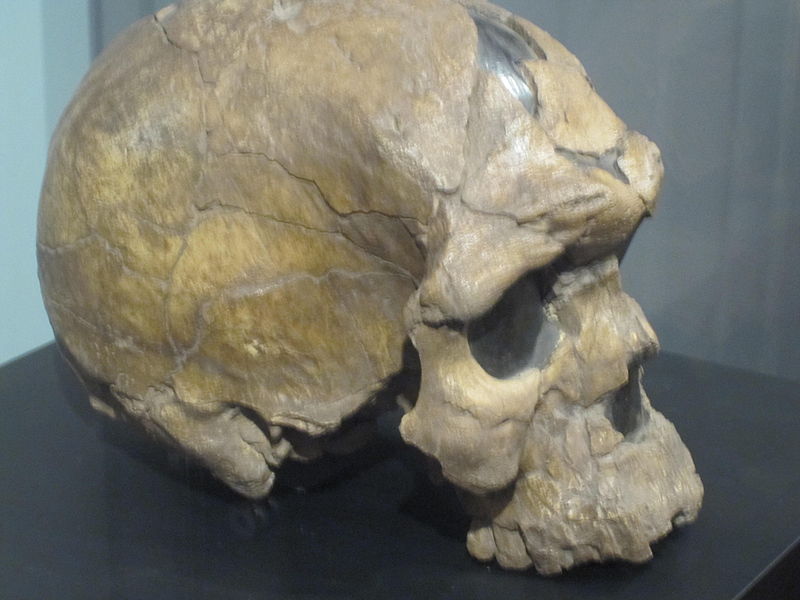
Homo sapiens idaltu
proposed subspecies within the genus Homo
Homo cepranensis
species of mammal

Rajasaurus
Rajasaurus () is a genus of carnivorous abelisaurid theropod dinosaur from the Late Cretaceous of India, containing one species: Rajasaurus narmadensis. The bones were excavated from the Lameta Formation in the Gujarat state of Western India, probably inhabiting what is now the Narmada River Valley. It was formally described by palaeontologist Jeffrey A. Wilson and colleagues in 2003 based on a partial skeleton comprising the braincase, spine, hip bone, legs, and tail–a first for an Indian theropod. The dinosaur likely measured , and had a single horn on the forehead which was probably used fo

Olorotitan
Olorotitan is a monotypic genus of lambeosaurine duck-billed dinosaur, containing a single species, O. arharensis. It was among the last non-avian dinosaurs to go extinct during the Cretaceous–Paleogene extinction event, having lived from the middle to late Maastrichtian age of the Late Cretaceous period. The remains were found in the Udurchukan Formation beds of Kundur, Arkharinsky District, Amur Oblast, Eastern Russia, in the vicinity of the Amur River.

Zupaysaurus
Zupaysaurus (; "ZOO-pay-SAWR-us") is an extinct genus of early theropod dinosaur living during the Norian stage of the Late Triassic in what is now Argentina. Fossils of the dinosaur were found in the Los Colorados Formation of the Ischigualasto-Villa Unión Basin in northwestern Argentina. Although a full skeleton has not yet been discovered, Zupaysaurus can be considered a bipedal predator, up to long. It may have had two parallel crests running the length of its snout.

Zalmoxes
Zalmoxes is a genus of probable rhabdodontid ornithopod dinosaur from the Maastrichtian age of the Late Cretaceous in what is now Romania. The genus is known from specimens first named as the species Mochlodon robustum in 1899 by Franz Nopcsa before being reclassified as Rhabdodon robustum by him in 1915. In 1990, this name was corrected to Rhabdodon robustus by George Olshevsky and, in 2003, the species was once more reclassified as the type species Zalmoxes robustus. Zalmoxes represents one of the most common vertebrates of Transylvania during the latest Cretaceous period. The generic name r

Isisaurus
Isisaurus (named after the Indian Statistical Institute) is a genus of titanosaurian dinosaur from the Late Cretaceous Lameta Formation of India and Pab Formation of Pakistan. The genus contains a single species, Isisaurus colberti.
Amazonsaurus maranhensis
Amazonsaurus ( , 'Amazon lizard') is a genus of diplodocoid sauropod dinosaur from the Early Cretaceous Period of what is now South America. It would have been a large-bodied quadrupedal herbivore with a long neck and whiplash tail. Although more derived diplodocoids were some of the longest animals ever to exist, Amazonsaurus was probably not more than 12 meters (40 ft) long. Gregory S. Paul estimated in 2010 its weight at 5000 kg.
.png)
Dinocephalosaurus
Dinocephalosaurus (meaning "terrible-headed reptile") is a genus of long necked, aquatic protorosaur that inhabited the Triassic seas of China. The genus contains the type and only known species, D. orientalis, which was named by Chun Li in 2003. Unlike other long-necked protorosaurs (which form a group known as the tanystropheids), Dinocephalosaurus convergently evolved a long neck not through elongation of individual neck vertebrae, but through the addition of neck
vertebrae that each had a moderate length. As indicated by phylogenetic analyses, it belonged in a separate lineage that also i

Aviatyrannis
Aviatyrannis is a genus of coelurosaurian theropod dinosaur, either a tyrannosauroid or an ornithomimosaurian, from the Oxfordian-Tithonian stages of the Late Jurassic found in Portugal.

Lusotitan
Lusotitan is a genus of herbivorous brachiosaurid sauropod dinosaur from the Late Jurassic of Portugal.
Serendipaceratops
Serendipaceratops (meaning "serendipitous horned face") is a genus of herbivorous ornithischian dinosaur, possibly an ankylosaur, from the early Cretaceous Period of Australia. The type species, S. arthurcclarkei, was named in 2003.

Fukuisaurus
Fukuisaurus (meaning "Fukui (Fortunate) lizard") is a genus of herbivorous ornithopod dinosaur that lived during the Early Cretaceous in what is now Japan. The type species is F. tetoriensis, which was named and described in 2003.

Sinornithomimus
Sinornithomimus is a genus of ornithomimid dinosaur that lived in the Late Cretaceous Ulansuhai Formation of Alshanzuo Banner, Inner Mongolia, northern China. The first remains were found in 1997 and described six years later in 2003 as the new genus and species Sinornithomimus dongi.

Mendozasaurus
Mendozasaurus is a genus of titanosaurian sauropod dinosaur. It was a member of Titanosauria, which were massive sauropods that were common on the southern landmasses during the Cretaceous. It is represented by several partial skeletons from a single locality within the Coniacian (lower Upper Cretaceous) Sierra Barrosa Formation in the south of Mendoza Province, northern Neuquén Basin, Argentina.
The type species, Mendozasaurus neguyelap, was described by Argentine paleontologist Bernardo Javier González Riga in 2003. Mendozasaurus is the first dinosaur named from Mendoza Province, Argentina,

Dromaeosauroides
Dromaeosauroides is a genus of dromaeosaurid theropod dinosaur from the Early Cretaceous of what is now Denmark and possibly also England. It was discovered in the Jydegaard Formation in the Robbedale valley, on the island of Bornholm in the Baltic Sea. This formation ranges from the Berriasian to the Valanginian ages. This is the only likely place for dinosaur remains to be discovered on Danish territory, since the Mesozoic deposits exposed in the rest of the country are marine. Dromaeosauroides is the first known dinosaur from Denmark, and the only one which has been scientifically named. It

Antetonitrus
Antetonitrus is a genus of sauropodiform dinosaur found in the Early Jurassic Elliot Formation of South Africa. The only species is Antetonitrus ingenipes. Sometimes considered a basal sauropod, it is crucial for the understanding of the origin and early evolution of this group. It was a quadrupedal herbivore, like its later relatives, but shows primitive adaptations to use the forelimbs for grasping, instead of purely for weight support.

Sinopterus
Sinopterus (meaning "Chinese wing") is a genus of tapejarid pterodactyloid pterosaur from the Aptian-age Lower Cretaceous Jiufotang Formation of Chaoyang, Liaoning, China. It was first described and named by Wang Xiaolin and Zhou Zhonghe. Historically, there were multiple species attributed to the genus although only one is considered to be valid. Sinopterus is known for its proportionally large skull, which has a bird-like pointed beak lacking teeth, and a long bony crest that starts with a tall premaxilla and goes back along the middle of the skull to form a point overhanging the rear of the
Rinconsaurus
Rinconsaurus is a genus of titanosaur sauropod dinosaur from the Late Cretaceous in what is now Argentina. The type species, Rinconsaurus caudamirus, was described by Calvo and Riga in 2003, and is based on three partial skeletons.

Colepiocephale
Colepiocephale (meaning "knucklehead") is a genus of pachycephalosaurid dinosaur from Late Cretaceous (middle Campanian stage) deposits of Alberta, Canada. It was collected from the Foremost Formation. The type species, C. lambei, was originally described by Sternberg in 1945 as Stegoceras lambei, and later renamed by Sullivan in 2003. C. lambei is a domed pachycephalosaur characterized principally by the lack of a lateral and posteriosquamosal shelf, a steeply down-turned parietal, and the presence of two incipient nodes tucked under the posterior margin of the parietosquamosal border.

Hanssuesia
Hanssuesia is a genus of pachycephalosaurid dinosaurs from the late Cretaceous period. It lived in what is now Alberta and Montana, and contains the single species Hanssuesia sternbergi.
thumb|left|Life restoration
Hanssuesia is based on a skull dome originally named Troodon sternbergi by Barnum Brown and Erich Maren Schlaikjer in 1943. The specific name honoured Charles Mortram Sternberg who found the dome in 1928 near Steveville in south Alberta. In 1945, it was transferred to Stegoceras by C.M. Sternberg himself, as a Stegoceras sternbergi.

Shenzhousaurus
Shenzhousaurus (meaning "Shenzhou lizard") is a genus of basal ornithomimosaurian theropod dinosaur from the Lower Cretaceous of China.left|thumb|RestorationThe holotype (NGMC 97–4–002, National Geological Museum of China) was collected from near the bottom (fluvial beds) of the Yixian Formation (Aptian) at the Sihetun fossil site, Beipiao, western Liaoning Province. This specimen consists of a partial skeleton preserved on a sandstone slab in a "death pose," its head above the torso. The distal parts of the hindlimbs, distal portion of the tail, and the forelimbs (except for part of the right
Ferganasaurus
Ferganasaurus (meaning "Fergana Valley lizard") is a genus of sauropod dinosaur that lived in the Balabansai Formation of Kyrgyzstan, which dates to the Callovian stage of the Middle Jurassic. It was formally described in 2003 by Alifanov and Averianov as the type species Ferganasaurus verzilini. It is believed to be similar to Rhoetosaurus.

Silesaurus
Silesaurus is a genus of silesaurid dinosauriform from the Late Triassic, of what is now Poland.

Anatosuchus
Anatosuchus ("duck crocodile", the name from the Latin anas ("duck") and the Greek souchos ("crocodile"), for the broad, duck-like snout) is an extinct genus of notosuchian crocodyliforms discovered in Gadoufaoua, Niger, and described by a team of palaeontologists led by the American Paul Sereno in 2003, in the Journal of Vertebrate Paleontology.

Phosphatodraco
Phosphatodraco is a genus of azhdarchid pterosaur that lived during the Late Cretaceous of what is now Morocco. In 2000 a pterosaur specimen consisting of five cervical (neck) vertebrae was discovered in the Ouled Abdoun Phosphatic Basin. The specimen was made the holotype of the new genus and species Phosphatodraco mauritanicus in 2003; the genus name means "dragon from the phosphates", and the specific name refers to the region of Mauretania. Phosphatodraco was the first Late Cretaceous pterosaur known from North Africa, and the second pterosaur genus described from Morocco. It is one of the

Sinodelphys
Sinodelphys is an extinct mammal from the Early Cretaceous, estimated to be 125 million years old. It was discovered and described in 2003 in rocks of the Yixian Formation in Liaoning Province, China, by a team of scientists including Zhe-Xi Luo and John Wible. While initially suggested to be the oldest known metatherian, later studies interpreted it as a eutherian.

Harpactognathus
Harpactognathus (meaning "seizing/grasping jaw") is a genus of pterosaur, a group of extinct flying reptiles, that lived during the Kimmeridgian stage of the Late Jurassic period in what is now Wyoming, United States. Harpactognathus is confidently known from a single, incomplete rostrum (front of the skull) found in 1996 at the Bone Cabin Quarry, though an incomplete mandible (lower jaw bone) and humerus (upper arm bone) from the quarry have tentatively been referred to the genus. The rostrum was described by paleontologist Kenneth Carpenter and colleagues in 2003, who named the type and only

Equijubus
Equijubus (; Mǎzōng meaning "horse mane" after the area Mǎzōng Mountain 马鬃山 in which it was found), is a genus of herbivorous hadrosauroid dinosaur from the Early Cretaceous (Albian stage) of northwestern China.

Archaeovenator hamiltonensis
left|thumb|159x159px|Life restoration
Archaeovenator is an extinct genus of Late Carboniferous varanopid synapsids known from Greenwood County, Kansas of the United States. It was first named by Robert R. Reisz and David W. Dilkes in 2003 and the type species is Archaeovenator hamiltonensis. Archaeovenator hamiltonensis is known from the holotype KUVP 12483, a three-dimensionally preserved, nearly complete and articulated skeleton, including the skull, with limbs and girdles slightly separated from postcranial skeleton. It was collected in the Hamilton Quarry, from the Calhouns Shale Form
Liaoningopterus
Liaoningopterus, sometimes misspelled as "Liaoningopteryx", was a genus of anhanguerid pterodactyloid pterosaur from the Barremian-Aptian-age Lower Cretaceous Jiufotang Formation of Chaoyang, Liaoning, China.
Bainoceratops
Bainoceratops (meaning "mountain horned face", after the type locality, Bayn Dzak) is a genus of ceratopsian dinosaur from the late Campanian in the Late Cretaceous. The type species is B. efremovi. Its fossils were found in southern Mongolia in the Djadochta Formation.

Yixianosaurus longimanus
Yixianosaurus (meaning "Yixian lizard") is a maniraptoran theropod dinosaur genus from the Early Cretaceous of China.
Shuangmiaosaurus
Shuangmiaosaurus is a genus of herbivorous iguanodontian ornithopod dinosaur which lived in China during the Late Cretaceous Period, about 100 million years ago.

Ludodactylus
Ludodactylus (meaning "play finger") is a genus of anhanguerid pterodactyloid pterosaur from the Early Cretaceous period (Aptian stage) of what is now the Crato Formation of the Araripe Basin in Ceará, Brazil. The type and only species is L. sibbicki. The generic name Ludodactylus refers to the fact that the animal had the combination of teeth and a Pteranodon-like head crest, similar to many toy pterosaurs, and no such creature was known to exist until the discovery of Ludodactylus. However, Ludodactylus is not the only pterosaur now known to possess these features, its very close relative Ca

Chaoyangopterus
Chaoyangopterus is a genus of chaoyangopterid pterosaur known from a partial skeleton found in Liaoning, China. Chaoyangopterus was found in rocks dating back to the Aptian-age Lower Cretaceous Jiufotang Formation of Dapingfang, Chaoyang.
%20fig.%2011.png)
Lokotunjailurus
Lokotunjailurus is an extinct genus of saber-toothed cats (Machairodontinae) which existed during the late Miocene and earliest Pliocene epoch and is known from localities in northern, central, eastern and southern Africa. A big cat, it was more slender than comparable recent species and its build suggests cursoriality. It is grouped among a group of similar-looking saber-toothed cats known as the scimitar-tooths.

Tethysaurus
Tethysaurus is an extinct genus of tethysaurine mosasauroid from the Early Turonian (Late Cretaceous) period. The only species is Tethysaurus nopcsai.
Ekorus ekakeran
Ekorus ekakeran is a large, extinct mustelid mammal. Fossils, including largely complete skeletons, are known from the late Miocene of Kenya.
Chunerpeton tianyiensis
Chunerpeton (meaning "early creeping animal") is an extinct genus of salamander from the Middle or Late Jurassic Daohugou Beds in Ningcheng County, Nei Mongol (Inner Mongolia), China, containing the only species Chunerpeton tianyiensis. It was a small animal measuring in length, and was neotenic, with the retention of external gills into adulthood.

Tatenectes
Tatenectes is a genus of cryptoclidid plesiosaur known from the Upper Jurassic of Wyoming. Its remains were recovered from the Redwater Shale Member of the Sundance Formation, and initially described as a new species of Cimoliosaurus by Wilbur Clinton Knight in 1900. It was reassigned to Tricleidus by Maurice G. Mehl in 1912 before being given its own genus by O'Keefe and Wahl in 2003. Tatenectes laramiensis is the type and only species of Tatenectes. While the original specimen was lost, subsequent discoveries have revealed that Tatenectes was a very unusual plesiosaur. Its torso had a flatte

Thililua
Thililua is a genus of polycotylid plesiosaur, containing one species, T. longicollis.
Brohisaurus
Brohisaurus is a problematic genus of dubious dinosaurs known from the Late Jurassic (Kimmeridgian-aged) Sembar Formation of Pakistan. The genus contains a single species, Brohisaurus kirthari.
Terminonatator
Terminonatator (meaning "last swimmer") is a genus of elasmosaurid plesiosaur from the Late Cretaceous of Saskatchewan, Canada. It is known from a skull and partial skeleton from a young adult, found in the Campanian-age Bearpaw Formation near Notukeu Creek in Ponteix. Terminonatator is currently one of the youngest plesiosaurs from the Western Interior Seaway.
Teraterpeton
Teraterpeton (meaning "wonderful creeping thing" in Greek) is an extinct genus of trilophosaurid archosauromorphs. It is known from a partial skeleton from the Late Triassic Wolfville Formation of Nova Scotia, described in 2003. It has many unique features seen in no other related form, including an elongated, toothless snout and large openings for the nostrils. Because of this, Teraterpeton was originally placed in its own family, Teraterpetidae, related to Trilophosaurus. Newer studies generally place it within Trilophosauridae.
Maotherium
Maotherium is a genus extinct symmetrodont mammal that was discovered in Early Cretaceous rocks in Liaoning Province, China, in 2003. Its scientific name directly translates to "fur beast", in reference to the impressions of fur around the fossil. Maotherium belongs to an extinct group of Mesozoic mammals called symmetrodonts. Though little is known about this group, the symmetrodonts have several similarities - specifically their teeth. They have tall pointed, but simple molars in a triangular arrangement. Originally symmetrodonts were known since the 1920s. Now a vast majority have been rest
Anoualerpeton
Anoualerpeton is an extinct genus of lissamphibian in the family Albanerpetontidae. It is the oldest and most primitive albanerpetontid known. Fossils have been found of two different species, Anoualerpeton priscus from the Middle Jurassic (Bathonian) aged Forest Marble and Kilmaluag formations of England and Scotland, and Anoualerpeton unicus from Late Jurassic-Early Cretaceous (Tithonian-Berriasian) Ksar Metlili Formation of Morocco. A. unicus is the only named albanerpetontid from Gondwana.
Gobititan
Gobititan is a genus of herbivorous sauropod dinosaur from the Aptian faunal stage of the Early Cretaceous. The name of this genus is derived from the Gobi Desert region and the Titans of Greek mythology, which is a reference to its large body size. The specific name shenzhouensis, is derived from "Shenzhou", an ancient name for China.
Zhongjianichthys
thumb|Restoration
Zhongjianichthys is an extinct genus of primitive jawless fish that lived in the Cambrian Period, approximately 518 million years ago, in what is now Southwest China. As a myllokunmingiid, it is considered one of the earliest known vertebrates in the fossil record alongside the other two identified genera, Haikouichthys and Myllokunmingia. Like its confamilials, its fossils were found in the Maotianshan Shales in Yunnan province.
Brasilodon
Brasilodon ("tooth from Brazil") is an extinct genus of small, mammal-like cynodonts that lived in what is now Brazil during the Norian age of the Late Triassic epoch, about 225.42 million years ago. While no complete skeletons have been found, the length of Brasilodon has been estimated at . Its dentition shows that it was most likely an insectivore. The genus is monotypic, containing only the species B. quadrangularis. Brasilodon belongs to the family Brasilodontidae, whose members were some of the closest relatives of mammals, the only cynodonts alive today. Two other brasilodontid genera,
Karanisia
Karanisia is an extinct genus of strepsirrhine primate from Middle Eocene fossil deposits in Egypt.
Bullacephalus
Bullacephalus is an extinct genus of biarmosuchian therapsids belonging to the family Burnetiidae. The type species B. jacksoni was named in 2003. It is known from a relatively complete skull and lower jaw, discovered in the Late Permian Tapinocephalus Assemblage Zone of the Beaufort Group of South Africa. This genus of therapsida lived during the Late Permian period, approximately 250 million years ago.
Pseudophlegethontia
Pseudophlegethontia is an extinct genus of aïstopod tetrapodomorphs. It is the only member of the family Pseudophlegethontiidae. The only species is the type species P. turnbullorum, named in 2003. Fossils of Pseudophlegethontia have been found from the Mazon Creek fossil beds in Grundy County, Illinois, a conservation lagerstätte well known for the exceptional preservation of middle Pennsylvanian taxa.
Osmolskina
Osmolskina is a genus of archosauriform reptile which lived during the Early Triassic in what is now Poland. The type species, Osmolskina czatkowicensis, was described by Magdalena Borsuk−Białynicka and Susan Evans in 2003. The generic name honors the late female Polish paleontologist Halszka Osmólska.
==Resemblance to Euparkeria==
Osmolskina closely resembles the well-known genus Euparkeria. The authors of the 2003 paper considered classifying Osmolskina within the family Euparkeriidae, noting the animal's close resemblance to Euparkeria, but concluded that "Euparkeriidae remains monotypic be
Santacruzodon
Santacruzodon is an extinct genus of cynodonts which existed in Brazil during the Triassic period. The type species is Santacruzodon hopsoni.
Bunostegos
Bunostegos ("knobbly [skull] roof") is an extinct genus of pareiasaur parareptile from the Late Permian of the Agadez Region in Niger. The type species, Bunostegos akokanensis, was named from the Moradi Formation in 2003. It was a cow-sized animal with a distinctive skull that had large bony knobs, similar in form to those of other pareiasaurs but far larger. The species appears to have lived in a desert in the centre of the supercontinent of Pangaea.
Beipiaopterus chenianus
Beipiaopterus is a genus of ctenochasmatid pterosaur from the Early Cretaceous period (Aptian stage) of what is now the Yixian Formation of the China.
Jidapterus
Jidapterus is a genus of chaoyangopterid pterosaur from the Aptian-age Lower Cretaceous Jiufotang Formation of Chaoyang, Liaoning, China. The genus was in 2003 named by Dong Zhiming, Sun Yue-Wu and Wu Shao-Yuan. The type species is Jidapterus edentus. The genus name is derived from Jílín Dàxué or "Jilin University" and a Latinized Greek pteron, "wing". The specific name means "toothless" in Latin.
Haasiasaurus
Haasiasaurus is an extinct genus of early mosasauroid. The genus contains a single species, H. gittelmani, which was found in Cenomanian to Turonian (Upper Cretaceous, about 100 to 93 million years ago) rocks near Ein Yabrud, in the Palestinian West Bank, approximately north of Jerusalem. It was named in honour of the palaeontologist Georg Haas, replacing the original name Haasia which was preoccupied by a millipede. Haasiasaurus was one of the oldest mosasauroids, measuring long. The genus potentially represents a chimera, since the cranial and postcranial material were not found in associati
Priosphenodon
Priosphenodon is an extinct, large herbivorous eilenodontine rhynchocephalian known from the mid-Cretaceous (Albian-Turonian) of Argentina. It is one of the largest known sphenodontians.