Category
page 1Founding monarchs in Europe

Augustus
Augustus (born Gaius Octavius; 23 September 63 BC – 19 August AD 14), also known as Octavian (), was the founder of the Roman Empire and the first Roman emperor from 27 BC until his death in AD 14. The reign of Augustus initiated an imperial cult and an era of imperial peace (the or ) in which the Roman world was largely free of armed conflict. The principate, a style of government where the emperor showed nominal deference to the Senate, was established during his reign and lasted until the Crisis of the Third Century.

Charlemagne
Charlemagne ( ; 2 April 748 – 28 January 814) was King of the Franks from 768, King of the Lombards from 774, and Emperor of what is now known as the Carolingian Empire from 800. He united most of Western and Central Europe and was the first recognised emperor to rule from the west after the fall of the Western Roman Empire approximately three centuries earlier. Charlemagne's reign was marked by political and social changes that had lasting influence on Europe throughout the Middle Ages.

Clovis I
first king of the Franks (c. 466-511)
%20-%20Napoli%20MAN%209043%20-%2001.jpg)
Theseus
thumb|Theseus after having slain the Minotaur, freeing captive Athenian boys; Cretans approaching to marvel the scene, Antique fresco from [[Pompeii]]
Theseus (, ; ) was a divine hero in Greek mythology, famous for slaying the Minotaur. The myths surrounding Theseus, his journeys, exploits, and friends, have provided material for storytelling throughout the ages.

Æthelstan
Æthelstan or Athelstan (; ; ; ; – 27 October 939) was King of the Anglo-Saxons from 924 to 927 and King of the English from 927 to his death in 939. He was the son of King Edward the Elder and his first wife, Ecgwynn. Modern historians regard him as the first King of England and one of the "greatest Anglo-Saxon kings". He never married and had no children; he was succeeded by his half-brother, Edmund I.

Odoacer
Odoacer ( – 15 March 493 AD), also spelled Odovacer or Odovacar, was a barbarian soldier and statesman from the Middle Danube who was an officer of the Roman army and deposed the Western Roman child emperor Romulus Augustulus to become the ruler of Italy (476–493). Odoacer's overthrow of Romulus Augustulus is traditionally understood as marking the end of the Western Roman Empire.

Stephen I of Hungary
11th-century king of Hungary and saint

Rurik
Rurik (also spelled Rorik, Riurik or Ryurik; ; ; died 879) was a Varangian chieftain of the Rus' who, according to tradition, was invited to reign in Novgorod in the year 862. The Primary Chronicle states that Rurik was succeeded by his kinsman Oleg who was regent for his infant son Igor.

Bohdan Khmelnytsky
Ukrainian military, political and statesman, Hetman of the Zaporizhzhya Army, head of Ukraine (1648–1657) during the Hetmanship

Afonso I of Portugal
king of Portugal from 1139 to 1185

Mieszko I
Duke of Poland

Margaret I of Denmark
Queen of Denmark, Norway, and Sweden

Otto of Greece
King of Greece (1832-1862)

Catholic Monarchs
title for Queen Isabella I of Castile and King Ferdinand II of Aragon

Cadmus
In Greek mythology, Cadmus (; ) was the legendary Phoenician founder of Boeotian Thebes. He was, alongside Perseus and Bellerophon, the greatest hero and slayer of monsters before the days of Heracles. Commonly stated to be a prince of Phoenicia, the son of king Agenor and queen Telephassa of Tyre, the brother of Phoenix, Cilix and Europa, Cadmus traced his origins back to Poseidon and Libya.

Kenneth MacAlpin
King of the Picts

Romulus
Romulus (, ) was the legendary founder and first king of Rome. Various traditions attribute the establishment of many of Rome's oldest legal, political, religious, and social institutions to Romulus and his contemporaries. Although many of these traditions incorporate elements of folklore, and it is not clear to what extent a historical figure underlies the mythical Romulus, the events and institutions ascribed to him were central to the myths surrounding Rome's origins and cultural traditions.
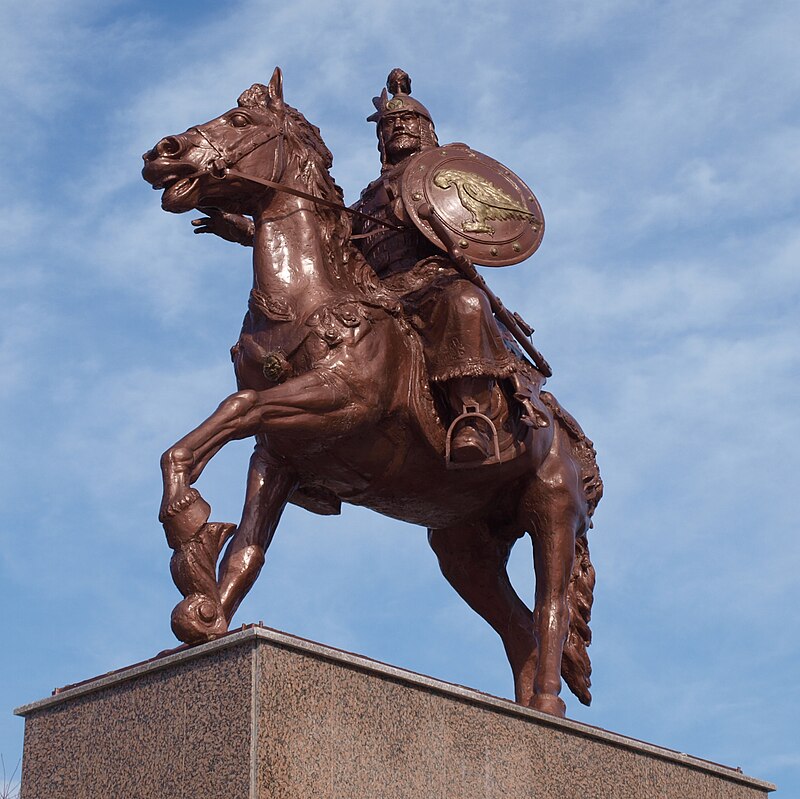
Asparuh of Bulgaria
Bulgarian ruler

Pelagius
first king of Asturias

Árpád
190px|thumb|right|alt=Árpád's statue at the Heroes' Square|Árpád's statue at the Heroes' Square (Budapest)
Árpád (; 845 – 907) was the head of the confederation of the Magyar tribes at the turn of the 9th and 10th centuries. He might have been either the sacred ruler or kende of the Hungarians, or their military leader or gyula, although most details of his life are debated by historians, because different sources contain contradictory information. Despite this, many Hungarians refer to him as the "founder of our country", and Árpád's preeminent role in the Hungarian conquest of the

Merovech
Merovech (; ; 411 –457) was the ancestor of the Merovingian dynasty, and the grandfather of its founder Clovis I. He was reportedly a king of the Salian Franks, but records of his existence are mixed with legend and myth. The most important written source, Gregory of Tours, recorded that Merovech was said to be descended from Chlodio, a roughly contemporary Frankish warlord who pushed from the Silva Carbonaria in modern central Belgium as far south as the Somme, north of Paris in modern-day France. His supposed descendants, the kings Childeric I and Clovis I, are the first well-attested Merovi

Harald Fairhair
King of Norway

Mindaugas
Mindaugas (c. 1203 – 12 September 1263) was the first known Grand Duke of Lithuania and the only crowned King of Lithuania. Little is known of his origins, early life, or rise to power; he is mentioned in a 1219 treaty as an elder duke, and in 1236 as the leader of all the Lithuanians. The contemporary and modern sources discussing his ascent mention strategic marriages along with banishment or murder of his rivals. He extended his domain into regions southeast of Lithuania proper during the 1230s and 1240s. In 1250 or 1251, during the course of internal power struggles, he was baptised as a R

Nicholas I of Montenegro
Prince and King of Montenegro (1841–1921)

Stefan Dušan
emperor of Serbia 1331–1355

Karađorđe
Đorđe Petrović (; ; – ), known by the sobriquet Karađorđe (; ), was a Serbian revolutionary leader who led a struggle against the Ottoman Empire during the First Serbian Uprising. Karađorđe Petrović held the title of Grand Vožd of Serbia from 14 February 1804 to 3 October 1813.

Samo
Samo ( – ) was the founder and sole ruler of the first recorded unified tribal polity of Slavs, later known as ''Samo's realm'', ruling from 623 until his death in 658. According to Fredegar—the earliest source about Samo and the one from which all later ones derive—he was a Frankish merchant from Sens.
Hacı I Giray
Khan of Crimea
Boniface I, Marquess of Montferrat
King of Thessalonica
Lech, Czech, and Rus
3 legendary brothers, each the mythical founder of the 3 Slavic peoples (Poles, Czechs, and the Rus'), appearing in the Wielkopolska Chronicle

Stefan the First-Crowned
King of Serbia
Brutus of Troy
legendary descendant of the Trojan hero Aeneas
Inigo Arista
king of Pamplona
Siegfried of Luxembourg
First Count of Luxembourg
Přemysl the Ploughman
Bohemian peasant and husband of Princess Libuše
Hengist and Horsa
legendary brothers said to have led the invasion of Britain in 5th century
Unknown Archon
Serbian leader
Érimón
Érimón (Modern ), commonly Anglicised as Heremon, son of Míl Espáine (and great-grandson of Breoghan, king of Celtic Galicia), according to medieval Irish legends and historical traditions, was one of the chieftains who took part in the Milesian invasion of Ireland, which conquered the island from the Tuatha Dé Danann, and one of the first Milesian High Kings.
Porga of Croatia
Duke of Croatia
Nór
Nór (Old Norse Nórr) is according to the Orkneyinga Saga the eponymous founder of Norway.

Angul
Legendary ancestor of the Angles and Danes