Category
page 1Four-dimensional geometry
four-dimensional space
geometric space with four dimensions

4-polytope
{|class=wikitable style="float:right; margin-left:8px"
|+ Graphs of the six convex regular 4-polytopes
|-
!{3,3,3}
!{3,3,4}
!{4,3,3}
|- valign=top align=center
|120px5-cellPentatope4-simplex
|121px16-cellOrthoplex4-orthoplex
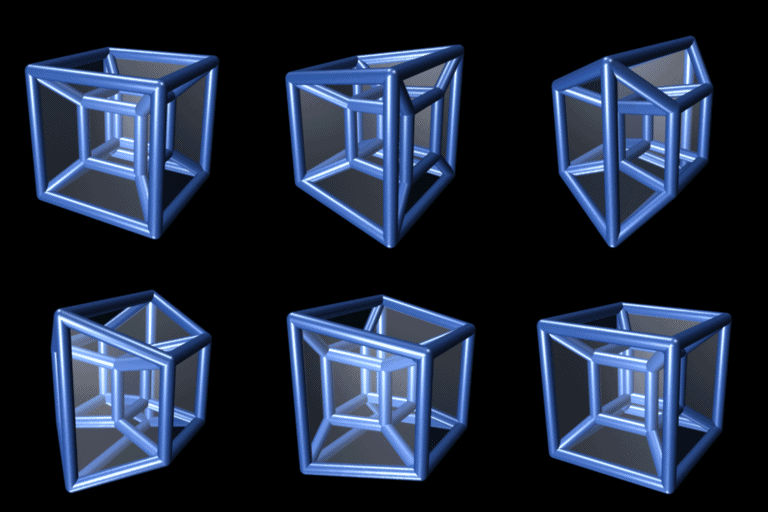
|120px8-cellTesseract4-cube
|-
!{3,4,3}
!{3,3,5}
!{5,3,3}
|- valign=top align=center
|120px24-cellOctaplex
|120px600-cellTetraplex
|120px120-cellDodecaplex
|}

3-sphere
thumb|Stereographic projection of the hypersphere's parallels (red), meridians
(blue) and hypermeridians (green). Because this projection is conformal, the curves intersect each other orthogonally (in the yellow points) as in 4D. All curves are circles: the curves that intersect have infinite radius (= straight line). In this picture, the whole 3D space maps the surface of the hypersphere, whereas in the next picture the 3D space contained the shadow of the bulk hypersphere.
thumb|Direct projection of 3-sphere into 3D space and covered with surface grid, showing structure as stack of 3D spher
rotation group SO(4)
special orthogonal group
Clifford torus
four-dimensional geometrical object
duocylinder
right|frame|Stereographic projection of the duocylinder's ridge
(see below), as a [[flat torus. The ridge is rotating about the -plane.]]
fourth dimension in art
attempt to demonstrate the 4th dimension in visual arts
Spherinder
thumb|The spherinder can be seen as the volume between two parallel and equal solid 2-spheres (3-balls) in 4-dimensional space, here stereographically projected into 3D.
In four-dimensional geometry, the spherinder, or spherical cylinder or spherical prism, is a geometric object, defined as the Cartesian product of a 3-ball (or solid 2-sphere) of radius r1 and a line segment of length 2r2:
"—And He Built a Crooked House—"
science fiction short story by Heinlein