Category
page 1Four Quls

Al-ʾIkhlāṣ
Al-Ikhlāṣ (, "Sincerity"), also known as the '''Declaration of God's Unity and al-Tawḥid' (, "Monotheism"), is the 112th chapter (sūrah'') of the Quran.
According to George Sale, this chapter is held in particular veneration by Muslims, and declared, by Islamic tradition, to be equal in value to a third part of the whole Quran. It is said to have been revealed during the Quraysh's conflict with Muhammad; in answer to a challenge over the distinguishing attributes of God, Muhammad invited them to worship.
.jpg)
Al-Nās
thumb|upright=1.25|Closing pages from a Mamluk Sultanate|Mamluk Qur'an with chapter 113 and 114 in [[muhaqqaq script. Cairo, c. 1360-1380. Chester Beatty Library]]
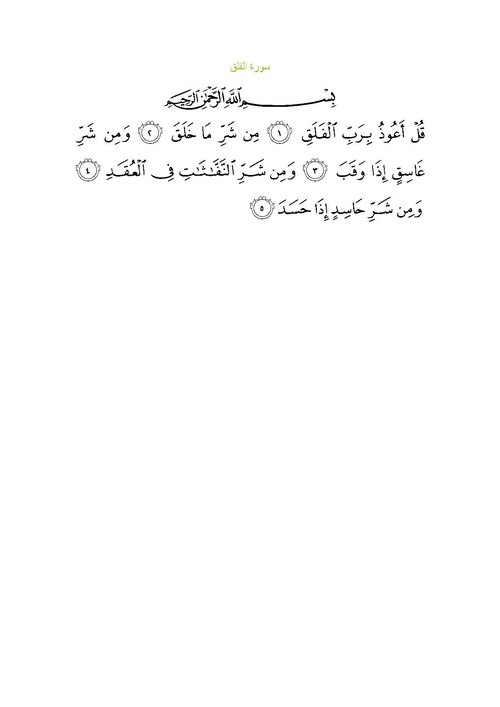
Al-Falaq
Al-Falaq (, al-falaq in Arabic language is (break apart; burst; cleave; fissure)[1] and was also explained as (creatures or creation) whereas it meant (Daybreak) in old explanations.

Al-Kāfirūn
right
Al-Mu'awwidhatayn
'''Al-Mu'awwidhatayn' (), an Arabic expression meaning "The Two Protectors" or "The Two Protective Incantations", refers to the final two surahs (chapters) of the Quran: 113 (Al-Falaq) and 114 (Al-Nas). They are called by this name because of their use of the term ʿādhā (meaning "protection" or "refuge") in a phrase that occurs in both surahs: ʿqul aʿūdhu bi-rabbi al- ... min ...'' ("Say: I seek refuge with the Lord of ... from/against ... "). Likewise, the two surahs appear consecutively in the Qur'an, are both very short, and bear additional stylistic resemblances with one another, broadly f