Category
page 1Galaxies

Black hole
A black hole is an astronomical body so compact that its gravity prevents anything, including light, from escaping. Albert Einstein's theory of general relativity, which describes gravitation as the curvature of spacetime, predicts that any sufficiently compact mass will form a black hole. The boundary of no escape is called the event horizon. In general relativity, crossing a black hole's event horizon traps an object inside but produces no locally detectable change. General relativity also predicts that every black hole should have a central singularity, where the curvature of spacetime is infinite.
galaxy
A galaxy is a system of stars, stellar remnants, interstellar gas, dust, and dark matter bound together by gravity. The word is derived from the Greek '''' (), meaning 'milky', a reference to the Milky Way galaxy that contains the Solar System. Galaxies, averaging an estimated 100million stars, range in size from dwarfs with less than a thousand stars to the largest galaxies known—supergiants with one hundredtrillion stars, each orbiting its galaxy's center of mass. Most of the mass in a typical galaxy is in the form of dark matter, with only a few percent of that mass visible in the form of s
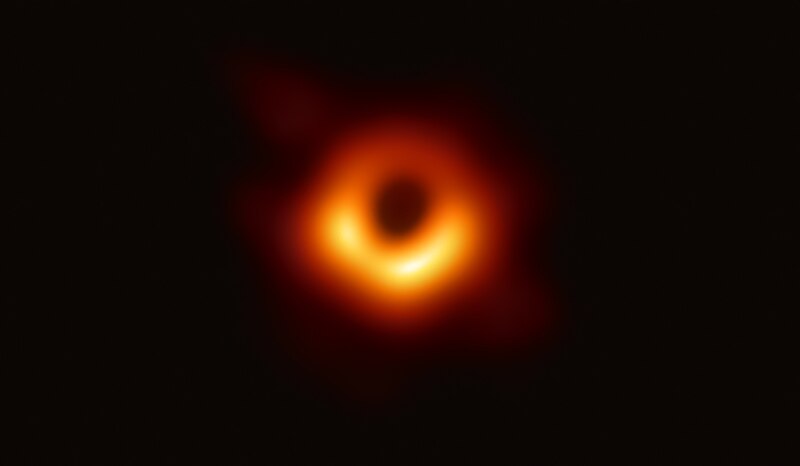
supermassive black hole
black hole with mass above 10⁵ solar masses, usually found at the centers of galaxies
galactic halo
component of a galaxy
galaxy formation and evolution
area of study in astrophysics
deep-sky object
any astronomical object that is not an individual star
galactic bulge
central feature/region of a spiral galaxy
galactic disc
component a of disc galaxy
NGC 2263
galaxy
Galaxy Zoo
crowdsourced astronomy project
dark matter halo
theoretical component of a galaxy that envelops the galactic disc and extends well beyond the edge of the visible galaxy
intergalactic travel
The hypothetical travel that is crewed or uncrewed between galaxies
Cosmos Redshift 7
galaxy
IOK-1
IOK-1 is a distant galaxy in the constellation Coma Berenices. When discovered in 2006, it was the oldest and most distant galaxy ever found, at redshift 6.96.
void galaxy
galaxy found in a cosmological void
.jpg)
EGSY8p7
__NOTOC__
EGSY8p7 (EGSY-2008532660) is a distant galaxy in the constellation of Boötes, with a spectroscopic redshift of z = 8.68 (photometric redshift 8.57), a light travel distance of 13.2 billion light-years from Earth. Therefore, at an age of 13.2 billion years, it is observed as it existed 570 million years after the Big Bang, which occurred 13.8 billion years ago, using the W. M. Keck Observatory. In July 2015, EGSY8p7 was announced as the oldest and most-distant known object, surpassing the previous record holder, EGS-zs8-1, which was determined in May 2015 as the oldest and m
NGC 7041B
galaxy
MoM-z14
MoM-z14 is the most distant known galaxy, with a redshift of z = 14.44. The galaxy was first imaged on 16 May 2025 by the NIRcam instrument aboard the James Webb Space Telescope (JWST). That image captured the galaxy during its formation about 280 million years after the Big Bang, during the Reionization Era of the early universe. This was the stage of cosmic evolution when neutral hydrogen began once again to ionize due to energy radiated by the earliest celestial objects.
Pea galaxy
possibly a type of luminous blue compact galaxy which is undergoing very high rates of star formation
luminosity function
astronomical measure of the number of stars or galaxies per luminosity interval
ultra diffuse galaxy
extremely low luminosity galaxy
jellyfish galaxy
type of galaxy found in galaxy clusters, characterised by ram pressure stripping of gas from the affected galaxy by the intracluster medium, triggering starbursts along a tail of gas
thick disk
geographic region of a galaxy
BDF-3299
BDF-3299 is a remote galaxy with a redshift of z = 7.109 corresponds to a distance traveled by light to come down to Earth of 12.9 billion light-years.

Thin disk
structural component of galaxies

Dwarf galaxy problem
the fact that the number of observed dwarf galaxies is orders of magnitude lower than expected from numerical cosmological simulations
galaxy color–magnitude diagram
diagram showing the relationship between absolute magnitude and mass of galaxies
SXDF-NB1006-2
SXDF-NB1006-2 is a distant galaxy located in the Cetus constellation, with a spectroscopic redshift of z = 7.213 or 12.91 billion light-years away. It was discovered by the Subaru XMM-Newton Deep Survey Field. The galaxy was claimed to be the most distant galaxy at announcement in June 2012, as the more distant claimants were not confirmed spectroscopically at the time. It exceeded the previous confirmed distance holder, GN-108036, also discovered by the Subaru. Oxygen emission lines have been detected in its spectrum.
Faint blue galaxy
Type of galaxy
Lyman-alpha emitter
Type of distant galaxy
Lyman-break galaxy
Star-forming galaxies at high redshift
Kennicutt-Schmidt Law
Astronomical trend of star formation
Fanaroff-Riley classification

M-sigma relation
Relationship between the stellar mass dispersion of a galaxy bulge and the mass of the supermassive black hole at its center
Hypercompact stellar system
cluster of stars around a supermassive black hole
Local Volume
collection of >500 galaxies within 11 megaparsecs from Earth
CDG-2
Candidate Dark Galaxy 2 (CDG-2) is a candidate for a dark galaxy, composed predominantly of dark matter, along with four globular clusters, in the Perseus cluster. It'd be one of the most dark matter dominated galaxies probably detected, estimated to be between 99.94% and 99.98% dark matter. It has been not confirmed yet if it's a true dark galaxy, more studies are required for a definitive conclusion.
LAE J095950.99+021219.1
galaxy
RD1
RD1 or 0140+326 RD1 is a distant galaxy, it once held the title of most distant galaxy known. RD1 was discovered in March 1998, and is at z = 5.34, and was the first object found to exceed redshift 5. It bested the previous recordholders, a pair of galaxies at z=4.92 lensed by the galaxy cluster CL 1358+62 (CL 1358+62 G1 & CL 1358+62 G2). It was the most distant object known to mankind for a few months in 1998, until BR1202-0725 LAE was discovered at z = 5.64.
Hess diagram
Diagram of stars in astronomy