Category
page 1Gandhism

satyagraha
thumb|Mahatma Gandhi leading the famous 1930 [[Salt March, a notable example of satyagraha.]]

three wise monkeys
pictorial maxim, embodying the proverbial principle “see/hear/speak no evil”, depicted as three monkeys

Gandhism
thumb|300px|Khan Abdul Ghaffar Khan (left) of the [[Khudai Khidmatgars and Mohandas 'Mahatma' Gandhi (right) of the Indian National Congress]]
Gandhism, also referred to as Gandhianism, is a body of ideas that describes the inspiration, vision, and the life work of Mohandas K. Gandhi. It is particularly associated with his contributions to the idea of nonviolent resistance, sometimes also called civil resistance.
Quit India Movement
political and social movement in British India during World War II
Swadeshi movement
Movement started as part of Indian Independence movement
Gandhi Peace Prize
award for contributions towards social, economic and political transformation through non-violence and other Gandhian methods

Swaraj
Swarāj (IAST: , ) can mean, generally self-governance or "self-rule". The term was used, in its modern political sense, as early as 1852. A mention of swaraj appears in the Anglo-Marathi journal or the periodical Dnyanodaya, in the issue that was published on 15 May, 1852 (The Dnyanodaya, Bombay, 1852, vol. xi, pp. 154–155). It was also used synonymously with "home-rule" by Mahatma Gandhi, and the word usually refers to Gandhi's concept of Indian independence from foreign domination. Swaraj lays stress on governance, not by a hierarchical government, but by self-governance through individuals
Champaran Satyagraha
first civil resistance movement led by Mohandas Karamchand Gandhi in India in 1916
Bardoli Satyagraha
civil disobedience and revolt in the Indian Independence Movement
Bhoodan movement
a voluntary land reform movement in India
Sarvodaya
Sarvōdaya (, from sarv-, 'all' and uday, 'rising') is a Sanskrit term which generally means "universal uplift" or "progress of all". The term was used by Mahatma Gandhi as the title of his 1908 translation of John Ruskin's critique of political economy, Unto This Last, and Gandhi came to use the term for the ideal of his own political philosophy. Later Gandhians, like the Indian nonviolence activist Vinoba Bhave, embraced the term as a name for the social movement in post-independence India which strove to ensure that self-determination and equality reached all strata of Indian society. Samant
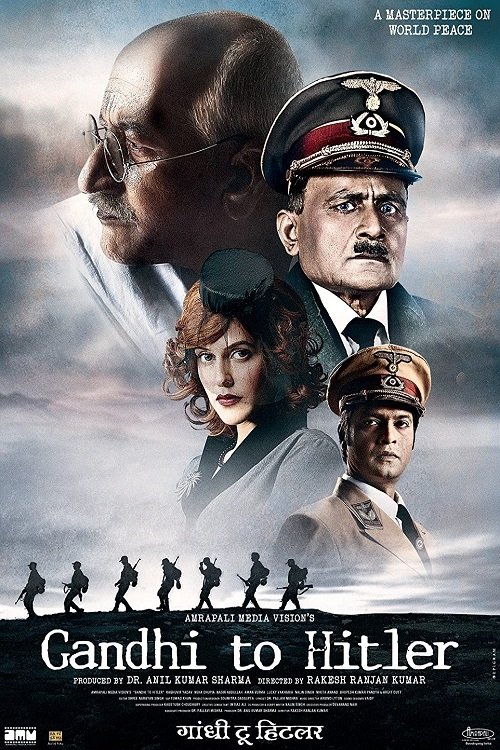
Dear Friend Hitler
2011 film by Rakesh Ranjan Kumar

Padayatra
thumb|Thousands taking part in Ashadhi Ekadashi|Ashadhi Vari ([[Warkari) the annual Hindu religious padayatra at Dive Ghat, Maharashtra, 2022]]
A padayatra () is a journey undertaken on foot, used both as a political–mass outreach tool and a spiritual pilgrimage (yatra). It is a journey undertaken by politicians or prominent citizens to interact more closely with different parts of society, educate about issues concerning them, and galvanise their supporters. Padayatras or foot pilgrimages are also Hindu religious pilgrimages undertaken towards sacred shrines or pilgrimage sites.

Gandhi Bhawan
auditorium hall in Chandigarh, India

Seven Blunders of the World
Mohandas Gandhi's list of negative qualities
Kheda Satyagraha of 1918
civil resistance movement organized by Gandhi in India
Nai Talim
principle which states that knowledge and work are not separate
Jamnalal Bajaj Award
Indian award for promoting Gandhian values, community service and social development
Gandhigiri
Gandhigiri is a neologism in India which is used to express the tenets of Gandhism (the ideas of Mahatma Gandhi, which include Satyagraha and Ahimsa) in contemporary terms. The term became popular due to its usage in the 2006 Hindi film, Lage Raho Munna Bhai.
Gandhian economics
economic system of Mahatma Gandhi
South African Indian Congress
South African organisation
Hindu–Muslim unity
religiopolitical concept in the Indian subcontinent
Quit India speech
Speech by Mahatma Gandhi during Quit India movement
non-possession
Non-possession (, '''''') is a religious tenet followed in Buddhist, Hindu, and Jain traditions in South Asia. In Jainism, is the virtue of non-possessiveness, non-grasping, or non-greediness.

opposition to World War II
Dignity of Labour
Social philosophy
Tana Bhagat Movement
tribal uprising of a section of the Tana Bhagats and Oraons
Gandhi Peace Foundation
Indian organisation
Composite nationalism
a concept arguing that the Indian nation is made of up people of diverse cultures, castes, communities, and faiths