Category
page 1Garden features

stairs
Stairs are a structure designed to bridge a large vertical distance between lower and higher levels by dividing it into smaller vertical distances. This is achieved as a diagonal series of horizontal platforms called steps which enable passage to the other level by stepping from one to another step in turn. Steps are very typically rectangular, but may instead be straight, curved, or may consist of two or more straight pieces connected at angles.

greenhouse
right|thumb|Victoria amazonica (giant Amazon waterlilies) in a large greenhouse at the [[Saint Petersburg Botanical Garden]]
A greenhouse is a structure that is designed to regulate the temperature and humidity of the environment inside. There are different types of greenhouses, but they all have large areas covered with transparent materials that let sunlight pass and block it as heat. The most common materials used in modern greenhouses for walls and roofs are rigid plastic made of polycarbonate, plastic film made of polyethylene, or glass panes. When the inside of a greenhouse is exposed to
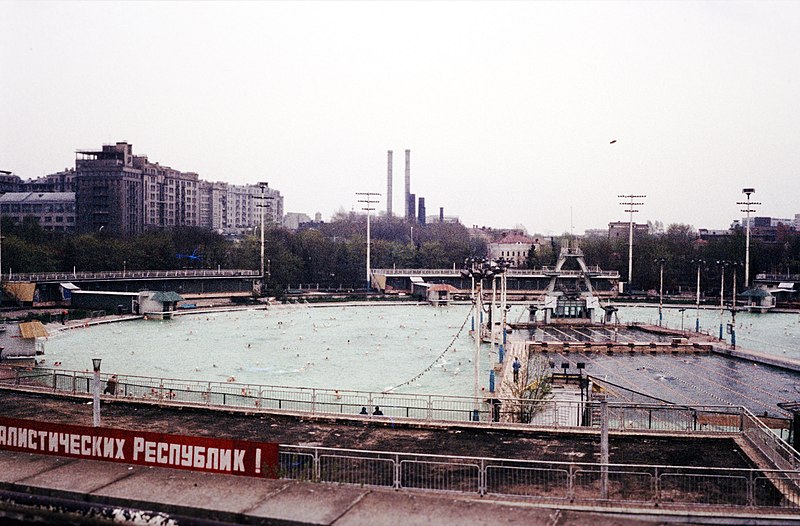
swimming pool
excavation or containment structure filled with water and used for swimming

lawn
thumb|The Lawn at the [[University of Virginia, facing south]]
thumb|The lawn of a small Summer house|summerhouse
thumb|A croquet lawn at a club in [[Edinburgh, Scotland]]
thumb|San Francisco Botanical Garden lawn, United States

cast iron
group of iron-carbon alloys

bench
piece of furniture on which several people may sit at the same time
.jpg)
gate
thumb|Gate from Bucharest (Romania)
thumb|right|Art Nouveau gate of [[Castel Béranger (Paris)]]
thumb|Candi bentar, a typical [[Indonesian gate that is often found on the islands of Java and Bali]]
.jpg)
obelisk
thumb|One of the two Luxor Obelisks, on the [[Place de la Concorde in Paris; a red granite monolithic column, high, including the base, which weighs over .]]
thumb|Lateran Obelisk in Piazza San Giovanni in Laterano, [[Rome. With its height of (with the base and the cross it reaches 45.70 m) it is the largest standing ancient monolithic obelisk in the world.]]

balcony
A balcony (from , "scaffold") is a platform that typically projects from the wall of a building, supported by columns or console brackets, and enclosed with a balustrade, usually above the ground floor. They are commonly found on multi-level houses, apartments and buildings.

hedge
thumb|right|240 px|A typical clipped European beech hedge in the [[Eifel, Germany]]
thumb|right|240px|A round hedge of creeping groundsel

lighting
thumb|Acropolis of Athens illuminated at night
thumb|Illuminated cherry blossoms, light from the shop windows, and Japanese lantern at night in Ise, Mie, Japan

labyrinth
thumb|Silver coin from Knossos displaying the 7-course "Classical" design to represent the Labyrinth,

barbecue
thumb|upright=1.35|Meat being barbecued at The Salt Lick restaurant

fleur-de-lis
thumb|Fleur-de-lis
thumb|Arms of the Kings of France blazoned Azure, three fleurs-de-lis or
The fleur-de-lis, also spelled fleur-de-lys (plural fleurs-de-lis or fleurs-de-lys), is a common heraldic charge in the (stylized) shape of a lily (in French, and mean and respectively). Most notably, the fleur-de-lis is depicted on multiple flags of Quebec and on the traditional coat of arms of France that was used from the High Middle Ages until the French Revolution in 1792, and then again in brief periods in the 19th century. This design still represents France and the House of Bourbon in the form o

gazebo
thumb|right|Japanese-style gazebo in the Moscow Botanical Garden of Academy of Sciences
thumb|upright=1.4|The Victorian architecture|Victorian-style bandstand gazebo at Fellows Riverside Gardens at [[Mill Creek Park, Youngstown, Ohio]]
A gazebo is a pavilion structure, sometimes octagonal or turret-shaped, often built in a park, garden, or spacious public area. Some are used on occasions as bandstands.

pergola
thumb|Rose Pergola at Kew Gardens, London|alt=A open-topped passageway of brick pillars and wooden beams with roses growing around in a garden setting under a blue sky with fluffy clouds

corbel
In architecture, a corbel is a structural piece of stone, wood or metal keyed into and projecting from a wall to carry a bearing weight, a type of bracket. A corbel is a solid piece of material in the wall, whereas a console is a piece applied to the structure. A piece of timber projecting in the same way was called a "tassel" or a "bragger" in England.
thumb|An interior look at the roof of a corbelled house in South Africa
The technique of corbelling, where rows of corbels deeply keyed inside a wall support a projecting wall or parapet, has been used since Neolithic (New Stone Age) times. It

boulder
thumb|This Balancing rock|balancing boulder, "[[Balanced Rock", stands in Garden of the Gods park in Colorado Springs, Colorado, United States.]]
thumb|Boulder in British Columbia, Canada
thumb|Kämmenkivi stone on the Pisa hill in Kuopio, Finland
thumb|Balanced granite boulders at Hyderabad, India
In geology, a boulder is a rock fragment with size greater than in diameter. Smaller pieces are called cobbles and pebbles. While a boulder may be small enough to move or roll manually, others are extremely massive. In common usage, a boulder is too large for a person to move. Smaller boulders are us

maze
thumb|upright=1.35|A hedge maze at [[Longleat stately home in England]]

tree house
platform or building constructed around, next to or among the trunk or branches of one or more mature trees while above ground level

kitchen garden
space separate from the rest of the residential garden

pavilion
thumb|260px|A marble pavilion, Red Fort, Delhi
In architecture, pavilion has several meanings;
It may be a subsidiary building that is either positioned separately or as an attachment to a main building. Often it is associated with pleasure. In palaces and traditional mansions of Asia, there may be pavilions that are either freestanding or connected by covered walkways, as in the Forbidden City (Chinese pavilions), Topkapi Palace in Istanbul, and in Mughal buildings like the Red Fort.
As part of a large palace, pavilions may be symmetrically placed building blocks that flank (appear to join
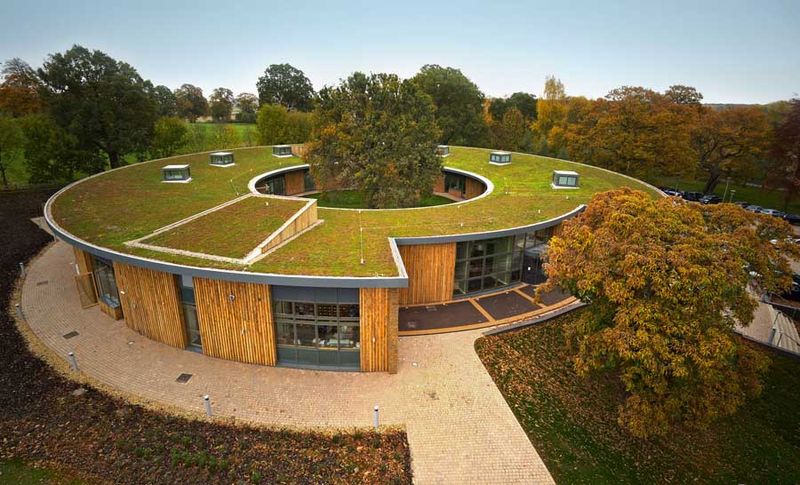
green roof
roof of a building that is partially or completely covered with vegetation and a growing medium, planted over a waterproofing membrane.

baluster
thumb|upright|Illustration of various examples of balusters, in A Handbook of Ornament, by Franz S. Meyer
thumb|upright|The term derives from the swelling form of the half-open flower of Punica granatum, in Italian balaustra
dry stone walling
mortarless masonry method

footbridge
thumb|Women heading to market across a footbridge in Nahulingo, El Salvador
thumb|A footbridge in Shaharah District, Yemen
A footbridge (also a pedestrian bridge, pedestrian overpass, or pedestrian overcrossing) is a bridge designed solely for pedestrians. While the primary meaning for a bridge is a structure which links "two points at a height above the ground", a footbridge can also be a lower structure, such as a boardwalk, that enables pedestrians to cross wet, fragile, or marshy land. Bridges range from stepping stones–possibly the earliest man-made structure to "bridge" water–to elaborat

avenue
wide, straight, usually tree-lined road or approach

shed
right|thumb|A rural shed
right|thumb|Modern secure bike sheds
right|thumb|A garden shed with a gambrel roof
barbecue grill
device for barbecueing or grilling
grove
small group of trees

handrail
thumb|300px|A modern handrail made of metal

patio
thumb|A patio outside of a home in the Netherlands

nymphaeum
thumb|280px|The Jerash nymphaeum
hot tub
large tub or small pool
electric fence
shock barrier to contain animals or people
roof lantern
architectural element
paver
stone, wood or tile structure which can serve as floor; pavement type with solid blocks

parterre
thumb|upright=1.4|right|Conservation and restoration of historic gardens|Restoration work on a parterre en broderie at [[Wrest Park, England]]
thumb|upright=1.4|The palace at Oranienbaum, Russia, parterre en broderie with six colours of mineral base, and red flowers.
thumb|upright=1.4|Cutwork parterre with only grass and gravels, at the Peterhof Palace in Russia
thumb|upright=1.4|Victorian parterre at Waddesdon Manor (2016)

exedra
thumb|Exedra of Pamphilidas, Acropolis of Lindos, Rhodes, Greece
thumb|right|The foundations and partial floor of a late Roman villa. The floored part is the exedra. The rest of the floor has deteriorated and is missing, with only parts of the [[hypocaust columns remaining. Hot air circulated through the hypocaust to heat the house.]]
An exedra (: exedras or exedrae) is a semicircular architectural recess or platform, sometimes crowned by a semi-dome, and either set into a building's façade or free-standing. The original Greek word ('a seat out of doors') was applied to a room that opened onto
green wall
form of building greening

deckchair
thumb|A deckchair
A deckchair (or deck chair) is a simple folding chair, usually with a folding frame and a single strip of canvas as the seat and back(backrest).
Deckchairs are usually used on a ship deck, on the beach, or in the garden.
reflecting pool
water feature found in gardens, parks, and at memorial sites, consists of a shallow pool of water, undisturbed by fountain jets, for a reflective surface
%2C_the_ancient_capital_of_Kangleipak_%E2%80%94_Early_modern_era_street_lamps_%E2%80%94_Old_Footpath.jpg)
footpath
thumb|Footpath inside the Kangla Fort, [[Imphal]]
thumb|upright|Footpath through the forest in Brastad, Sweden

gloriette
thumb|upright=1.8|The Gloriette in the Schönbrunn Palace Garden, Vienna, Austria
A gloriette (from the 12th-century French meaning "little room") is a building in a garden erected on a site that is elevated with respect to the surroundings. The structural execution and shape can vary greatly, often in the form of a pavilion or tempietto, more or less open on the sides.

ashlar
thumb|Dry stone|Dry ashlar masonry laid in parallel courses on an Inca wall at [[Machu Picchu]]
thumb|Ashlar masonry north gable of Banbury Town Hall, Oxfordshire
thumb|quarry-faced stone|Quarry-faced red Longmeadow sandstone in random ashlar was specified by architect [[Henry Hobson Richardson for the North Congregational Church (Springfield, Massachusetts, 1871).]]

monopteros
thumb|upright|Schematic plan of a monopteros
A monopteros (Ancient Greek: , from: μόνος, 'only, single, alone', and , 'wing'), also called a monopteron or cyclostyle, is a circular colonnade supporting a roof but without any walls. Unlike a tholos (in its wider sense as a circular building), it does not have walls making a cella or room inside. In Greek and especially Roman antiquity, the term could also be used for a tholos. In ancient times, monopteroi (Ancient Greek: ) served among other things as a form of baldachin for a cult image. An example of this is the Monument of Lysicrates in Athe

ha-ha
thumb|Comparison of a ha-ha (top) and a regular wall (bottom). Both walls prevent access, but one does not block the view looking outward.

latticework
__NOTOC__
thumb|Mashrabiya screen on display at the [[British Museum]]
Latticework is an openwork framework consisting of a criss-crossed pattern of strips of building material, typically wood or metal. The design is created by crossing the strips to form a grid or weave.
Latticework may be functional – for example, to allow airflow to or through an area; structural, as a truss in a lattice girder;
used to add privacy, as through a lattice screen; purely decorative; or some combination of these.
desire path
travel path created by use, usually representing the shortest or most easily navigated route
trellis
architectural structure, usually made from an open framework or lattice of interwoven or intersecting pieces of wood, bamboo or metal that is normally made to support and display climbing plants, especially shrubs
bird feeder
receptacle or construction to supply bird food to birds
letter box
mailbox or slot into which incoming mail can be delivered
water garden
type of water body with species of aquatic plant
stepping stones
a set of stones used as a crossing point

carport
right|thumbnail|Carport in front of garagesthumb|One example of the many common types of modern carports sold on the market. This particular one is a stand-alone model.
thumb|right|Carport in Japan
A carport is a covered structure used to offer limited protection to vehicles, primarily cars, from rain and snow. The structure can either be free standing or attached to a wall. Unlike most structures, a carport does not have four walls, and usually has one or two. Carports offer less protection than garages but allow for more ventilation. In particular, a carport prevents frost on the windshield.

chashitsu
thumb|Jo-an is a chashitsu (tea house) and inscribed as a National Treasure.
thumb| in its garden setting, Itsuku-shima,
Chashitsu (, 'tea room') in Japanese tradition is an architectural space designed to be used for tea ceremony (chanoyu) gatherings.

grating
thumb|A metro ventilation grating in Lisbon

rill
thumb|right|A downslope view of part of the erosion|eroding rill network from [[County Tyrone, Northern Ireland. See below for a close-up view of a single rill]]
In hillslope geomorphology, a rill is a shallow channel (no more than a few inches/centimeters deep) cut into soil by the erosive action of flowing surface water. Similar but smaller incised channels are known as microrills; larger incised channels are known as gullies.
wicket gate
pedestrian door or gate, particularly one built into a larger door or into a wall or fence

flagstone
thumb|Portage Park (Chicago)|Portage Park in [[Chicago is known for its flagstone decorations.]]