Category
page 1Genealogy

genealogy
upright=1.35|thumb|The family tree of Louis III, Duke of Württemberg (ruled 1568–1593)
thumb|352x352px|The family tree of "the Landas", a 17th-century family
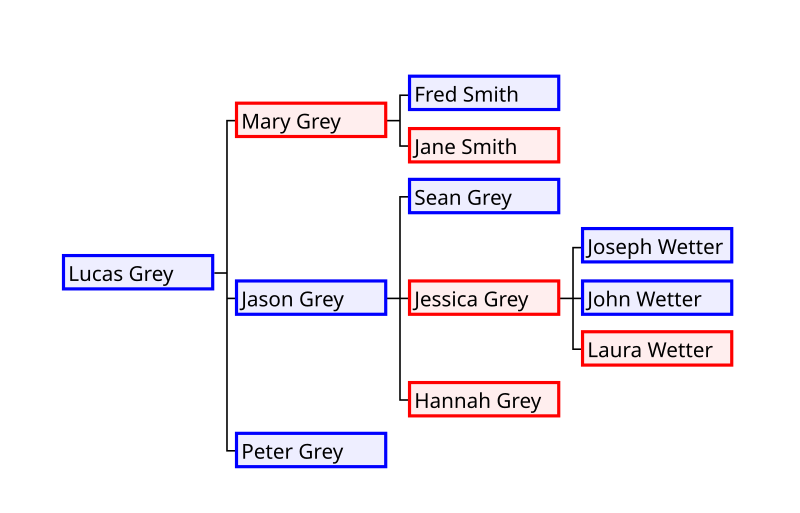
family tree
chart representing family relationships in a conventional tree structure
most recent common ancestor
most recent individual from which all organisms in a group are directly descended
Jure uxoris
Title of nobility used by a man because his wife holds it in her own right
nomen nescio
Latin phrase denoting an unnamed person
Generations of Noah
genealogy of the sons of Noah and their dispersion into many lands after the Flood found in Genesis
parish register
paper register of births, marriages and deaths in various offices

Adnanites
The Adnanites () were a tribal confederation of the Ishmaelite Arabs who originate from the Hejaz. They trace their lineage back to Ishmael, son of the Islamic prophet and patriarch Abraham and his wife Hagar, through Adnan. The Islamic prophet Muhammad belonged to the Quraysh tribe of the 'Adnanites'.

ahnentafel
thumb|right|300px|The first ahnentafel, published by Michaël Eytzinger in Thesaurus principum hac aetate in Europa viventium Cologne: 1590, pp. 146–147, in which Eytzinger first illustrates his new functional theory of numeration of ancestors; this schema showing Henry III of France as n° 1, de cujus, with his ancestors in five generations. The remainder of the volume shows 34 additional schemas for rulers and princes of Europe using his new method.
thumb|Seize quartiers [[coat of arms display document (1786)]]
An ahnentafel (German for "ancestor table"; ) or ahnenreihe ("ancestor series"; ) i
pedigree collapse
concept in genealogy
cadet branch
noble house composed of descendants of a monarch's or aristocrat's younger children (cadets)
consanguine marriage
marriage between relatives
Arolsen Archives
centre for documentation, information and research on Nazi persecution, forced labour and the Holocaust in Nazi Germany and its occupied regions
coefficient of inbreeding
mathematical estimate of inbreeding

coefficient of relationship
measure of the degree of consanguinity (or biological relationship) between two individuals
genealogy tourism
tourism based on ancestry
progenitor
In genealogy, a progenitor (rarer: primogenitor) is the founder (sometimes one that is legendary) of a family, line of descent, gens, clan, tribe, noble house, or ethnic group. Genealogy (commonly known as family history) understands a progenitor to be the earliest recorded ancestor of a consanguineous family group of descendants.
Jure matris
latin phrase meaning "by right of his mother"
Iranian identity booklet
one of the Iranian identity documents
academic genealogy
links between academics based on mentoring relationships
Whakapapa
thumb|Māori woman with a representation of her ancestress Te Iringa in Waikato.
Genealogy is a fundamental principle in Māori culture, termed specifically in this context as whakapapa (, , lit. 'layering'). Reciting one's whakapapa proclaims one's identity among the Māori, places oneself in a wider context, and links themself to land and tribal groupings and their mana.
Stela of Pasenhor
ancient Egyptian stela
Les lignages d'outremer
Old French text describing the genealogy of the main Crusader families linked to John of Ibelin
nobility proof
proof that all four grandparents were aristocrats
Genealogy of Ankhefensekhmet
ancient Egyptian genealogy
genealogical numbering system
data visualization for family trees