Category
page 1General equilibrium theory
perfect competition
market structure in which firms are price takers for a homogenous product
IS/LM model
Islm
general equilibrium theory
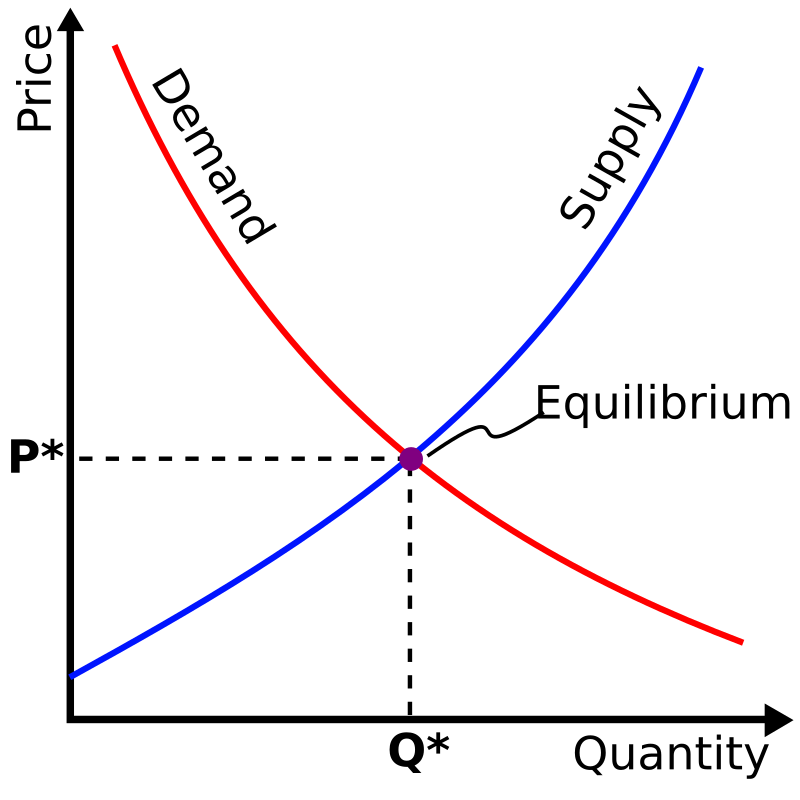
theory of equilibrium between supply and demand
dynamic stochastic general equilibrium
macroeconomic method applying general equilibrium theory and microeconomic principles to postulate economic phenomena, e.g. economic growth, business cycles, policy effects or market shocks
Walras' law
principle in general equilibrium theory that budget constraints imply that the values of excess demand sum to zero regardless of whether the prices are general equilibrium prices
fundamental theorems of welfare economics
Complete, full information, perfectly competitive markets are Pareto efficient
Kakutani fixed-point theorem
theorem that a function f: S→Pow(S) on a compact nonempty convex subset S⊂ℝⁿ, whose graph is closed and whose image f(x) is nonempty and convex for all x∈S, has a fixed point
Arrow–Debreu model
economic model of a market, suggesting that under certain economic assumptions there exist prices such that aggregate supplies equal aggregate demands for every commodity
Walrasian auction
simultaneous auction where each agent calculates its demand for the good at every possible price and submits this to an auctioneer
Shapley–Folkman lemma
result in convex geometry
partial equilibrium
concept in economics
Computable general equilibrium
class of economic models
convexity in economics
significant topic in economics
numéraire
The numéraire (or numeraire) is a basic standard by which value is computed. In mathematical economics it is a tradable economic entity in terms of whose price the relative prices of all other tradables are expressed. In a monetary economy, one of the functions of money is to act as the numéraire, i.e. to serve as a unit of account and therefore provide a common benchmark relative to which the value of various goods and services can be measured against.
Sonnenschein–Mantel–Debreu theorem
theorem in general equilibrium economics about the excess demand curve
non-convexity
economics