Category
page 1Geological epochs

Holocene
The Holocene () is the current geological epoch, beginning approximately 11,700 years ago. It follows the Last Glacial Period, which concluded with the Holocene glacial retreat. The Holocene and the preceding Pleistocene together form the Quaternary period. The Holocene is an interglacial period within the ongoing glacial cycles of the Quaternary, and is equivalent to Marine Isotope Stage 1.

Pleistocene
The Pleistocene ( ; referred to colloquially as the Ice Age) is the geological epoch that lasted from to 11,700 years ago, spanning the Earth's most recent period of repeated glaciations. Before a change was finally confirmed in 2009 by the International Union of Geological Sciences, the cutoff of the Pleistocene and the preceding Pliocene was regarded as being 1.806 million years Before Present (BP). Publications from earlier years may use either definition of the period. The end of the Pleistocene corresponds with the end of the last glacial period and also with the end of the Paleolith

Miocene
The Miocene ( ) is the first geological epoch of the Neogene Period and extends from about (Ma). The Miocene was named by Scottish geologist Charles Lyell and comes from Ancient Greek μείων (meíōn), , and καινός (kainós), , and thus means "less recent", because it has 18% fewer modern marine invertebrates than the Pliocene has. The Miocene followed the Oligocene and preceded the Pliocene.

Eocene
The Eocene ( ) is a geological epoch that lasted from about 56 to 33.9 million years ago (Ma). It is the second epoch of the Paleogene Period in the modern Cenozoic Era.

Pliocene
The Pliocene ( ; also Pleiocene) is the epoch in the geologic time scale that extends from 5.33 to 2.58 million years ago (Ma). It is the second and most recent epoch of the Neogene Period in the Cenozoic Era. The Pliocene follows the Miocene Epoch and is followed by the Pleistocene Epoch. Prior to the 2009 revision of the geologic time scale, which placed the four most recent major glaciations entirely within the Pleistocene, the Pliocene also included the Gelasian Stage, which lasted from 2.59 to 1.81 Ma, and is now included in the Pleistocene.

Oligocene
The Oligocene is a geologic epoch of the Paleogene Period that extends from about 33.9 million to 23 million years before the present ( to ). As with other older geologic periods, the rock beds that define the epoch are well identified but the exact dates of the start and end of the epoch are slightly uncertain. The name Oligocene was coined in 1854 by the German paleontologist Heinrich Ernst Beyrich from his studies of marine beds in Belgium and Germany. The name comes from Ancient Greek ὀλίγος (olígos), , and καινός (kainós), , and refers to the sparsity of extant forms of molluscs. The Olig

Paleocene
The Paleocene ( ), or Palaeocene, is a geological epoch that lasted from about 66 to 56 Ma (million years ago). It is the first epoch of the Paleogene Period in the modern Cenozoic Era. The name comes from Ancient Greek παλαιός (palaiós), meaning "old", and καινός (kainós), meaning "new", translating to "the old part of the Eocene".
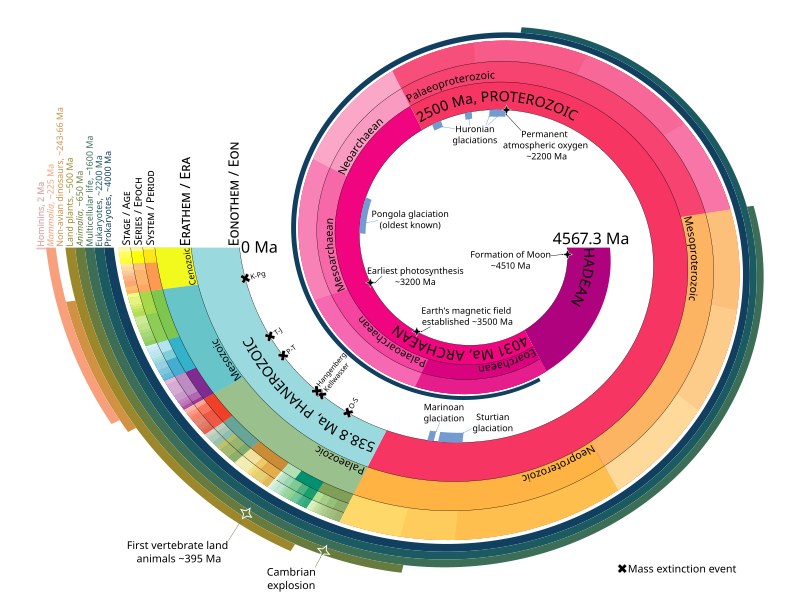
epoch
subdivision of geological time; shorter than a period and longer than an age
Late Cretaceous
second geologic series and epoch of the Cretaceous system and period
Late Jurassic
third epoch of the Jurassic Period
Early Cretaceous
first geologic series and epoch of the Cretaceous system and period
Mississippian
first subperiod of the Carboniferous Period
Early Jurassic
first epoch of the Jurassic period
Pennsylvanian
second and final subperiod of the Carboniferous Period
Middle Jurassic
second series and epoch of the Jurassic system and period
Middle Triassic
Second epoch of the Triassic period
Late Triassic
third and last series and epoch of the Triassic system / Triassic period
Early Triassic
first series and epoch of the Triassic system and period
Lopingian
The Lopingian, informally the Late or Upper Permian, is the uppermost series/last epoch of the Permian, and last epoch of the Paleozoic. The Lopingian was preceded by the Guadalupian and followed by the Early Triassic.

Cisuralian
The Cisuralian, also known as the Early Permian, is the first series/epoch of the Permian. The Cisuralian was preceded by the Pennsylvanian and followed by the Guadalupian. The Cisuralian Epoch is named after the western slopes of the Ural Mountains in Russia and Kazakhstan and dates between 298.9 ± 0.15 – 274.4 ± 0.4 Ma.
Llandovery
first series and epoch of the Silurian system and period
Furongian
The Furongian or Late Cambrian is the fourth and final epoch and series of the Cambrian. It lasted from to million years ago. It succeeds the Miaolingian series of the Cambrian and precedes the Lower Ordovician Tremadocian Stage. It is subdivided into three stages: the Paibian, Jiangshanian and the unnamed 10th stage of the Cambrian.
Meghalayan
The Meghalayan age is the name given in 2018, by the International Commission on Stratigraphy, to the current age or latest geologic age – or uppermost stage of the Quaternary. It is also the upper, or latest, of three subdivisions of the Holocene epoch or series. This way of breaking down time is based only on geology; for example, it is unrelated to the three-age system of historical periods into which human development is sometimes divided.
Ludlow
third series and epoch of the Silurian system and period
Pridoli
fourth and last series and epoch of the Silurian system and period
Wenlock
second series and epoch of the Silurian system and period
series
sequence of rock depositions defining a chronostratigraphic unit corresponding to a specific epoch on the geologic time scale

Guadalupian
The Guadalupian is the second and middle series/epoch of the Permian. The Guadalupian was preceded by the Cisuralian and followed by the Lopingian. It is named after the Guadalupe Mountains of New Mexico and Texas, and dates between 274.4 ± 0.4 – 259.51 ± 0.21 Mya. The series saw the rise of the therapsids, a minor extinction event called Olson's Extinction and a significant mass extinction called the end-Capitanian extinction event. The Guadalupian is also known as the Middle Permian.

Greenlandian
In the geologic time scale, the Greenlandian is the earliest age or lowest stage of the Holocene Epoch or Series, part of the Quaternary. Beginning in 11,650 BP (9701 BCE or 300 HE) and ending with the 8.2-kiloyear event (c. 8200–8300 BP, 6200–6300 BCE, 3600–3700 HE), it is the earliest of three sub-divisions of the Holocene. It was officially ratified by the International Commission on Stratigraphy in June 2018 with the later Northgrippian and Meghalayan Ages/Stages. The lower boundary of the Greenlandian Age is the GSSP sample from the North Greenland Ice Core Project in ce
Northgrippian
In the geologic time scale, the Northgrippian is the middle of three ages or stages of the Holocene Epoch or Series. It was officially ratified by the International Commission on Stratigraphy in June 2018, along with the earlier Greenlandian and later Meghalayan ages/stages. The age takes its name from the North Greenland Ice Core Project (NorthGRIP). The age began 8,276 BP (6326 BCE or 3854 HE), near the 8.2-kiloyear event, and goes up to the start of the Meghalayan, which began 4,200 BP (2250 BCE or 7750 HE), near the 4.2-kiloyear event.
Terreneuvian
The Terreneuvian or Early Cambrian is the lowermost and oldest series of the Cambrian geological system. Its base is defined by the first appearance datum of the trace fossil Treptichnus pedum around million years ago. Its top is defined as the first appearance of trilobites in the stratigraphic record around million years ago. This series' name was formally accepted by the International Commission on Stratigraphy in 2007.
Miaolingian
The Miaolingian or Mid-Late Cambrian is the third Series of the Cambrian Period, and was formally named in 2018. It lasted from about to million years ago and is divided in ascending order into 3 stages: the Wuliuan, Drumian, and Guzhangian. The Miaolingian is preceded by the unnamed Cambrian Series 2 and succeeded by the Furongian series.
Early Ordovician
first epoch of the Ordovician Period
Cambrian Series 2
second series and epoch of the Cambrian system and period
Late Ordovician
third and final epoch of the Ordovician Period
Early Devonian
first series and epoch of the Devonian system and period
Capitalocene
alt=A faded, sepia-tinged illustration of rectangular buildings near a body of water. They are lined with many windows, and smokestacks protrude from the roofs|thumb|424x424px|McConnel & Company mills, Manchester . Fossil fuels were first used as a generalized power source in the British textile industry.
The Capitalocene is a critique of "man versus nature" thinking in climate politics. Frequently misunderstood as an alternative geological periodization to the Anthropocene proposal, the Capitalocene's leading proponents argue for the centrality of capitalism in the making of climate crisis. T