Category
page 1Geological processes

geomorphology
thumb|upright=1.4|Badlands incised into [[shale at the foot of the North Caineville Plateau, Utah, within the pass carved by the Fremont River and known as the Blue Gate. G. K. Gilbert studied the landscapes of this area in great detail, forming the observational foundation for many of his studies on geomorphology.]]
thumb|Surface of Earth, showing higher elevations in red

weathering
thumb|upright=1.35|A natural arch produced by erosion of differentially weathered rock in Jebel Kharaz ([[Jordan)]]
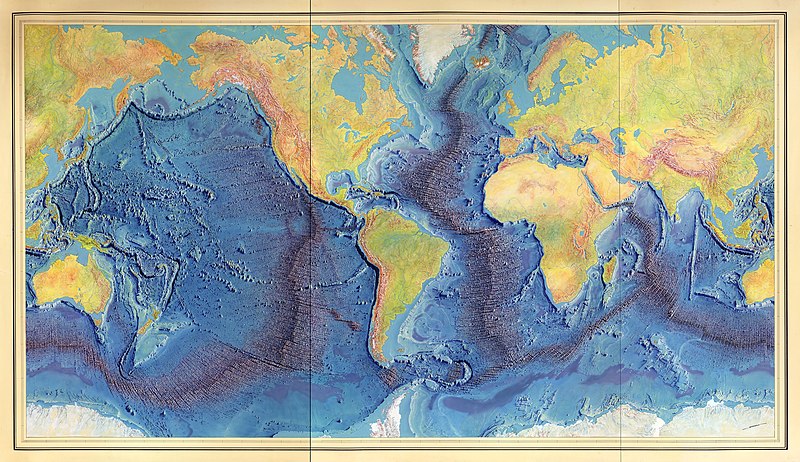
mid-ocean ridge
basaltic underwater mountain system formed by plate tectonic spreading

subduction
thumb|upright=1.85|Diagram of the geological process of subduction

orogeny
thumb|Map of the last orogenies to affect Earth's geologic provinces

fold
geological structure
seafloor spreading
process at mid-ocean ridges, where new oceanic crust is formed through volcanic activity and then gradually moves away from the ridge

metamorphism
thumb|upright=1.35|Schematic representation of a metamorphic reaction. Abbreviations of minerals: act = [[actinolite; chl = chlorite; ep = epidote; gt = garnet; hbl = hornblende; plag = plagioclase. Two minerals represented in the figure do not participate in the reaction, they can be quartz and K-feldspar. This reaction takes place in nature when a mafic rock goes from amphibolite facies to greenschist facies.]]

diagenesis
thumb|upright=1.35|A form of diagenesis is permineralization, in which buried organisms are replaced by minerals. These [[trilobites (Lloydolithus) were replaced by pyrite during a specific type of permineralization called pyritization.]]
thumb|upright=1.35|Permineralization in vertebra from Valgipes|Valgipes bucklandi

denudation
Denudation is the geological process in which moving water, ice, wind, and waves erode the Earth's surface, leading to a reduction in elevation and in relief of landforms and landscapes. Although the terms erosion and denudation are used interchangeably, erosion is the transport of soil and rocks from one location to another, and denudation is the sum of processes, including erosion, that result in the lowering of Earth's surface. Endogenous processes such as volcanoes, earthquakes, and tectonic uplift can expose continental crust to the exogenous processes of weathering, erosion, and mass was
marine transgression
geologic event
aeolian process
processes due to wind activity
Vaalbara
Vaalbara is a hypothetical Archean supercontinent consisting of the Kaapvaal craton (in present-day eastern South Africa) and the Pilbara Craton (in present-day north-western Western Australia). E. S. Cheney derived the name from the last four letters of each craton's name. The two cratons consist of continental crust dating from 3.6 to 2.7 Ga; this timing would make Vaalbara one of Earth's earliest supercontinents.
river bifurcation
the forking of a river into its distributaries
geothermal gradient
variation of temperature of Earth at different depths
rock cycle
time-consuming transitions through geologic time among the three main rock types: sedimentary, metamorphic, and igneous
diapir
thumb|400px|Diapirs in a subduction|subducting plate boundary

metasomatism
Metasomatism (from the Greek μετά metá "change" and σῶμα sôma "body") is the chemical alteration of a rock by hydrothermal and other fluids. It is traditionally defined as metamorphism which involves a change in the chemical composition, excluding volatile components. It is the replacement of one rock by another of different mineralogical and chemical composition. The minerals which compose the rocks are dissolved and new mineral formations are deposited in their place. Dissolution and deposition occur simultaneously and the rock remains solid.
lithification
Lithification (from the Ancient Greek word lithos meaning 'rock' and the Latin-derived suffix -ific) is the process in which sediments compact under pressure, expel connate fluids, and gradually become solid rock. Essentially, lithification is a process of porosity destruction through compaction and cementation. Lithification includes all the processes which convert unconsolidated sediments into sedimentary rocks. Petrifaction, though often used as a synonym, is more specifically used to describe the replacement of organic material by silica in the formation of fossils.
epeirogeny
upheavals or depressions of land exhibiting long wavelengths and little folding
hydrothermal circulation
circulation of hot water driven by heat exchange and accompanied by water-rock interactions and alterations
obduction
Obduction is a geological process whereby denser oceanic crust (and even upper mantle) is scraped off a descending ocean plate at a convergent plate boundary and thrust on top of an adjacent plate. When oceanic and continental plates converge, normally the denser oceanic crust sinks under the continental crust in the process of subduction. Obduction, which is less common, normally occurs in plate collisions at orogenic belts (some of the material from the subducting oceanic plate is emplaced onto the continental plate) or back-arc basins (regions where the edge of a continent is pulled away fr

sabkha
thumb|upright=1.5|Sebkhat (or Sebkha) El Melah, Tunisia in 2001, mostly dry. Note rectangular industrial evaporite pans, probably for sea-salt production, upper right. Landsat 7 image.
thumb|upright=1.5|Sebkhat El Melah in 1987, flooded. Landsat 5 image.
saltation
sediment transport process, moves grains across the bottom by bouncing or hopping.The actual current carries the sediment load in traction and saltation flows,whereas downslope movement under the force of gravity carries the sediment in gravity flows
igneous differentiation
processes by which magmas undergo bulk chemical change during the partial melting process, cooling, emplacement, or eruption
phreatomagmatic eruption
type of volcanic eruption
biogenic substance
substance produced by life processes; it may be either constituents, or secretions, of plants or animals
sediment transport
movement of solid particles, typically by gravity and fluid entrainment
Baer–Babinet law
superseded scientific theory
salt tectonics
study of salt-controlled structures (like salt domes), mechanisms, and tectonic deformation involving salt or other evaporates
cementation
term in geology
pneumatolysis
Pneumatolysis is an obsolete geologic term for magma emitting gasses that alter surrounding rock or crystallize minerals. Pneumatolysis is now considered a type of hydrothermal interaction.
exfoliation joint
type of weathering joint

permineralization
Permineralization is a process of fossilization of bones and tissues in which mineral deposits form internal casts of organisms. Carried by water, these minerals fill the spaces within organic tissue. Because of the nature of the casts, permineralization is particularly useful in studies of the internal structures of organisms, usually of plants.
mountain formation
geological processes that underlie the formation of mountains
shear zone
structural discontinuity surface in the Earth's crust and upper mantle
compaction
geological process by which a sediment progressively loses its porosity due to the effects of pressure from loading
iron cycle
Biogeochemical cycle of Fe2+/Fe3+
metamictization
Metamictisation (sometimes called metamictization or metamiction) is a natural process resulting in the gradual and ultimately complete destruction of a mineral's crystal structure, leaving the mineral amorphous. The affected material is therefore described as metamict.
avulsion
rapid abandonment of a river channel and formation of a new channel
fold and thrust belt
Area of folding and faulting adjacent to a mountain belt
dolomitization
thumb|Sedimentary layers of dolomitized limestone in an outcrop in the [[Philippines]]
thumb|Mountains with dolomite rock formations in northern Italy
Dolomitization is a geological process where magnesium ions replace calcium ions in the mineral calcite, resulting in the formation of dolomite.
serpentinization
thumb|Chromite|Chromitic [[serpentinite from Styria Province, Austria]]
Serpentinization is a hydration and metamorphic transformation of ferromagnesian minerals, such as olivine and pyroxene, in mafic and ultramafic rock to produce serpentinite. Minerals formed by serpentinization include the serpentine group minerals (antigorite, lizardite, chrysotile), brucite, talc, Ni-Fe alloys, and magnetite. The mineral alteration is particularly important at the sea floor at tectonic plate boundaries.
Tension (geology)
stress which stretches rocks in two opposite directions
degradation
lowering of a fluvial surface, such as a stream bed or floodplain, through erosional processes
iron catastrophe
runaway melting of early earth's interior as a result of potential energy release from sinking iron and nickel melted by heat of radioactive decay
ore genesis
how the various types of mineral deposits form within the Earth's crust.
Deep water cycle
movement of water in the deep Earth
shear
in geology, the response of a rock to deformation usually by compressive stress
Cuspate foreland
geographical features found on coastlines and lakeshores that are created primarily by longshore drift
river channel migration
geomorphological process that involves the lateral migration of an alluvial river channel across its floodplain