Category
page 1Gilding

illuminated manuscript
manuscript in which the text is supplemented by the addition of decoration
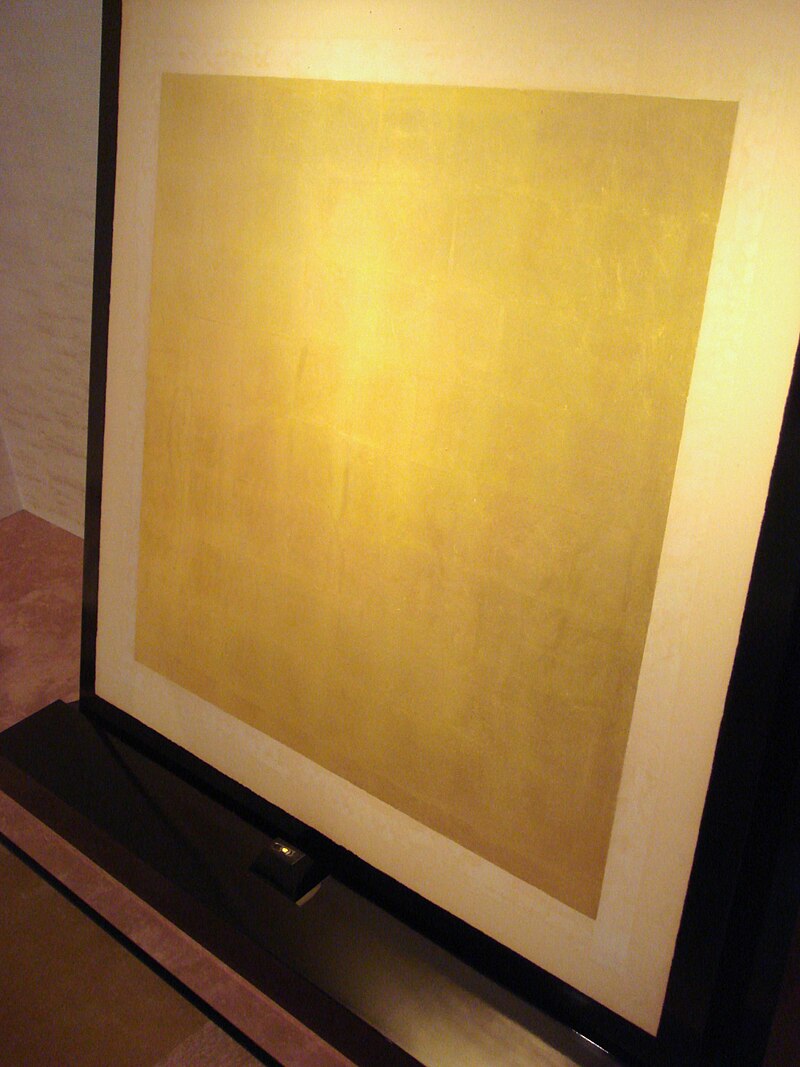
gold leaf
very thin gold used in art

gilding
thumb|right|Gilded frame ready for burnishing (metal)|burnishing with an [[agate stone tool]]
thumb|right|Application of gold leaf to a reproduction of a 15th-century panel painting
Gilding is a decorative technique for applying a very thin coating of gold over solid surfaces such as metal (most common), wood, porcelain, or stone. A gilded object is also described as "gilt". Where metal is gilded, the metal below was traditionally silver in the West, to make silver-gilt (or vermeil) objects, but gilt-bronze is commonly used in China, and also called ormolu if it is Western. Methods of gilding

gesso
thumb|A restored gesso panel representing Martin of Tours|St. Martin of Tours, from St. Michael and All Angels Church, Lyndhurst, Hampshire

silver-gilt
thumb|The Burghley Nef, silver-gilt (with sections ungilded), and [[nautilus shell, 1527–1528, France, V&A Museum]]

ormolu
thumb|French ormolu mantel clock (around 1800) by Julien Béliard (1758 – died after 1806), Paris. The clock case by Claude Galle (1758–1815)
Ormolu (; ) is the gilding technique of applying finely ground, high-carat gold–mercury amalgam to an object of bronze, and objects finished in this way. The mercury is driven off in a kiln, leaving behind a gold coating. The French refer to this technique as ; in English, it is known as gilt bronze. Around 1830, legislation in France outlawed the use of mercury for health reasons, though use continued to the 1900s.
Goldbeater's skin
processed outer membrane of the intestine of an animal
levkas
Within the field of icon painting, levkas is the mixture of fine alabaster powder, calcium sulfate (a form of gypsum), or calcium carbonate (chalk) along with glue (often rabbit skin glue, sometimes fish glue derived from the bladder of a sturgeon) applied in layers to a surface prior to gilding that surface with gold leaf or painting it, similar to gesso. The levkas is a bright white color which allows the colors of the paint to appear their brightest. As many as six to seven layers may be applied in preparation for the painting of a religious icon. A painting or icon whose surface has been d
verre églomisé
glass decorating technique
Lai rot nam
rabbit-skin glue
glue from mainly hides of hares, rabbits and related small animals