Category
page 1Gold coins

ducat
thumb|Austrian gold ducat depicting Kaiser Franz Joseph I of Austria|Franz-Josef,
The ducat ( ) coin was used as a trade coin in Europe from the later Middle Ages to the 19th century. Its most familiar version, the gold ducat or sequin containing around of 98.6% fine gold, originated in Venice in 1284 and gained wide international acceptance over the centuries. Similarly named silver ducatons also existed. The gold ducat circulated along with the Florentine florin and preceded the modern British pound sterling.
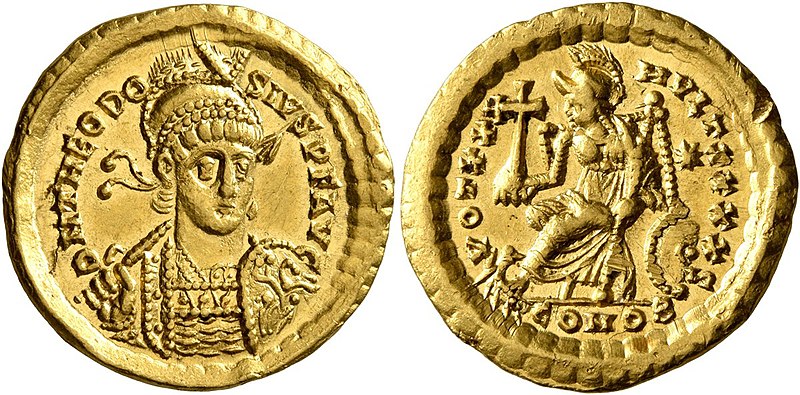
solidus
gold coin issued in the Late Roman Empire

aureus
thumb|300x300px|Aureus minted in 193 by Septimius Severus to celebrate [[Legio XIV Gemina, the legion that proclaimed him emperor]]
The aureus ( aurei, 'golden') was the main gold coin of ancient Rome from the 1st century BC to the early 4th century AD, when it was replaced by the solidus. This type of coin was sporadically issued during the Republic and standardized during the Empire, originally valued at 25 silver denarii and 100 sestertii. It was about the same size as the denarius, but heavier than the denarius since gold is denser than silver.
.jpg)
florin
thumb|right|Reverse of an Italian florin coin
gold coin
coin made from gold
Abkhazian apsar
currency of Abkhazia

Persian daric
thumb|Type IIIb Achaemenid Daric, c. 420 BC.
German mark
German currency from 1871–1923

hyperpyron
thumb|250px|right|Hyperpyron of Emperor Manuel I Komnenos (r. 1143–1180), showing its typical [[scyphate (cup-shaped) form.]]The hyperpyron (, nómisma hypérpyron ) was a Byzantine coin in use during the late Middle Ages, replacing the solidus as the Byzantine Empire's standard gold coinage in the 11th century. It was introduced by emperor Alexios I Komnenos.
Louis d'or
French coin

doubloon
thumb|right|Spanish 4-doubloon, or doubloon of 8 escudos, stamped as minted in Mexico city mint in 1798. Obverse: Carlos IV of Spain|Carol.IIII.D.G. Hisp.et Ind.R. Reverse:.in.utroq.felix. .auspice.deo.fm.
The doubloon (from Spanish doblón, or "double", i.e. double escudo) was a two-escudo gold coin worth approximately four Spanish dollars or 32 reales, and weighing 6.766 grams (0.218 troy ounce) of 22-karat gold (or 0.917 fine; hence 6.2 g fine gold). Doubloons were minted in Spain and the viceroyalties of New Spain, Peru, and New Granada (modern-day Colombia, Ecuador, Panama, and Venezuela).
gold dinar
type of coin
Napoleon
colloquial term for a former French gold coin

bezant
thumb|upright=1.6|Crusader coins of the Kingdom of Jerusalem: Denier in European style with [[Holy Sepulchre (1162–1175); Kufic gold bezant, imitation of the Fatimid dinar (1140–1180); gold bezant with Christian symbol (1250s) (British Museum). Gold coins were first copied dinars and bore Kufic script, but after 1250 Christian symbols were added following Papal complaints.]]
thumb|upright=1.6|County of Tripoli gold bezant in Arabic (1270–1300), and Tripoli silver gros (1275–1287). [[British Museum.]]
sultani
Ottoman gold coin
sequin
type of currency

Tremissis
thumb|Tremissis from Constantinople in the second reign of Zeno (emperor)|Zeno
upright|thumb|Merovingian dynasty|Frankish gold Tremissis with Christian cross, issued by minter , [[Dorestad, Netherlands, mid-600s]]
koban
coin from the Edo period of Japan

Histamenon
thumb|right|260px|Histamenon of Emperor Constantine VIII ()

pistole
thumb|Double escudo ("pistole") of Philip IV of Spain|Felipe IV, 1630
thumb|Double escudo ("pistole") of Charles III of Spain|Carlos III, 1772
thumb|Pistole coin weight, c. 1690
thumb|Quarter-ducat of the Canton of Zürich, 1751; nicknamed "pistole"
Pistole is the French name given to a Spanish gold coin in use from 1537; it was a doubloon or double escudo, the gold unit. The name was also given to the Louis d'Or of Louis XIII of France, and to other European gold coins of about the value of the Spanish coin. One pistole was worth approximately ten livres or three écus, but higher figures are a

tarì
thumb|Norman tarì of Roger II of Sicily, with [[Arabic inscriptions, minted in Palermo. Now in the British Museum.]]
thumb|A pre-Norman Sicilian ruba'i/tarì in the name of Caliph Ma'ad al-Mustansir Billah|Al-Mustansir. [[British Museum.]]
thumb|A pre-Norman Sicilian ruba'i/tarì in the name of Caliph Al-Hakim bi-Amr Allah|Al-Hakim, 1005. [[British Museum.]]
Tarì (from Arabic , ) was the Christian designation of a type of gold coin of Islamic origin minted in Sicily, Malta and Southern Italy from about 913 to the 13th century.

Mancus
thumb|A mancus of king Ethelred the Unready|Æthelred II, 1003–1006.

augustalis
thumb|right|Example of a Neapolitan augustale, showing a Roman Emperor
An augustalis or augustale, also agostaro, was a gold coin minted in the Kingdom of Sicily beginning in 1229 or in 1231 according to others.

Tetarteron
The tetarteron (, "quarter [coin]") was a Byzantine term applied to two different coins, one gold circulating from the 960s to 1092 in parallel to the histamenon, and one copper used from 1092 to the second half of the 13th century.
modern gold dinar
proposed currency that aims to revive the gold dinar of the medieval Umayyad Caliphate

Ōban
thumb|The Ōban (大判) was the largest denomination, valued at 10 Ryōs. Here, a [[Keichō Ōban, minted from 1601.]]
thumb|Maneki Neko, with Ōban attached to collar
An Ōban (大判) was a monetary ovoid gold plate, and the largest denomination of Tokugawa coinage. Tokugawa coinage worked according to a triple monetary standard, using gold, silver and bronze coins, each with their own denominations.
thumb|left|Keichō gold coinage: Ōban, Koban, [[Ichibuban, 1601–1695.]]
The first Oban – Tenshō Ōban (天正大判) – were minted by the Gotō family under the orders of Hideyoshi in 1588.
.jpg)
Gold Ashrafi
thumb|Ashrafi minted in the reign of Ashraf Hotak|Shāh Ashraf Hōtak (d. 1730)
gold franc
unit of account for the Bank for International Settlements from 1930 until April 1, 2003
Vreneli
Vreneli (aka Goldvreneli) is the informal name for a range of legal tender gold coins of the Swiss franc. The coins were issued between 1897 and 1936, in 1947 and in 1949. All coins issued after 1936 are restrikes (legal tender ceased September 29, 1936).
Friedrich d'or
Prussian gold coin (pistole) nominally worth 5 silver Prussian Reichsthalers
Philippeioi
Philippeioi (, Philíppeioi), later called Alexanders (Ἀλέξανδροι, Aléxandroi), were the gold coins used in the ancient Greek Kingdom of Macedonia. First issued at some point between 355 and 347 BC, the coins featured a portrait of the Greek deity Apollo on the obverse, and on the reverse, an illustration of a biga, a Greek chariot drawn by two horses. They had the value of one gold stater each. In the first issuing, Apollo was depicted with long hair, but after that the design was altered permanently to one in which Apollo's hair was shorter.
Thrymsa
thumb|An early medieval Anglo-Saxon gold thrymsa (or shilling) coin from c. 650–675 AD.|alt=The thrymsa () was a gold coin minted in seventh-century Anglo-Saxon England. It originated as a copy of Merovingian tremisses and earlier Roman coins with a high gold content. Continued debasement between the 630s and the 650s reduced the gold content in newly minted coins such that after c. 655 the percentage of gold in a new coin was less than 35%. The thrymsa ceased to be minted after about 675 and was superseded by the silver sceat.
Islamic State Dinar
currency used by IS
moidore
A moidore or moydore was historically a gold coin of Portuguese origin. While the coin shows a face value of 4,000 réis, its real value was 20% higher or 4,800 réis from 1688 to 1800. On its obverse is the face value and the Portuguese coat of arms, and on its reverse is the Order of Christ Cross. Moidores were minted from 1677 to as late as 1910, mainly in the Kingdom of Portugal and in Portuguese colonies like Brazil and Mozambique. Gold coins were also issued in fractions or multiples of moidores, ranging from one-tenth of a moidore to five moidores.
Egyptian gold stater
first coin minted in ancient Egypt
Almoravid dinar
a gold dinar coin minted under the Almoravid dynasty
rainbow cup
type of Celtic coin
Kelantanese dinar
currency issued by the Government of the Malaysian state of Kelantan
Agnel
coin
Ying Yuan
Português (coin)
16th century Portuguese gold coin
Ichibuban
The (lit: "one gold bu") was a monetary unit of Japan. The Ichibuban was a gold coin that was worth a quarter of a Koban.
Oncia
thumb|A silver Maltese oncia from 1741–73
In southern Italy, the oncia (plural oncie or once) or onza (pl. onze) was a unit of account during the Middle Ages and later a gold coin minted between 1732 and 1860. It was also minted in the southern Italian territories of the Spanish Empire, and a silver coin of the same value was minted by the Knights of Malta. The name is derived from the ancient Roman uncia. It is sometimes translated as ounce.
Liudhard medalet
Anglo-Saxon gold object
red złoty
South African Mint
mint
Ides of March coin
43–42 BC Roman denarius coin
Moby Dick Coin
Ecuadorian doubloon described in Moby Dick