Category
page 1Gothic warriors

Theodoric the Great
king of the Germanic Ostrogoths and ruler of Italy (493–526)

Alaric I
King of the Visigoths
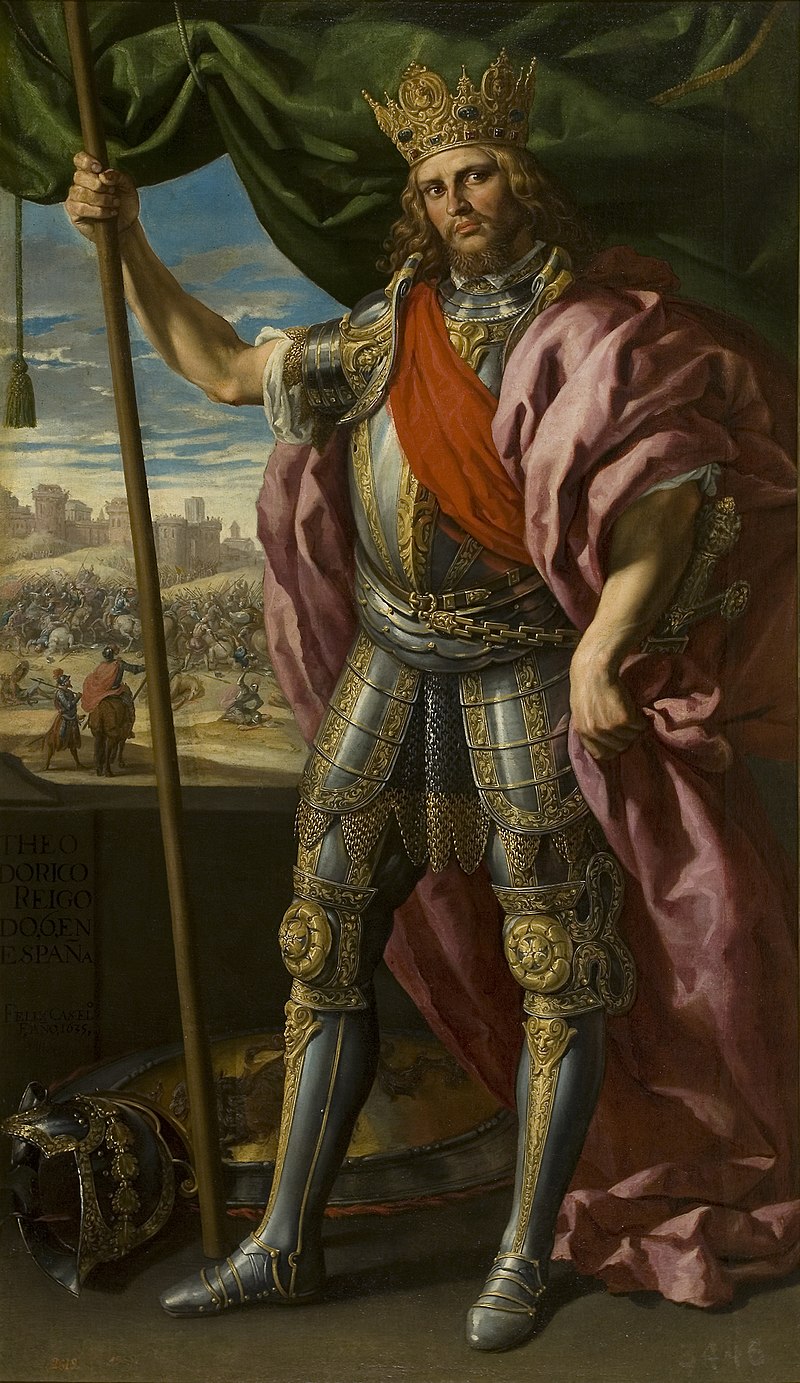
Theodoric I
King of the Visigoths

Pelagius
first king of Asturias

Totila
Totila, original name Baduila (died 1 July 552), was the penultimate King of the Ostrogoths, reigning from 541 to 552. A skilled military and political leader, Totila reversed the tide of the Gothic War, recovering by 543 almost all the territories in Italy that the Eastern Roman Empire had captured from his Kingdom in 540.
Ataulf
Athaulf (also Athavulf, Atawulf, or Ataulf and Adolf, Latinized as Ataulphus) ( 37015 August 415) was king of the Visigoths from 411 to 415. During his reign, he transformed the Visigothic state from a tribal kingdom to a major political power of late antiquity.

Wallia
Wallia, Walha or Vallia (Spanish: Walia, Portuguese Vália), ( 385 – 418) was king of the Visigoths from 415 to 418, earning a reputation as a great warrior and prudent ruler. He was elected to the throne after Athaulf and Sigeric were both assassinated in 415. One of Wallia's most notable achievements was negotiating a foedus (a kind of treaty or agreement) with the Roman emperor Honorius in 416. This agreement allowed the Visigoths to settle in Aquitania, a region in modern-day France, in exchange for military service to Rome. This settlement marked a significant step towards the eventual est

Roderic
Roderic (also spelled Ruderic, Roderik, Roderich, or Roderick; Spanish and , ; died July 711) was the Visigothic king in Hispania between 710 and 711. He is well known as "the last king of the Goths". He is an obscure figure about whom little can be said with certainty. He was the last Goth to rule from Toledo, but not the last Gothic king, a distinction which belongs to Ardo.

Euric
Euric (Gothic: 𐌰𐌹𐍅𐌰𐍂𐌴𐌹𐌺𐍃, Aiwareiks, see Eric), also known as Evaric ( 426 – 28 December 484), son of Theodoric I, ruled as king (rex) of the Visigoths, after murdering his brother, Theodoric II, from 466 until his death in 484. Sometimes he is called Euric II.
Thorismund
Thorismund (also Thorismod or Thorismud, as manuscripts of the chief source confusingly attest) ( 420–453), became king of the Visigoths after his father Theodoric I was killed in the Battle of the Catalaunian Plains (also called Battle of Châlons) in 451 CE. He was murdered in 453 and was succeeded by his brother Theodoric II.
Fritigern
Fritigern (fl. 370s) was a Thervingian Gothic chieftain whose decisive victory at Adrianople during the Gothic War (376–382) led to favourable terms for the Goths when peace was made with Gratian and Theodosius I in 382.

Liuvigild
Liuvigild, Leuvigild, Leovigild, or Leovigildo (Spanish and Portuguese; c. 519–586) was a Visigothic king of Hispania and Septimania from 569 to 586. Known for his Codex Revisus or Code of Leovigild, a law allowing equal rights between the Visigothic and Hispano-Roman population, his kingdom covered modern Spain down to Toledo and Portugal. Liuvigild ranks among the greatest Visigothic kings of the Arian period. He consolidated and expanded Visigothic power by defeating the Suebi, campaigning against the Byzantines in the south, and extending control over Basque territories. His legal reforms

Ermanaric
right|250px|thumb|The orange area signifies the Chernyakhov Culture, identified with Ermanaric's kingdom, in the early fourth century.
right|250px|thumb|Ermanaric's kingdom at the end of the fourth century (a map from 1899).
Ermanaric (died 376) was a Greuthungian king who before the Hunnic invasion evidently ruled a sizable portion of Oium, the part of Scythia inhabited by the Goths at the time. He is mentioned in two Roman sources: the contemporary writings of Ammianus Marcellinus, and in Getica by the sixth-century historian Jordanes. He also appears in a fictionalized form in later Germani
Theudis
Theudis (Gothic: 𐌸𐌹𐌿𐌳𐌴𐌹𐍃, Þiudeis, Spanish: Teudis, Portuguese: Têudis), ( 480 – June 548) was king of the Visigoths in Hispania from 531 to 548.

Alfonso I of Asturias
duke of Cantabria and king of Asturias
%2003.JPG)
Aspar
thumb|Detail of a dish depicting Aspar and his elder son Ardabur (consul 447)|Ardabur ( 434).

Wamba
Visigothic king

Teia
thumb|Coin of Teia, merely inscribing: ("Teia the King").
Teia (died 552 or 553), also known as Teja, Theia, Thila, Thela, and Teias, was the last Ostrogothic King of Italy. He led troops during the Battle of Busta Gallorum and had noncombatant Romans slaughtered in its aftermath. In late 552/early 553, he was killed during the Battle of Mons Lactarius. Archaeological records attesting to his rule show up in coinage found in former Transalpine Gaul.
.jpg)
Gundemar
thumb|Imaginary portrait of Gundemar by Bernardino Montañés. Oil on canvas (1858)
Theodemir
King of the ostrogothic Greuthungi

Radagaisus
thumb|upright=1.35|Giorgio Vasari, Defeat of Radagaiso below Fiesole, 1563–1565
Radagaisus (died 23 August 406) was a Gothic king who led an invasion of Roman Italy in late 405 and the first half of 406. A committed pagan, he was executed after being defeated by the general Stilicho.
Valamir
Valamir or Valamer ( – 469) was an Ostrogothic king in the former Roman province of Pannonia from AD 447 until his death. During his reign, he fought alongside the Huns against the Roman Empire and then, after Attila the Hun's death, fought against the Huns to consolidate his independent control over a large group of Goths.
Ardo
Ardo (or Ardonus, possibly short for Ardabastus; died 720/721) is the last attested king of the Visigoths, reigning from 713 or 714 until his death in 720 or 721. The Visigothic Kingdom was already severely reduced in power and area at the time he succeeded Achila II, and his dominions probably did not extend beyond Septimania and present-day Catalonia, due to the Arab conquests of the previous three years.

Gainas
Gainas (?-400 AD, Greek: Γαϊνάς) was a Gothic leader who served the Eastern Roman Empire as magister militum during the reigns of Theodosius I and Arcadius. He played an important role in the events in the eastern part of the empire by the end of the 4th century.

Cniva
thumb|250-251 Gothic campaign
Cniva ( mid-3rd century AD) was a Gothic king who invaded the Roman Empire in the middle of the 3rd century AD. His regnal years are uncertain. He successfully captured the city of Philippopolis (Plovdiv in Bulgaria) in 250 and killed Emperor Decius and his son Herennius Etruscus at the Battle of Abritus as he was attempting to leave the Empire in 251. This was the first time a Roman Emperor had been killed in combat against foreigners. He was allowed by the new Emperor Trebonianus Gallus to leave with his spoils and was paid tribute to stay out of the empire.
Vithimiris
Vithimir or Vithimer (in Latin: Vithimiris) was a king of the Greuthungi, ruling for some unspecified time in the area of present-day southern Ukraine.
Theodoric Strabo
Ostrogoth chieftain
Geberic
Geberic was a king of the Goths of the fourth century AD, reported in the 6th by Jordanes in his history of the Amal dynasty-led Goths, the Getica.
Flavius Areobindus Dagalaifus Areobindus
Byzantine general and politician (460-512)
Alaviv
Alavivus (flourished in 4th century AD) was a Gothic co-king of a group of Thervingi together with Fritigern. Along with the latter he led the migration of the Thervingi from Dacia across the Danube into the Roman Empire in the late 4th century AD. Upon arrival in the Roman Empire, the Goths suffered from widespread famine, with some Gothic parents reportedly being forced to sell their children into slavery in return for rotten dog meat in order to avoid starvation. In 376, Valens' lieutenant Lupicinus invited Alavivus and Fritigern to a banquet to discuss provisions for their people, where Al
Sarus
Gothic chieftain
Tribigild
Tribigild, also called Tarbigilus (; ; 399) was an Ostrogothic general whose rebellion against the Eastern Roman Empire precipitated a major political crisis during the reign of Emperor Arcadius.
Theudimer
8th century Spanish Visigothic ruler
Fravitta
Flavius Fravitta (Greek: ; died 404/405) was a leader of the Goths and a top-ranking officer in the army of the Eastern Roman Empire.
John of Gothia
Crimean Gothic Greek Orthodox Metropolitan bishop of Doros, and rebel leader
Areobindus
Roman general (magister militum) and consul of 434
Fruela of Cantabria
Cantabrian chieftain
Ovida
Ovida or Odiva (died 481/482) was a late Western Roman general and warlord of likely Gothic origin and the last Roman ruler of Dalmatia. Ovida initially served Julius Nepos, ruler of Roman Dalmatia and later western Roman emperor in Italy from 474 to 475. After being usurped in 475, Nepos continued to claim the imperial title in exile in Dalmatia, supported by the Eastern Roman Empire, but he was murdered by Ovida and another general, Viator, in 480. Upon his death, Ovida became the ruler of Dalmatia, a position he held until he was defeated and killed by Odoacer, the first barbarian King of I

Godas
thumb|right|Vandal coin found in Sardinia depicting Godas. Latin legend : REX CVDA.
Godas (died 533) was a Gothic nobleman of the Vandal kingdom in North Africa. King Gelimer of the Vandals made him governor of the Vandalic province of Sardinia, but Godas stopped forwarding the taxes he collected and declared himself ruler of Sardinia.
Plinta
thumb|A detail of the Missorium of Aspar. Over Aspar and his son Ardabur, there are two imagines clipeatae depicting raffiguranti Flavius Ardabur and Plinta (right).
Dagalaifus
Roman politician, consul 461
Bessas
Byzantine general

Hervor
thumb|300px|right|Hervor, daughter of Heidrek, dying at the Hlöðskviða|Battle of the Goths and Huns, a painting by [[Peter Nicolai Arbo.]]
Hervör (Old Norse: Hervǫr) is the name shared by two female characters in the Tyrfing Cycle, presented in The Saga of Hervör and Heidrek with parts found in the Poetic Edda. The first, the Viking Hervör, challenged her father Angantýr's ghost in his gravemound for his cursed sword Tyrfing. She had a son, Heidrek, father of the other Hervör. The second Hervör was a commander killed in battle with her brother.
Remistus
Remistus (died 17 September 456) was a general of the Western Roman Empire and commander-in-chief of the army under Emperor Avitus.

Flavius Arintheus
Flavius Arintheus (or Arinthaeus; died AD 378) was a Roman army officer who started his career in the middle ranks and rose to senior political and military positions. He served the emperors Constantius II, Julian, Jovian and Valens. In 372 he was appointed consul, alongside Domitius Modestus.
Ostrogota
Ostrogotha was a leader of the Goths in Ukraine, who invaded Roman Moesia during the Crisis of the Third Century. He was a contemporary of Cniva, who also led Gothic armies in the same period.
Anagast
Anagast or Anagastes () was a magister militum in the army of the Eastern Roman Empire. He was probably a Goth, as his name (as well as that of his father, Arnegisc(clus)) seems to be of Gothic origin. He was sent to negotiate with Dengizich, a son of Attila, when the western wing of the Huns invaded the empire with the intention to finally conquer its capital Constantinople and had already reached the Danube. However, Dengizich refused to negotiate with him and demanded to speak directly with the emperor Leo I. The western wing of the Huns was defeated and Dengizich was killed in 469.
Butheric
Butheric (; ; died 390) was a Roman general of Gothic descent. Under the reign of emperor Theodosius I, Butheric was stationed in Thessalonica as a magister militum. According to Sozomen, in June of the year 390 he had a famous circus charioteer arrested in Thessalonica, who openly practiced pederasty. This was based on the emperor's law which punished "sin against nature" with death. The population reacted violently against the arrest, both for the popularity of the charioteer and for prejudices against Goths. Butheric was lynched by the mob in the circus. In retaliation, Theodosius authorize
Farnobius
Farnobius (died AD 377) was a Gothic chief who was killed in a battle with the Roman army of Frigeridus while trying to cross the mountains from Thrace into Illyricum.
Vinitharius
Vinitharius or Vinithar was possibly a king of the Greuthungian Goths around 375-376 AD. Vinitharius is mentioned by Gothic historian Jordanes in Getica. According to him, Vinitharius became the new king of the Greuthungi after the death of Ermanaric (Hermanaric). Ammianus Marcellinus reports that Ermanaric was succeeded by Vithimiris.
Oppas
Oppas (died after 712), also spelled Oppa, was a member of the Visigothic elite in the city of Toledo on the eve of the Muslim conquest of Hispania. He was a son of Egica and therefore a brother or half-brother of Wittiza.
Sunifred
Suniefred was a Visigothic nobleman who rebelled during the reign of Egica () and briefly ruled as king from Toledo.
Sigisvultus
Flavius Sigisvultus (fl. 427–448) was a general of the late Western Roman Empire.
Odotheus
Odotheus (in Zosimus Aedotheus) was a Greuthungi king who in 386 led an incursion into the Roman Empire. He was defeated and killed by the Roman general Promotus. His surviving people settled in Phrygia.
Aligern
Aligern or Aligernus was an Ostrogoth military leader, active in the Gothic War (535-554). By the end of the war, Aligern had joined the Byzantine army. The main sources about him are Procopius and Agathias.
Godilas
Godilas () was a Byzantine general, active in the reigns of Emperor Justin I () and Emperor Justinian I ().
Dagisthaeus
Dagisthaeus (, Dagisthaîos) was a 6th-century Eastern Roman military commander, probably of Gothic origin, in the service of the emperor Justinian I.
Heidrek
Heidrek or Heiðrekr (Old Norse: ) is one of the main characters in the cycle about the magic sword Tyrfing. He appears in the Hervarar saga, and probably also in Widsith, together with his sons Angantyr (Incgentheow) and Hlöð (Hlith), and Hlöð's mother Sifka (Sifeca). The etymology is , meaning "honour", and , meaning "ruler, king".
Cannabaudes
Cannabaudes or Cannabas (died 271) was a third-century leader of the Gothic tribe of the Tervings, who died in a battle against the Roman emperor Aurelian.
Ansemund
Ansemund was the Gothic count of Nîmes, ruling from 752 until his death in 754.