Category
page 1Graphic design

image
thumb|The act of making a 2D image with a mobile phone camera. The display of the phone shows the [[photograph that will be made and stored.|right]]

Bauhaus
.jpg)
lithography
thumb|upright=1.3|A lithograph of Charles Marion Russell's The Custer Fight (1903), with the range of tones fading toward the edges.
.jpg)
poster
thumb|upright|Poster for the Holzer Fashion Store, 1902
thumb|Police can sometimes put up a poster to let the public know about a criminal.
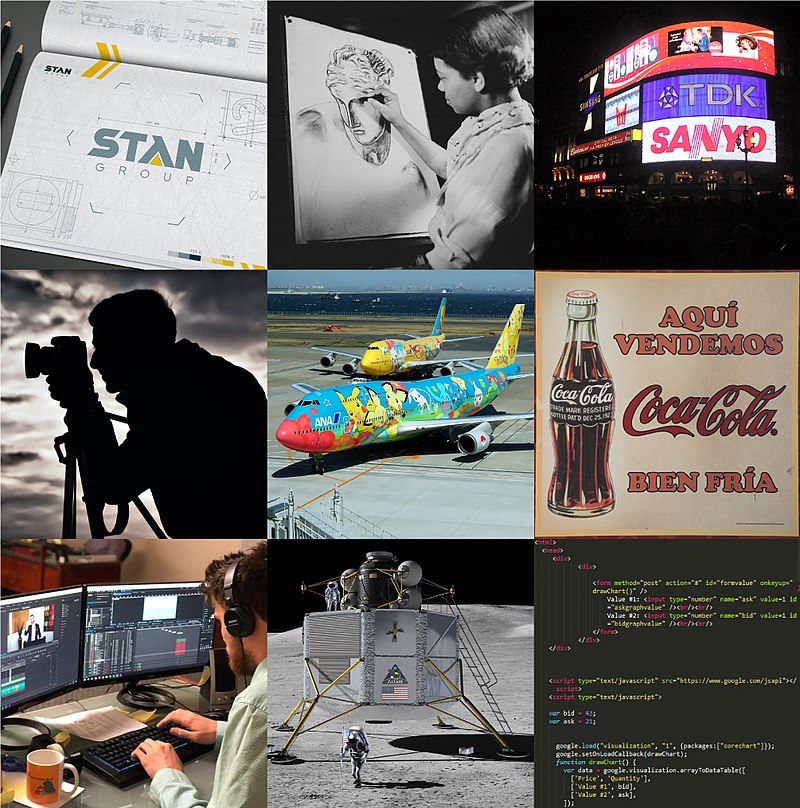
graphic design
visual design of content in various media

brand
thumb|right|alt=Photograph of the Apple Store Omotesando in Tokyo, Japan|Apple Inc. was the world's most valuable brand in 2024 according to Brand Finance.
thumb|The Coca-Cola [[wordmark is a distinctive brand logo used to attract the attention of people attending a sporting event, or watching it on television.]]
.jpg)
illustration
thumb| Illustration by Jessie Willcox Smith (1863–1935)
An illustration is a decoration, interpretation, or visual explanation of a text, concept, or process, designed for integration in print and digitally published media, such as posters, flyers, magazines, books, teaching materials, animations, video games and films. An illustration is typically created by an illustrator. Digital illustrations are often used to make websites and apps more user-friendly, such as the use of emojis to accompany digital type. Illustration also means providing an example; either in writing or in picture form.

graphics
Graphics () are visual images or designs on some surface, such as a wall, canvas, screen, paper, or stone, to inform, illustrate, or entertain. In contemporary usage, it includes a pictorial representation of data, as in design and manufacture, in typesetting and the graphic arts, and in educational and recreational software. Images that are generated by a computer are called computer graphics.

Gestalt psychology
theory of mind examining human perception, structures and organizing principles in sensory impressions

vector graphics
computer graphic image defined by points, lines and curves
%202088.jpg)
ideogram
An ideogram or ideograph (from Greek + ) is a symbol that is used within a given writing system to represent an idea or concept in a given language. (Ideograms are contrasted with phonograms, which indicate sounds of speech and thus are independent of any particular language.) Some ideograms are more arbitrary than others: some are only meaningful assuming preexisting familiarity with some convention; others more directly resemble their signifieds. Ideograms that represent physical objects by visually illustrating them are called pictograms.

bookbinding
thumb|A traditional bookbinder at work
thumb|Bookbinder's type holder

trailer
advertisement for a feature film

Bézier curve
curve used in computer graphics and related fields

stencil
thumb|320px|right|Parts of a stencil
thumb|320px|Stenciled warning sign in Singapore
thumb|Stencilled Gaelic type
thumb|320px|Japanese Ise-katagami stencil for printing textiles
Stencilling produces an image or pattern on a surface by applying pigment to a surface through an intermediate object, with designed holes in the intermediate object. The holes allow the pigment to reach only some parts of the surface creating the design. The stencil is both the resulting image or pattern and the intermediate object; the context in which stencil is used makes clear which meaning is intended. In practic

infographics
thumb|upright=1.35|A Washington Metro subway map

Pantone
Pantone LLC (stylized as PANTONE) is an American limited liability company headquartered in Carlstadt, New Jersey, and best known for its Pantone Matching System (PMS), a proprietary color naming system used in a variety of industries, notably graphic design, fashion design, product design, textile industry, printing, as well as manufacturing and supporting the management of color from design to production, in physical and digital formats, across coated paper and uncoated paper stocks, as well as cotton, polyester, nylon and plastics.
.jpg)
thumbnail
thumb|Thumbnail images being used to show a sample of image files within a folder, on a computer operating system.
A thumbnail is a reduced-size version of a picture or video, used to help in recognizing and organizing them, serving the same role for images as a normal text index does for words. In the age of digital images, visual search engines and image-organizing programs normally use thumbnails, as do most modern operating systems or desktop environments, such as Microsoft Windows, macOS, KDE (Linux) and GNOME (Linux). On web pages, they also avoid the need to download larger files unnece
image editing
processes of altering images, digital or traditional photos, adding, pasting, cutting words
Deutscher Werkbund
German association of artists, architects, designers and industrialists
page layout
part of graphic design that deals in the arrangement of visual elements on a page
visual communication
communication of ideas and information in forms that can be read or looked upon
style guide
set of standards for the writing and design of documents
graphic arts
various forms of visual artistic expression, typically two-dimensional graphics, in particular drawing and printmaking
Frutiger Aero
graphic design style associated with the 2000s
user interface design
system of design user interface for machines
information design
area of graphic design related to displaying information effectively, rather than just attractively or for artistic expression
vignette
in graphic design, a unique form for a frame to an image, either illustration or photograph
dark pattern
user interface designed for a user to make choices without being aware of them
secession
artist group that separates itself from official academic art
prepress
Prepress is the term used in the printing and publishing industries for the processes and procedures that occur between the creation of a print layout and the final printing. The prepress process includes the preparation of artwork for press, media selection, proofing, quality control checks and the production of printing plates if required. The artwork is quite often provided by the customer as a print-ready PDF file created in desktop publishing.
clip art
graphic illustrations created for reuse by others
International Typographic Style
20th century European graphic design style
International System of Typographic Picture Education
method of showing social, technological, biological, and historical connections in pictorial form; standardized and abstracted pictorial symbols to represent social-scientific data with serial repetition
cartographic generalization
drafting / engineering process
Jugendstil
(; "Youth Style") was an artistic movement, particularly in the decorative arts, that was influential primarily in Germany, Austria, and elsewhere in Europe to a lesser extent from about 1895 until about 1910. It was the German and Austrian counterpart of Art Nouveau. The members of the movement were reacting against the historicism and neo-classicism of the official art and architecture academies. It took its name from the art journal , founded by the German artist Georg Hirth. It was especially active in the graphic arts and interior decoration.
commercial art
art created for commercial purposes
Adobe Firefly
image-generating machine learning model

Adobe Express
software
cover art
artwork on the outside of a published product
Bauhaus Dessau
building complex in Dessau, Germany
embossing tape
labelling medium usually of hard plastic

centerfold
thumb|A centerfold spread from a 1962 issue of the physique magazine Champ, showing a male model in a posing strap. In this example, the reader would be required to rotate the magazine to view the photo properly.
thumb|"Torpedoes in His Path: Can he, with that load, get through without exploding them?"
U.S. President Rutherford B. Hayes carries a cabinet on his back, containing Vice President William Wheeler, Secretary of the Treasury [[John Sherman, and Secretary of the Interior Carl Schurz. In the background are James G. Blaine, John Logan, Abram Hewitt and others. Published in Puck Magazine

Ico-D
international organisation for designers

Poster Museum at Wilanów
Art Museum in Poland

kusazōshi
is a term that covers various genres of popular woodblock-printed illustrated literature during the Japanese Edo period (1600–1868) and early Meiji era. These works were published in the city of Edo (now Tokyo).
headpiece
an ornament placed above the text matter of a page or at the beginning of a chapter
line art
graphic material that consists of lines or areas of pure black and pure white and requires no screening for reproduction
Graphic facilitation
combination of graphics such as diagrams, pictures, symbols, and writing in meetings, seminars, workshops and conferences
News design
process of arranging material on a newspaper page
Polish School of Posters
art movement
volvelle
thumb|A 15th century volvella of the moon
upright|thumb|A sixteenth-century wheel chart, a page of Astronomicum Caesareum by [[Petrus Apianus, 1540, apparently relating to the Moon. The red dragons mark out one odd-sized and 26 equal-sized central divisions; the orbital period of the moon is 27.3 days.]]
upright|thumb|A volvelle from the sixteenth century edition of the De sphaera mundi by [[Johannes de Sacrobosco.]]
AIGA
American professional organization for communication design
motion graphic design
designing the motion of graphics
above the fold
top section of the front page of a newspaper or website

design history
academic discipline
heterogram
logogram consisting of the embedded written representation of a word in a foreign language, which does not have a spoken counterpart in the main language of the text; e.g. the symbol &, derived from the Latin "et", is read as the English word "and"
99designs
99designs is a Melbourne, Australia, based company that operates a freelancer platform for connecting graphic designers and clients. The company was founded in 2008, and has a United States office in Oakland, California.
graphic charter
Project document

Quark, Inc.
company