Category
page 1Gravimetry
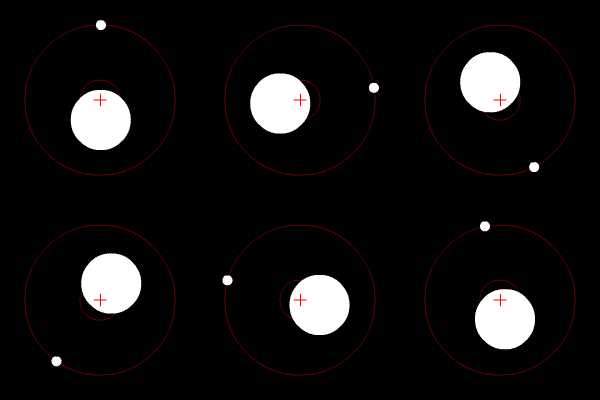
gravitational acceleration
acceleration of an object caused by gravity

geoid
thumb|upright=1.5|Map of the undulation of the geoid in meters (based on the EGM96 gravity model and the [[WGS84 reference ellipsoid).]]
gal
unit of acceleration

g-force
thumb|In straight and level flight, lift (L) equals weight (W). In a steady level banked turn of 60°, lift equals double the weight (L = 2W). The pilot experiences 2 g and a doubled weight. The steeper the bank, the greater the g-forces.
thumb|This Top Fuel dragster can accelerate from zero to in 0.86 seconds. This is a horizontal acceleration of 5.3 g. Combining this with the vertical g-force in the stationary case using the [[Pythagorean theorem yields a g-force of 5.4 g.]]

gravimetry
thumb|upright|An Autograv CG-5 gravimeter being operated
gravimeter
REDIRECT Gravimetry#Gravimeters

Gravity Recovery and Interior Laboratory
thumb|right|MoonKAM shot
The Gravity Recovery and Interior Laboratory (GRAIL) was an American lunar science mission in NASA's Discovery Program which used high-quality gravitational field mapping of the Moon to determine its interior structure. The two small spacecraft, GRAIL A (Ebb) and GRAIL B (Flow), were launched on 10 September 2011 aboard a single launch vehicle: the most-powerful configuration of a Delta II, the 7920H-10. GRAIL A separated from the rocket about nine minutes after launch, GRAIL B followed about eight minutes later. They arrived at their orbits around the Moon 25 hours ap
gravity anomaly
difference between the observed acceleration of a planet's gravity and a value predicted from a model
mass concentration
region of a planet or moon's crust that contains a large positive gravitational anomaly

geopotential
Geopotential (symbol W) is the potential of the Earth's gravity field. It has SI units of square metre per square seconds (m2/s2). For convenience it is often defined as the of the potential energy per unit mass, so that the gravity vector is obtained as the gradient of the geopotential, without the negation. In addition to the actual potential (the geopotential), a theoretical normal potential (symbol U) and their difference, the disturbing potential (), can also be defined.
Eötvös experiment
physics experiment

gravity gradiometry
measurement of variations in Earth's gravitational field
Deep Space Atomic Clock
Atomic clock used for radio navigation in space
Bouguer anomaly
a gravity anomaly
Clairaut's theorem
formula for the surface gravity on a viscous rotating ellipsoid in hydrostatic equilibrium under the action of its gravitational field and centrifugal force
Allais effect
Alleged anomalous behavior of pendulums or gravimeters
physical geodesy
study of the physical properties of the Earth's gravity field as part of Higher Geodesy
Indian Ocean Geoid Low
gravity anomaly in the Indian Ocean
Free-air gravity anomaly
theoretical gravity
Mathematical model of Earth's gravity