Category
page 1Gravitational lensing

cosmic microwave background
electromagnetic radiation as a remnant from an early stage of the universe in Big Bang cosmology
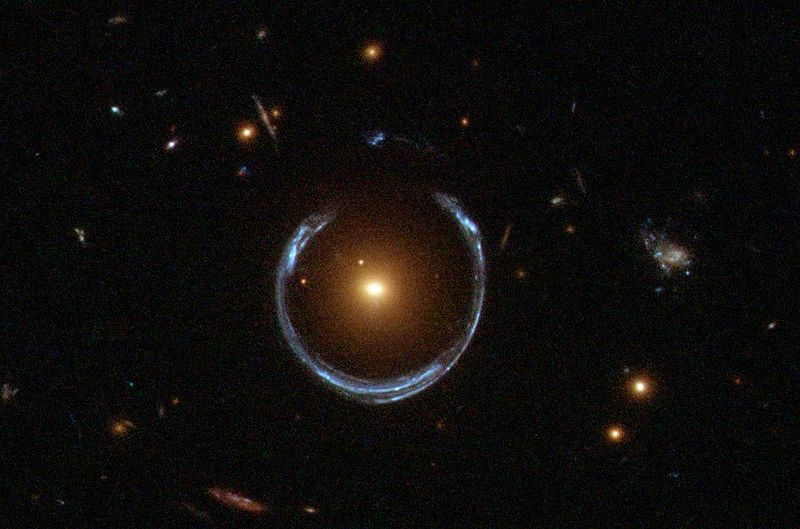
gravitational lens
distribution of matter between a distant light source and a observer
Einstein Cross
image of a quasar
Einstein ring
an image of a distant light source (such as a galaxy or star) which has been distorted into a ring through gravitational lensing caused by an object with an extremely large mass (such as another galaxy or a black hole)
NGC 6505
galaxy
MACS J1149 Lensed Star 1
blue supergiant, the most distant star detected at 9 billion light years from Earth
Abell 1689
galaxy cluster
Bohdan Paczyński
Polish astronomer (1940-2007)
Optical Gravitational Lensing Experiment
long-term variability sky survey
Twin Quasar
gravitationally lensed quasar
gravitational microlensing
astronomical phenomenon due to the gravitational lens effect
A1689-zD1
A1689-zD1 is a galaxy in the Virgo constellation. It was a candidate for the most distant and therefore earliest-observed galaxy discovered , based on a photometric redshift.
Abell 2667
galaxy cluster

OGLE-2005-BLG-390L
OGLE-2005-BLG-390L is a star thought to be a spectral type M (a red dwarf; 95% probability, 4% probability it is a white dwarf, <1% probability it is a neutron star or black hole). This galactic bulge star is located in the Scorpius constellation at a far distance of about 21,500 light years, near the border with Sagittarius.

OGLE-2006-BLG-109L
OGLE-2006-BLG-109L (where the last 'L' stands for lens) is a dim magnitude 17 M0V galactic bulge star approximately 4,920 light-years away in the constellation of Scorpius.
OGLE-2005-BLG-169L
OGLE-2005-BLG-169L is a dim and distant magnitude 20 galactic bulge star located about 2,700 parsecs away in the constellation Sagittarius. If it is a main sequence star, then it is most likely a red dwarf with about half of the mass of the Sun. Other possibilities are a white dwarf star, or (less likely) a neutron star or black hole.
MOA-2007-BLG-192L
Redirect MOA-2007-BLG-192Lb#Host star
Einstein radius
measurement of light ray bending from a gravitational lens
Microlensing Observations in Astrophysics
astronomical research project
SN Refsdal
supernova
OGLE 2003-BLG-235L
OGLE-2003-BLG-235L (MOA-2003-BLG-53L) is a star in the constellation of Sagittarius. The first gravitational microlensing event for which a planet orbiting the lens was detected around this star. The event occurred in during July 2003. Two groups observed and independently detected the event: the Optical Gravitational Lensing Experiment (OGLE) and the Microlensing Observations in Astrophysics (MOA), hence, the double designation. It is an orange dwarf star of spectral type K, which is accompanied by a giant planet.
EWS 2005-BLG-71
OGLE-2005-BLG-071L is a distant, magnitude 19.5 galactic bulge star located in the constellation Scorpius, approximately 11,000 light years away from the Solar System. The star is probably a red dwarf with a mass 43% of that of the Sun.
strong gravitational lensing
effect strong enough to produce multiple images, arcs, or even Einstein rings

MOA-2007-BLG-400L
MOA-2007-BLG-400L is a star located 22472.1 light-years (6890 parsecs) away in the constellation of Sagittarius. This star is presumed to be a red dwarf with a spectral type of M3V, based on its mass of 0.35 M☉.
SDSSJ0946+1006
thumb|right|300px|SDSSJ0946+1006 gravitational lens
SDSSJ0946+1006 is an unusual gravitational lens system consisting of three galaxies at distances of respectively three, six, and eleven billion light years from Earth. In a report presented at the 211th meeting of the American Astronomical Society, researchers Raphael Gavazzi and Tommaso Treu of the University of California, Santa Barbara described the discovery of a double Einstein ring produced by the gravitational lensing of light from two distant galaxies. The observations were made using the Hubble Space Telescope.

Godzilla Star
variable star
weak gravitational lensing
gravitational deflection of light without creating noticeable extra images
Probing Lensing Anomalies Network
network of optical astronomical telescopes used for photometry
PA-99-N2
PA-99-N2 is a microlensing event detected in the direction of the Andromeda Galaxy in 1999.
QSO B1359+154
Quasar
Deep Lens Survey
Gravitational lensing survey
Huchra's lens
quasar
MOA 2009-BLG-387
MOA-2009-BLG-387L is a red dwarf in the Sagittarius constellation that is host to the planet MOA-2009-BLG-387Lb. The star is estimated to be nearly 20,000 light years away and approximately one fifth the mass of the Sun, although large confidence intervals exist, reflecting the uncertainties in both the mass and distance. The star drew the attention of astronomers when it became the lens of gravitational microlensing event MOA-2009-BLG-387L, in which it eclipsed a background star and created distorted caustics, an envelope of reflected or refracted light rays. Analysis of the caustic events an