Category
page 1Gravity
.jpg)
gravity
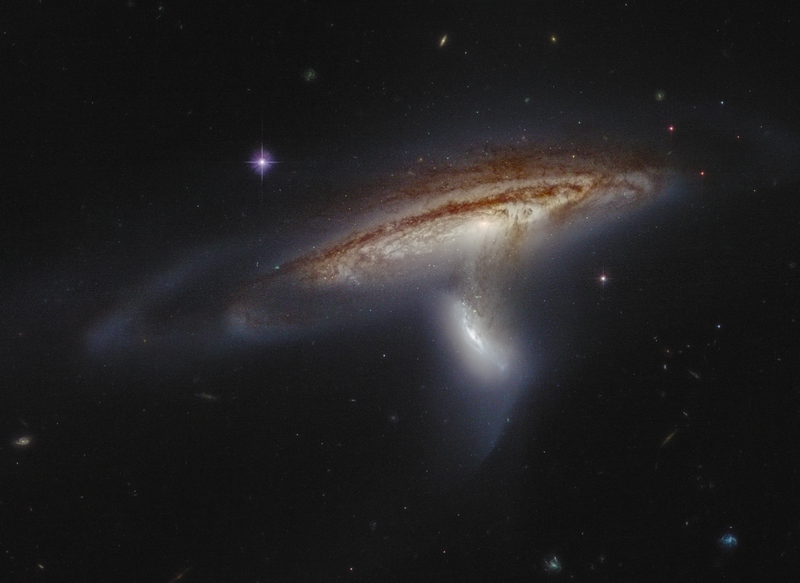
thumb|upright=1.35|The shapes of two massive galaxies in this image evolved under the effects of gravity.

orbit
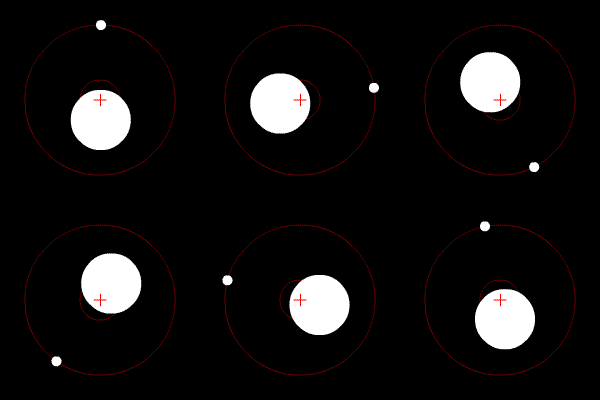
right|thumb|Variation of orbital eccentricity

geomorphology
thumb|upright=1.4|Badlands incised into [[shale at the foot of the North Caineville Plateau, Utah, within the pass carved by the Fremont River and known as the Blue Gate. G. K. Gilbert studied the landscapes of this area in great detail, forming the observational foundation for many of his studies on geomorphology.]]
thumb|Surface of Earth, showing higher elevations in red

Newtonian gravitational constant
physical constant relating the gravitational force between objects to their mass and distance
gravitational acceleration
acceleration of an object caused by gravity

wormhole
thumb|upright=1.3|A wormhole visualized as a two-dimensional surface. Route (a) is the shortest path through normal space between points 1 and 2; route (b) is a shorter path through a wormhole.

free fall
motion of a body where its weight is the only force acting upon it; any motion of a body where gravity is the only force acting upon it

white hole
hypothetical region of spacetime that serves as the opposite of a black hole

weightlessness
thumb|upright=1.35|Astronauts on the International Space Station experience only microgravity and thus display an example of weightlessness. [[Michael Foale can be seen exercising in the foreground.]]

Roche limit
astronomical concept
tidal force
secondary effect of the force of gravity of one body on another
gravity of Earth
acceleration that the Earth imparts to objects on or near its surface
levitation
physical process by which an object is held aloft, without mechanical support, in a stable position
gravitational potential
scalar potential that describes a gravitational field
Roche lobe
Teardrop-shaped spacetime distortion near binary stars
artificial gravity
inertial force that mimics the effects of gravity, usually by rotation
Cavendish experiment
gravity experiment
gravitational energy
type of potential energy
microgravity
environment with extremely low apparent gravitational force
surface gravity
standard surface gravity
N-body problem
problem of predicting the individual motions of a group of celestial objects interacting with each other gravitationally
standard acceleration of free fall
standard gravitational acceleration on Earth's surface
gravitational-wave astronomy
type of astronomy involving observation of gravitational waves
exotic matter
unusual or hypothetical physical substance or state

quadrupole
A quadrupole or quadrapole is one of a sequence of configurations of things like electric charge or current, magnetic fields, or gravitational mass that can exist in ideal form, but it is usually just part of a multipole expansion of a more complex structure reflecting various orders of complexity.
introduction to general relativity
non-technical introduction to the theory of gravity by Albert Einstein
negative mass
hypothetical type of exotic matter whose mass is of opposite sign to the mass of normal matter
intelligent falling
parody of intelligent design
gravitation of the Moon
stellar dynamics
branch of astrophysics that statistically models the collective movement of stars
Hypotheses non fingo
famous phrase used by Isaac Newton in one of his essays
Schiehallion experiment
experiment to determine the mean density of the Earth
Einstein–Hilbert action
Action that yields the Einstein field equations through the principle of least action
Shell theorem
Simplified gravity models for objects inside or outside a spherically symmetrical body
gravitational binding energy
minimum energy to remove a system from a gravitationally bound state
gravity train
type of train
equations for a falling body
mathematical description of a body in free fall
flyby anomaly
unexplained observed excessive energy during Earth flybys of spacecraft

vertical deflection
lunar theory
theoretical description of motion of Earth's moon
Schrödinger–Newton equations
nonlinear modification of the Schrödinger equation
N-body simulation
simulation of a dynamical system of particles
Gravity of Mars
gravitational force exerted by the planet Mars
Barnes–Hut simulation
approximation algorithm for performing an n-body simulation
physical geodesy
study of the physical properties of the Earth's gravity field as part of Higher Geodesy
gravitational biology
Study of the effects gravity has on living organisms
Self-gravitation
thumb|A self-gravitating accretion disc in a quasi steady state
Self-gravity is gravitational force exerted by a system, particularly a celestial body or system of bodies, onto itself. At a sufficient mass, this allows the system to hold itself together.
The effects of self-gravity have significance in the fields of astronomy, physics, seismology, geology, and oceanography.
Homoeoid
shell bounded by two concentric, similar ellipses or ellipsoids
Lemaître–Tolman metric
Lorentzian metric describing an isotropic, expanding, nonhomogenous universe
Lemaître coordinates
particular set of coordinates for the Schwarzschild metric
hypergravity
thumb|Michael Collins (astronaut)|Michael Collins during centrifuge training
Hypergravity is defined as the condition where the force of gravity (real or perceived) exceeds that on the surface of the Earth. This is expressed as being greater than 1 g. Hypergravity conditions are created on Earth for research on human physiology in aerial combat and space flight, as well as testing of materials and equipment for space missions. Manufacturing of titanium aluminide turbine blades in 20 g is being explored by researchers at the European Space Agency (ESA) via an 8-meter wide Large Diamet
Painlevé conjecture
Physical theorem
Peres metric
Metric in relativity