Category
page 1Greek literature (post-classical)

New Testament
second division of the Christian biblical canon

Babrius
thumb|The fables of Babrius
Babrius (, Bábrios; ), also known as Babrias () or Gabrias (), was the author of a collection of Greek fables, many of which are known today as Aesop's Fables.
Greek Anthology
ancient collection of short poems
hyperbaton
Hyperbaton , in its original meaning, is a figure of speech in which a phrase is made discontinuous by the insertion of other words. In modern usage, the term is also used more generally for figures of speech that transpose sentences' natural word order, which is also called anastrophe.

Tetrabiblos
thumb|Quadripartitum, 1622

Deipnosophistae
right|thumb|Frontispiece to the 1657 edition of the Deipnosophists, edited by Isaac Casaubon, in Greek and [[Jacques Daléchamps' Latin translation]]
Palatine Anthology
collection of Greek poems
Chaldean Oracles
set of spiritual and philosophical texts widely used by Neoplatonist philosophers from the 3rd to the 6th century CE
On the Sublime
work by Pseudo-Longinus
The True Word
treatise by Celsus criticising Christianity
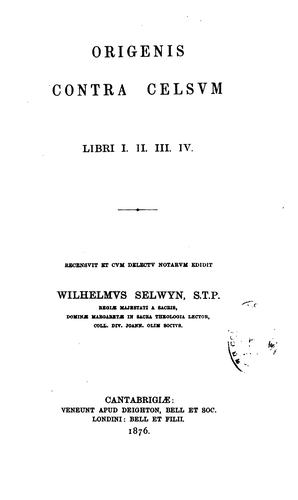
Contra Celsum
treatise by Origen

Chronicon
4th-century work by St. Jerome
On First Principles
theological treatise by Origen
Anacreontea
Anacreontea () is the title given to a collection of some sixty Greek poems on the topics of wine, beauty, erotic love, and the worship of Dionysus. The poems themselves appear to have been composed over a long period of time, dating to between the 1st century BC and the 6th century AD, and is attributed pseudepigraphically to Anacreon.

Letter to Flora
Gnostic text written by Ptolemy
Hermeneumata
The Hermeneumata (; also known as the Hermeneumata Pseudodositheana or Hermeneumata pseudo-Dositheana) are anonymous instructional manuals written in the third century CE to teach the Greek language to Latin-speaking people in the Roman Empire, and to teach Latin to Greek-speakers. The word Hermeneumata means "translations" or "interpretations".
Apology of Aristides
2nd century Christian text