Category
page 1Green River Formation

Esox
Esox is a genus of freshwater fish commonly known as pike or pickerel. It is the type genus of the family Esocidae. The type species of the genus is Esox lucius, the northern pike.

Gastornis
Gastornis is an extinct genus of large, flightless birds that lived during the mid-Paleocene to mid-Eocene epochs of the Paleogene period. Most fossils have been found in Europe, and some species typically referred to the genus are known from North America and Asia. Several genera, including the well-studied genus Diatryma, have historically been considered junior synonyms of Gastornis. However, this interpretation has been challenged recently, and some researchers currently consider Diatryma to be a valid genus.

moissanite
Moissanite () is naturally occurring silicon carbide and its various crystalline polymorphs. It has the chemical formula SiC and is a rare mineral, discovered by the French chemist Henri Moissan in 1893. Silicon carbide or moissanite is useful for commercial and industrial applications due to its hardness, optical properties, and thermal conductivity.

abelsonite
Abelsonite is a nickel porphyrin mineral with chemical formula C31H32N4Ni. It was discovered in 1969 in the U.S. State of Utah and described in 1975. The mineral is named after geochemist Philip H. Abelson. It is the only known crystalline geoporphyrin.

trona
Trona (trisodium hydrogendicarbonate dihydrate, also sodium sesquicarbonate dihydrate, Na2CO3·NaHCO3·2H2O) is a non-marine evaporite mineral. It is mined as the primary source of sodium carbonate in the United States, where it has replaced the Solvay process used in most of the rest of the world for sodium carbonate production. Turkey is also a major producer.

Icaronycteris
Icaronycteris is an extinct genus of microchiropteran (echolocating) bat that lived in the early Eocene, approximately , making it the earliest bat genus known from complete skeletons, and the earliest known bat from North America.

Onychonycteris finneyi
Onychonycteris was the more primitive of the three oldest bats known from complete skeletons, having lived in the area that is current day Wyoming during the Eocene period, 52.5 million years ago.

nahcolite
Nahcolite is a soft, colourless or white carbonate mineral with the composition of sodium bicarbonate (NaHCO3) also called thermokalite. It crystallizes in the monoclinic system.

Diplomystus
Diplomystus is an extinct genus of freshwater and marine clupeomorph fish distantly related to modern-day extant herrings, anchovies, and sardines. It is known from the United States, Canada, China, Uzbekistan and Lebanon from the Late Cretaceous to the middle Eocene. Many other clupeomorph species from around the world were also formerly placed in the genus, due to it being a former wastebasket taxon. It was among the last surviving members of the formerly-diverse order Ellimmichthyiformes, with only its close relative Guiclupea living for longer.
Knightia
Knightia is an extinct genus of clupeid bony fish that lived in the freshwater lakes and rivers of North America and Asia during the Eocene epoch. The genus was erected by David Starr Jordan in 1907, in honor of the late University of Wyoming professor Wilbur Clinton Knight, "an indefatigable student of the paleontology of the Rocky Mountains." It is the official state fossil of Wyoming, and the most commonly excavated fossil fish in the world.
Priscacara
thumb|right|upright|Cockerellites|Cockerellites liops
Heliobatis
Heliobatis is an extinct genus of stingray in the Myliobatiformes family Dasyatidae. At present the genus contains the single species Heliobatis radians.
Gallinuloides wyomingensis
Gallinuloides is a prehistoric genus of pangalliform bird. It lived about 48 million years ago in North America. The type specimen was found in a Green River Formation deposit in Wyoming.
Pseudocrypturus cercanaxius
Pseudocrypturus is a genus of extinct paleognathous bird. Three species are known and the type species is Pseudocrypturus cercanaxius. It is a relative of such modern birds as ostriches. It lived in the early Eocene.
The holotype fossil is in the collection of the Smithsonian's National Museum of Natural History. It has catalog number USNM 336103. It was collected from the Fossil Butte Member, Green River Formation, Lincoln County, Wyoming.
Mioplosus
Mioplosus is an extinct genus of lates perches that lived from the early to middle Eocene (about 56 to 33.9 million years ago). Five species of the genus has been described, Mioplosus labracoides is found in the Green River Formation Lagerstätte.
Erismatopterus
Erismatopterus is an extinct genus of percopsiform fish which lived during the early to middle Eocene epoch and containing the single species Erismatopterus levatus. A report of the genus in sediments of similar age in Washington State have been discredited. Erismatopterus is treated as part of the family Percopsidae, but formerly was the type genus of the extinct family Erismatopteridae. The genus is closely related to Amphiplaga of related lake sediments. Shoaling behavior has been reported from a mass mortality fossil of E. levatus and attributed as a predator-evasion response behavior.
Asineops
Asineops is an enigmatic genus of extinct freshwater ray-finned fish from the Eocene. It is the only member of the family Asineopidae and contains a single species, A. squamifrons, from the famous Green River Formation of Colorado, Wyoming, and Utah. It was described by Edward Drinker Cope in 1870. The name comes from the Greek for "donkey-faced".
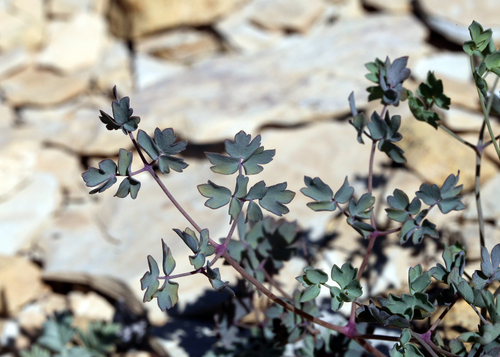
Thalictrum heliophilum
species of plant