Category
page 1Hacker culture

Hacker
thumb|upright=1.35|Participants in the Coding da Vinci hackathon, [[Berlin, Germany, April 26–27, 2014|alt=A group of people working on laptop computers at a common table]]

hackathon
thumb|A Wikimedia Hackathon in [[Prague]]
A hackathon (also known as a hack day, hackfest, datathon or codefest; a portmanteau of hacking and marathon) is an event where people engage in rapid and collaborative engineering over a relatively short period of time, such as 24 or 48 hours in person or several days online. They are often run using agile software development practices, such as sprint-like design wherein computer programmers and others involved in software development, including graphic designers, interface designers, product managers, domain experts, and others collaborate intensive

xkcd
xkcd (sometimes styled XKCD) is a serial webcomic created in 2005 by American author Randall Munroe. The comic's tagline describes it as "a webcomic of romance, sarcasm, math, and language". Munroe states on the comic's website that the name of the comic is not an acronym but "just a word with no phonetic pronunciation".
iOS jailbreaking
removal of limitations on Apple's iOS devices

Jaron Lanier
American computer scientist, musician, and author

hackspace
thumb|upright|A Germany|German hackerspace ([[RaumZeitLabor)]]
A hackerspace (also referred to as a hacklab, hackspace, or makerspace) is a community-operated, often "not for profit" (501(c)(3) in the United States), workspace where people with common interests, such as computers, machining, technology, science, digital art, or electronic art, can meet, socialize, and collaborate. Hackerspaces are comparable to other community-operated spaces with similar aims and mechanisms such as Fab Lab, men's sheds, and commercial "for-profit" companies.

hacktivism
thumbnail|upright=1.2|Anarchist hacker village at a Hackers On Planet Earth (HOPE) conference, 2018
Hacktivism (or hactivism; a portmanteau of hack and activism) is the use of computer-based techniques such as hacking as a form of civil disobedience to promote a political agenda or social change. A form of Internet activism with roots in hacker culture and hacker ethics, its ends are often related to free speech, human rights, or freedom of information movements.
life hack
trick to make life easier
disk image
computer file containing the contents and structure of a disk volume
Club-Mate
Club-Mate () is a caffeinated carbonated mate-extract beverage made by the Loscher Brewery (Brauerei Loscher) in Münchsteinach, Germany, which originated in 1924. Club-Mate has 20 mg of caffeine per 100 ml, sugar content of 5 g per 100 ml, and 20 kcal per 100 ml, which is lower than most energy drinks. Club-Mate is available in 0.33-litre and 0.5-litre bottles.
script kiddie
pejorative term for an unskilled hacker who uses scripts instead of coding on their own
Hacker Manifesto
manifesto from 1986 by Loyd Blankenship
fab lab
space for digital fabrication and use of communal tools
lock picking
practice of unlocking a lock without the original key
Free Software Song
1993 single by Richard Stallman
maker culture
community interested in do-it-yourself (technical) pursuits, from repairing household items to producing one's own food, clothes or technical items
NFO
In the Warez scene, .nfo (short for info) is a file name extension for a text file (sometimes called an NFO file) that accompanies and describes a release of pirated software or media. The file contains information such as title, authorship, year and license information. For software, it might contain installation notes. This information is delivered for publishing through digital media to make it searchable on the web as well as within local catalogues and libraries. This type of file is also often found in a demoscene production, where the respective group includes it for credits, contact de
hacker culture
subculture of individuals

Piratbyrån
'''''' ( "The Pirate Bureau") was a Swedish think tank established to support the free sharing of information, culture, and intellectual property. provided a counterpoint to lobby groups such as the Swedish Anti-Piracy Bureau.
Homebrew Computer Club
computer hobbyist users' group in California
ROM hacking
process of modifying a ROM image or ROM file of a video game
Ars Electronica
Austrian cultural, educational and scientific institute
Editor war
rivalry between users of Emacs and Vim
DIY biology
biotechnological social movement
body hacking
application of the hacker ethic to improve their own bodies with do-it-yourself cybernetic devices
luser
Before the popularization of the Internet in the 1990s, Internet slang defined a luser (sometimes expanded to local user; also luzer or luzzer) as a painfully annoying, stupid, or irritating computer user.
The word is a blend of "loser" and "user". Among hackers, the word luser takes on a broad meaning, referring to any normal user (in other words, not a "guru"), with the implication the person is also a loser. The term is partially interchangeable with the hacker term lamer.
Hacker Emblem
logo
hacker ethic
moral values and philosophy that are common in hacker culture
.jpg)
c-base
thumb|325px|Wikipedia community|Wikipedians from Berlin meet at the c-base.c-base e.V. is a non-profit association located in Berlin, Germany. Its purpose is to increase knowledge and skills pertaining to computer software, hardware and data networks. The association is engaged in numerous related activities. For example, the society has had stands at large festivals, such as Children's Day, where they introduce young people to topics like robotics and computer-aided design.

Naomi Wu
Chinese DIY maker
April Fools' Day Request for Comments
humorous technical standard proposal
Incompatible Timesharing System
time-sharing operating system developed by MIT
Neophile
Neophile or Neophiliac, a term popularised by author Robert Anton Wilson, is a personality type characterized by a strong affinity for novelty. The term was used earlier by Christopher Booker in his 1969 book The Neophiliacs, and by J. D. Salinger in his 1965 short story "Hapworth 16, 1924".
Hackers on Planet Earth
conference series
Shoulder surfing
using direct observation techniques, such as looking over someone's shoulder, to get information
Honker Union
group known for hacktivism, mainly present in Mainland China
Warez scene
organized network of pirate groups
Metalab
right|thumb|250px|Metalab in Vienna, Austria.
Retr0bright
thumb|A TRS-80 Color Computer showing significant yellowing
thumb|The same computer after treatment, showing yellowing largely reversed
Jason Scott
American technology historian and archivist
Evan Roth
American artist (born 1978)
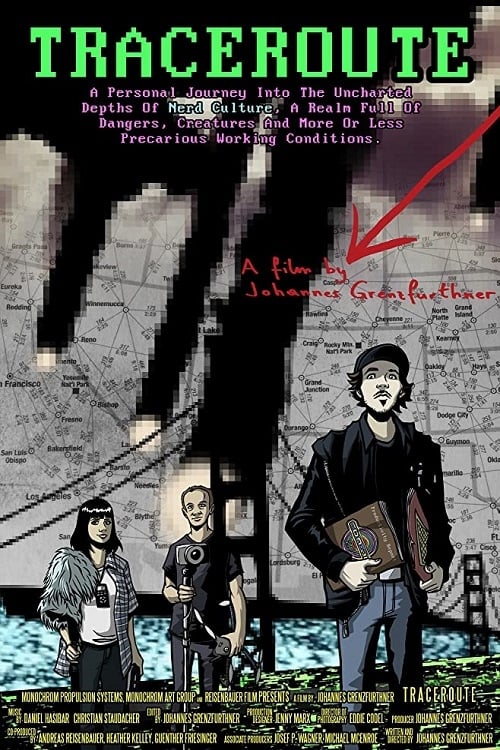
Traceroute
2016 film by Johannes Grenzfurthner
Hackers: Heroes of the Computer Revolution
essay by Steven Levy
mapathon
A mapathon (sometime written map-a-thon) is a coordinated mapping event and a kind of editathon. The public is invited to make online map improvements in their local area to improve coverage and to help disaster risk assessment and energy management.

Chema Alonso
Spanish executive and hacker
The Innovators: How a Group of Inventors, Hackers, Geniuses, and Geeks Created the Digital Revolution
book by Walter Isaacson
list of hackers
Wikimedia list article
monochrom
thumb|right|Monochrom members: Harald Homolka-List, Frank Apunkt Schneider, Anika Kronberger, Günther Friesinger, Evelyn Fürlinger, Roland Gratzer, Franz Ablinger, Johannes Grenzfurthner, Daniel Fabry. Image taken in Lower Austria, April 2012.
thumb|Art-theory group Monochrom's office and workspace at Museumsquartier's Quartier21 (December 2018)