Category
page 1Haemulinae

Pomadasys
Pomadasys is a genus of grunts native to the waters of the eastern Atlantic Ocean and through the Indian Ocean to the Pacific coast of the Americas. The name of this genus is a compound of poma meaning "lid" or "covering" and dasys meaning "rough", a reference to the serrated preopercle.

Haemulon
Haemulon is a genus of fish in the grunt family known as the scaled-fin grunts. Most are found in the western Atlantic Ocean, with a few species known from the eastern Pacific Ocean. This genus is considered to be one of the most important fish groups of the coral reefs of Brazil due to its commercial value and crucial ecological role.

Bigeye grunt
species of fish
Orthopristis
Orthopristis is a genus of marine ray-finned fish, grunts belonging to family Haemulidae. They are found in the Atlantic and Pacific coasts of the Americas.
Conodon
Conodon, from Ancient Greek κῶνος (kōnos), meaning "cone", and ὀδούς (odoús), meaning "tooth", is a genus of grunts native to the Pacific and Atlantic coasts of the Americas.
The currently recognized species in this genus are:
Conodon macrops Hildebrand, 1946 (lemoneye grunt)
Conodon nobilis Linnaeus, 1758 (barred grunt)
Conodon serrifer D. S. Jordan & C. H. Gilbert, 1882 (armed grunt)

Boridia grossidens
species of fish
Microlepidotus
Microlepidotus is a genus of grunts native to the Pacific coast of North America.
The currently recognized species in this genus are:
Microlepidotus brevipinnis (Steindachner, 1869) (humpback grunt)
Microlepidotus inornatus T. N. Gill, 1862 (wavyline grunt)
Xenichthys
Xenichthys is a genus of grunts native to the eastern Pacific Ocean.

Conodon nobilis
species of fish
Haemulopsis
Haemulopsis is a genus of marine ray-finned fish, grunts belonging to the family Haemulidae. They are native to the western Atlantic Ocean and, mainly, to the eastern Pacific Ocean.
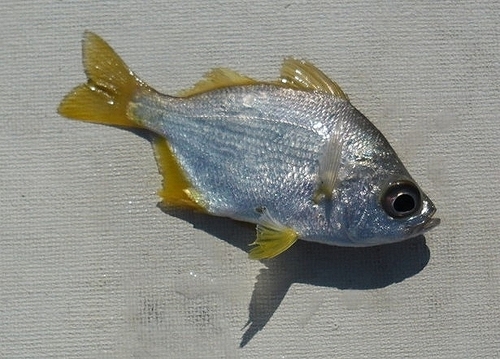
Parakuhlia macrophthalmus
species of fish
Isacia
Isacia conceptionis, the Cabinza grunt, is a species of grunt native to the Pacific Coast of South America and Nicaragua. It can be found at depths of in areas with rocky or sandy substrates. This species grows to in TL, with a maximum known weight of . It is important to local commercial fisheries. I. conceptionis is the only valid member of its genus.