Category
page 1Hand percussion

bell
A bell () is a directly struck idiophone percussion instrument. Most bells have the shape of a hollow cup that—when struck—vibrates in a single strong strike tone, with its sides forming an efficient resonator. The strike may be made by an internal "clapper" or "uvula", an external hammer, or—in small bells—by a small loose sphere enclosed within the body of the bell (jingle bell).

tambourine
The tambourine is a musical instrument in the percussion family consisting of a frame, often of wood or plastic, with pairs of small metal jingles, called "zills". Classically the term tambourine denotes an instrument with a drumhead, though some variants may not have a head. Tambourines are often used with regular percussion sets. They can be mounted, for example on a stand as part of a drum kit (and played with drum sticks), or they can be held in the hand and played by tapping, hitting, or shaking the instrument.
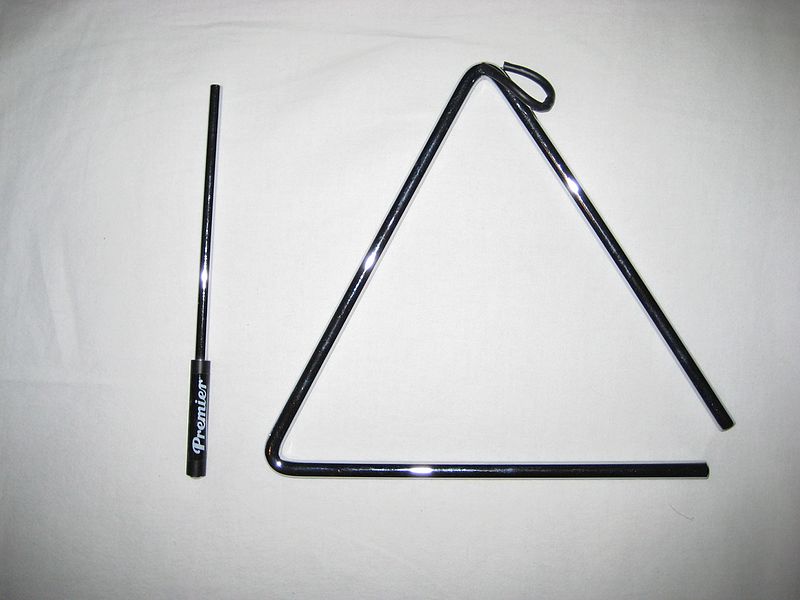
triangle
idiophone type of musical instrument in the percussion family

castanets
thumb|200px| Castanets seller in Granada, [[Spain]]
thumb|198px|Pierre-Auguste Renoir's 1909 painting Dancing girl with castanets
Castanets, also known as clackers or palillos, are a percussion instrument (idiophonic), used in Spanish, Calé, Moorish, Ottoman, Greek, Italian, Mexican, Sephardic, Portuguese, Filipino, Brazilian, and Swiss music. In ancient Greece and ancient Rome there was a similar instrument called the crotalum.
maraca
A maraca ( , , ), sometimes called shaker or chac-chac, is a rattle which appears in many genres of Caribbean and Latin music. It is shaken by a handle and usually played as part of a pair. A maraca player in the Spanish language is called a .

bodhrán
The bodhrán (, ; plural bodhráin) is a frame drum used in Irish music ranging from in diameter, with most drums measuring . The sides of the drum are deep. A goatskin head is tacked to one side (synthetic heads or other animal skins are sometimes used). The other side is open-ended for one hand to be placed against the inside of the drum head to control the pitch and timbre.
ratchet
percussion instrument

claves
Claves (; ) are a percussion instrument consisting of a pair of short, wooden sticks about 20–25 centimeters (8–10 inches) long and about 2.5 centimeters (1 inch) in diameter. Although traditionally made of wood (typically rosewood, ebony or grenadilla) many modern manufacturers offer claves made of fiberglass or plastic.
agogô
An agogô () is idiophone bell percussion instrument. With origins in West African music, it is now commonly used in traditional and popular Brazilian music. Agogôs are typically made from two cone-shaped pieces of metal with different pitches.

rainstick
thumb|300x300px|Traditional cactus rainsticks

handbell
A handbell is a bell designed to be rung by hand. To ring a handbell, a ringer grasps the bell by its slightly flexible handle – traditionally made of leather, but often now made of plastic – and moves the arm to make the hinged clapper strike the inside of the bell. An individual handbell can be used simply as a signal to catch people's attention or summon them together, but handbells are also often heard in tuned sets.
toy rattle
rattle for very young children
cabasa
The cabasa, similar to the shekere, is a percussion instrument that is constructed with loops of steel ball chain wrapped around a wooden cylinder. The cylinder is fixed to a long, wooden or plastic handle.
wood block
musical instrument

flexatone
thumb|Suggested notation of music for flexatone, using roll symbols for the tremolo and approximate pitch
thumb|Rhythmic pattern easily playable on the flexatone
rattle
class of musical instruments
bones
musical instrument
clash cymbals
cymbals played in matched pairs
thunder sheet
percussion instrument
clapper
musical instrument
headless tambourine
percussion instrument of the family of idiophones, consisting of a frame, often of wood or plastic, with pairs of small metal jingles
handchime
Handchimes are musical instruments which are rung by hand, similar to handbells. Typically, they are tuned square tubes with an external clapper mechanism.
Many handbell techniques can also be applied to handchimes, though some are more difficult (such as six-in-hand) or impossible (malleting). On a music score, handchimes are indicated by a diamond shape on each note as opposed to an oval shape.
Boomwhacker
thumb|240px|A large pile of pentatonic Boomwhackers
paiban
thumb|200px|Painting of a musician playing a paiban. Mogao Caves, cave 159, paiban
thumb|right|155px|A paiban used in Chaozhou people|Chaozhou music
The () is a clapper made from several flat pieces of hardwood or bamboo (or, formerly, sometimes also ivory or metal), which is used in many different forms of Chinese music. There are many different types of , and the instrument is also referred to as , , , or . Typical materials used for the include , , or , or bamboo, with the slats tied together loosely on one end with cord. It is held vertically by one hand and clapped together, producing a s
jam block
modern percussion instrument, hard plastic version of the wood block
monkey stick
English percussion instrument