Category
page 1Harmony
melody
thumb|A bar from Johann Sebastian Bach|J. S. Bach's [[Fugue No. 17 in A-flat, BWV 862, from The Well-Tempered Clavier (Part I), an example of counterpoint. The two voices (melodies) on each staff can be distinguished by the direction of the stems and beams.thumbthumb|Voice 1thumb|Voice 2thumb|Voice 3thumb|Voice 4]]

harmony
thumb|right|upright=1.35|Barbershop quartets, such as this US Navy Band ensemble, sing four-part pieces, made up of a [[melody line (normally the lead) and three harmony parts. ]]
In music, harmony is the concept of combining different sounds in order to create new, distinct musical ideas. Theories of harmony seek to describe or explain the effects created by distinct pitches or tones coinciding with one another; harmonic objects such as chords, textures and tonalities are identified, defined, and categorized in the development of these theories. Harmony is broadly understood to involve both a

chord
harmonic set of three or more notes

polyphony
Polyphony ( ) is a type of musical texture consisting of two or more simultaneous lines of independent melody, as opposed to a musical texture with just one voice (monophony) or a texture with one dominant melodic voice accompanied by chords (homophony).

tonal system
Tonality is the arrangement of pitches and/or chords of a musical work in a hierarchy of perceived relations, stabilities, attractions, and directionality.

homophony
thumb|right|400px|Homophony in Thomas Tallis|Tallis' "[[If Ye Love Me", composed in 1549. The soprano sings the melody (the primary line) while the lower voices fill out the harmony (as supporting lines). The rhythmic unison in all the parts makes this passage an example of homorhythm.File:If ye love me.ogg]]
In music, homophony (;, Greek: , homóphōnos, from , homós, "same" and , phōnē, "sound, tone") is a texture in which a primary part is supported by one or more additional strands that provide the harmony. One melody predominates while the other parts play either single notes or an elaborat

arpeggio
thumb|A series of arpeggios in J. S. Bach's "Jesu, Joy of Man's Desiring" [[File:Bach Arpeggio.mid|400x400px]]
thumb|"The Star-Spangled Banner" opens with an arpeggio.[[File:The Star-Spangled Banner arpeggio.mid]]
thumb|upright=2|Arpeggios open Beethoven's "Moonlight Sonata" and continue as accompaniment[[File:Beethoven piano sonata 14 mvmt 1 bar 1-4.mid|500x500px]]
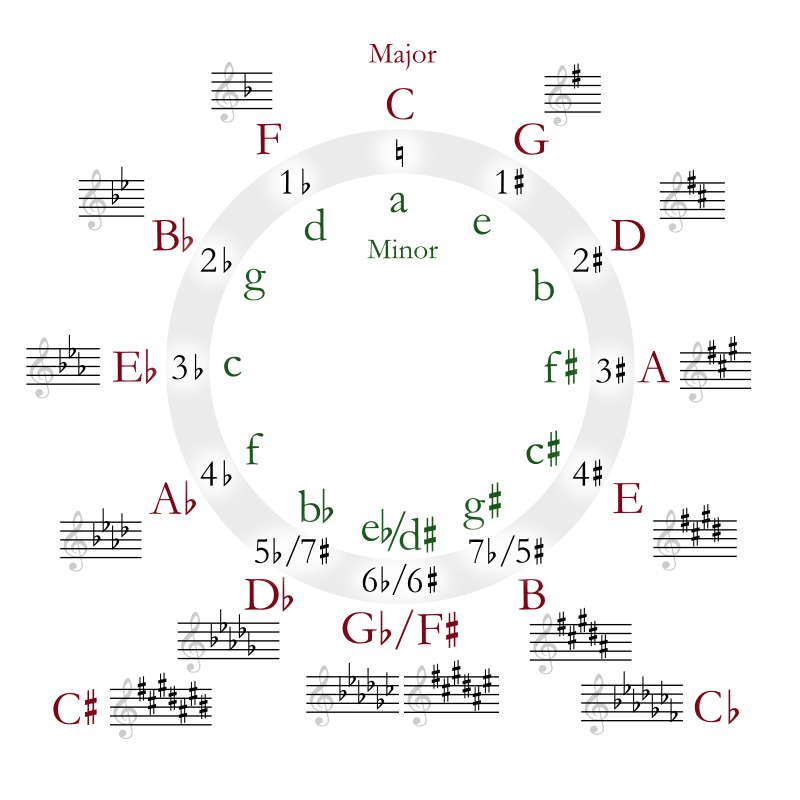
circle of fifths
relationship among the 12 tones of the chromatic scale, their corresponding key signatures, and the associated major and minor keys; geometrical representation of relationships among the 12 pitch classes of the chromatic scale in pitch class space
modulation
transition where a piece of music shifts between keys

monophony
thumb|350px|This melody for the traditional song "Pop Goes the Weasel" is monophonic as long as it is performed without chordal [[accompaniment. ]]
Harmonices Mundi
book by Johannes Kepler
chord progression
succession formed by the repetition of a melodic or harmonic motif at a higher or lower degree
sequence
immediate restatement of a motif at a higher or lower pitch in the same voice
inversion
musical term with meanings with respect to intervals, chords, voices, and melodies
parallel key
major and minor scales with the same tonic
false relation
type of dissonance in polyphonic music
major and minor
property of keys, scales, chords and music pieces
figure
shortest idea in music, a short succession of notes

harmonization
thumb|350px|right|Harmonised C major scale : I, ii, iii, IV, V7, vi, vii.
six-four chord
second inversion of the major triad
Tri Hita Karana
Balinese philosophy of harmony
jazz harmony
harmonic theories used in jazz
contrapuntal motion
movement of two melodic lines with respect to each other
limit
mathematical characterization of the harmonic complexity of music; way of characterizing the harmony found in a piece or genre of music, or the harmonies that can be made using a particular scale
common chord
chord formed by the root note, the third part of the same and a perfect fifth
Rule of the octave
Method of musical harmonization
diatonic and chromatic
terms in music theory to characterize scales
parallel harmony
in classical music, the parallel movement of two or more lines
Voice crossing
intersection of melodic lines in a composition