Category
page 1Hats

hat
thumb|A collection of 18th and 19th centuries men's beaver felt hats
thumb|upright|Woman in a Flowered Hat (1889), by Pierre-Auguste Renoir: Straw hat with brim decorated with cloth flowers and ribbons

fez
cone-shaped cap with a flat crown

beret
A beret ( , ; ; ; ) is a soft, round, flat-crowned cap made of hand-knitted wool, crocheted cotton, wool felt, or acrylic fibre.
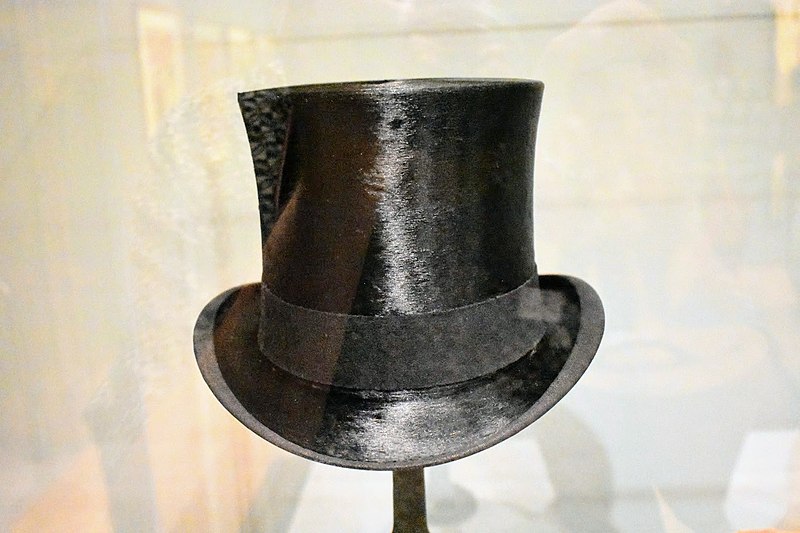
top hat
tall-crowned hat initially made of beaver felt and later, of silk plush

sombrero
The , also known as ('charro hat', referring to the traditional Mexican horsemen) and simply as in English, is a type of hat worn in Mexico. It features an extra-wide brim used to shield the face and eyes from the sun, that is slightly upturned at the edge; a usually high, conical, pointed crown; and a chin strap to hold it in place. Traditionally made of wool felt, hare fur, or wheat straw, it can be adorned with embroidery, decorative trim, or ribbons, with varying regional styles. The crown often has a reinforced band ("pedradas") for added strength in case of impact.

panama hat
traditional brimmed straw hat of Ecuadorian origin

bowler hat
hard, round-crowned hat with a narrow rolled brim

fedora
thumb|upright=1.2|A fedora made by Borsalino, with a pinch-front teardrop-shaped crown
thumb|A fedora made by Borsalino with a gutter-dent, side-dented crown, the front of the brim "snapped down" and the back "snapped up"

cockade
thumb|right|A woman fastening a Flag of Poland|red-and-white cockade to a Polish insurgent's square-shaped [[rogatywka cap during the January Uprising of 1863–64]]
straw hat
hat made of straw

papakhi
The papakha is a sheepskin hat worn by men throughout the Caucasus and also in uniformed regiments in the region and beyond.
thumb|A Caucasus|Caucasian wearing a papakha

Kalimavkion
thumb|Greek Orthodox clergyman wearing clerical kalimavkion.
thumb|Russian Orthodox style kamilavka
A kalimavkion (), kalymmavchi (καλυμμαύχι), or, by metathesis of the word's internal syllables, kamilavka (), is a clerical headdress worn by Orthodox Christian and Eastern Catholic monks (in which case it is black) or awarded to clergy (in which case it may be red or purple). An approximate equivalent in the Latin Church is the biretta ().

barretina
thumb|Catalan men wearing barretines
cowboy hat
high-crowned, wide-brimmed hat

tricorne
The tricorne or tricorn is a style of hat in a triangular shape, which became popular in Europe during the 18th century, falling out of style by the early 1800s. The word "tricorne" was not widely used until the mid-19th century. During the 18th century, hats of this general style were referred to as "cocked hats".
Tyrolean hat
type of hat originally from the Tyrol in the Alps

visor
thumb|Apollo 12 astronaut Alan Bean, wearing a helmet with visor, during the second moonwalk EVA near Sharp Crater.
thumb|Sports visor designed in Seoul, South Korea
thumb|An Arai GP5 racing drivers helmet tinted visor
A visor (also spelled vizor) is a surface that protects the eyes, such as shading them from the sun or other bright light or protecting them from objects.

Budenovka
thumb|A Red Army soldier wearing a budenovka in 1926

petasos
thumb|Hermes wearing a petasos. Coinage of Kapsa, Macedon, c. 400 BC

shtreimel
thumb|upright=.9|Shtreimel on a mannequin

camauro
thumb|right|Pope Benedict XVI wearing a camauro, December 2005.
A camauro (from the Latin and from the Greek , meaning "camel-skin hat") is a cap traditionally worn by the pope.
.jpg)
hatstand
thumb|upright=.8|Hall tree at the Clara Barkley Dorr House, in [[Pensacola, Florida, with a marble top shelf and umbrella stands at the sides]]
A hatstand (UK), hatrack (US), coat rack, coat stand, hat tree, hall tree, or portmanteau is a device used to store hats and often coats on, and umbrellas within. A coat rack often refers to a set of hooks that are attached to a wall. Usually made of wood or metal and standing at least tall, the self-standing variant is more often referred to as a hatstand and has a single pole, a sturdy base to prevent toppling, and an array of lengthy pegs at the top

skufia
thumb|Catholicos-Patriarch of All Georgia|Catholicos-Patriarch [[Ilia II of the Georgian Orthodox and Apostolic Church, wearing a Russian-style with jewelled cross (Tbilisi, Republic of Georgia)]]

pakol
thumb|200x200px|Pakol hat of the Chitral Scouts
thumb|A guard at Baltit Fort wearing a pakol, Karimabad, Hunza
The pakol (Urdu: پکول; Shina and ) is a traditional soft, flat, rolled-up and round-topped cap originating from the Gilgit and Chitral areas in northern Pakistan. It is typically made of wool and found in a variety of earthy colours, such as brown, black, grey, ivory, or dyed red using walnut. Today it is widely worn in Pakistan, the eastern region of Afghanistan, and parts of northern India.

šajkača
The šajkača (, ) is the Serbian national hat or cap. Traditionally worn by men in the Serbian countryside, it is named after Serb river troops known as šajkaši. A popular national symbol in Serbia since the beginning of the 20th century, it is typically black, grey or green in colour and is usually made of soft, homemade cloth. It became widely worn by Serb men beginning in the 1880s and was a key component in the uniform of the Serbian military from the end of the 19th century. Today, it is mostly worn by elderly men in rural communities.
Dhaka topi
Nepali hat

boater
__NOTOC__
thumb|Straw boater
thumb|right|Athlete and manager Connie Mack sporting a boater in 1911
karakul
type of hat
Gandhi cap
white coloured sidecap, pointed in front and back and having a wide band, worn in India
homburg
soft felt hat with the crown dented lengthwise and a slightly rolled brim

klobuk
thumb|St. Theophan the Recluse wearing a klobuk.
thumb|A Byzantine Rite|Byzantine Catholic Metropolitan wearing a white klobuk
thumb|Klobuk of Patriarch Philaret of Moscow (1619-33), Kremlin museum
cloche
close-fitting hats with a bell-shaped crown
gat
traditional men's hat of Korea
chaperon
medieval head cover
cappello romano
"Roman hat" in Latin, a type of wide-brimmed hat worn by clergy.
kausia
The kausia or causia () was an ancient Macedonian flat hat. A purple kausia with a diadem was worn by the Macedonian kings as part of the royal costume.
pillbox hat
small hat with no brim
hard hat
helmet type

deerstalker
thumb|250px|right|A deerstalker

trilby
thumb|Leonard Cohen wearing a trilby
A trilby is a narrow-brimmed type of hat. The trilby was once viewed as the rich man's favored hat; it is sometimes called the "brown trilby" in Britain and was frequently seen at the horse races.
opera hat
collapsible hat styled like a top hat

Sanbenito
thumb|220px|A convicted heretic before the Inquisition, wearing a sanbenito and a [[capirote (Francisco de Goya)]]
The sanbenito (; Catalan: gramalleta, sambenet, Portuguese: sambenito) was a penitential garment that was used especially during the Portuguese and Spanish Inquisitions. It was similar to a scapular, either yellow with red saltires for penitent heretics or black and decorated with devils and flames for impenitent heretics to wear at an auto-da-fé (meaning 'act of faith').

chullo
thumb|upright|Alpaca chullo
bucket hat
cloth hat with a downward-sloping brim
tam o' shanter
Scottish bonnet made with a headband and a circular crown, usually with a pompom in the center

hatpin
thumb|upright=0.75|Colleen Moore wearing a hat with a hatpin, 1920
thumb|upright=0.75|Hatpins
A hatpin is a decorative and functional pin for holding a hat to the head, usually by the hair. In Western culture, hatpins are almost solely used by women and are often worn in a pair. They are typically around in length, with the pinhead being the most decorated part.
doctoral hat
hat worn with formal dress by Ph.D. recipients in Finland and Sweden

koukoulion
thumb|The Catholicos-Patriarch of All Georgia wearing the koukolion
The koukoulion (Greek: κουκούλιον; Slavonic: kukol) is a traditional headdress worn by monks and certain patriarchs in Eastern Christianity.

Kufi
thumb|The late President Umaru Yar'Adua of [[Nigeria, a chieftain of the Fula emirate of Katsina, wearing a crown style kufi.]]
kasa
any of several traditional Japanese hats

mokorotlo
300px|thumb
Template:Hats
Wikimedia template
pork pie hat
style of hat

Bollenhut
thumb|Woman in the Black Forest, around 1900
thumb|Ludovico Wolfgang Hart, Three Girls of Gutach, 1864
thumb|Théodore Valerio, Couple of Hornberg, 1841
Doge's hat
headgear and symbol of the Doge of Venice

toque
A toque ( or ) is a type of hat with a narrow brim or no brim at all.
French hood
woman's headgear

blangkon
thumbnail|upright|Blangkons, the traditional Javanese headgear
A blangkon (Javanese: ) or belangkon (in Indonesian) is a traditional Javanese headgear worn by men and made of batik fabric. There are four types of blangkons, distinguished by the shapes and regional Javanese origin: Ngayogyakarta, Surakarta, Kedu, and Banyumasan.

montera
thumb|upright|Enrique Ponce wearing a montera.

mob cap
right|thumb|Simple American bonnet or mobcap, in a portrait by Benjamin Greenleaf, 1805