Category
page 1Helios
Sunday
thumb|Sol Iustitiae (Sun of Righteousness), derived from the Judeo-Christian Bible, Malachi 4:2. By [[Albrecht Dürer, ]]

helium
Helium (from ) is a chemical element; it has symbol He and atomic number 2. It is a colorless, odorless, non-toxic, inert, monatomic gas and the first in the noble gas group in the periodic table. Its boiling point is the lowest among all the elements, and it does not have a melting point at standard pressures. It is the second-lightest and second-most abundant element in the observable universe, after hydrogen. It is present at about 24% of the total elemental mass, which is more than 12 times the mass of all the heavier elements combined. Its abundance is similar to this in both the Sun and
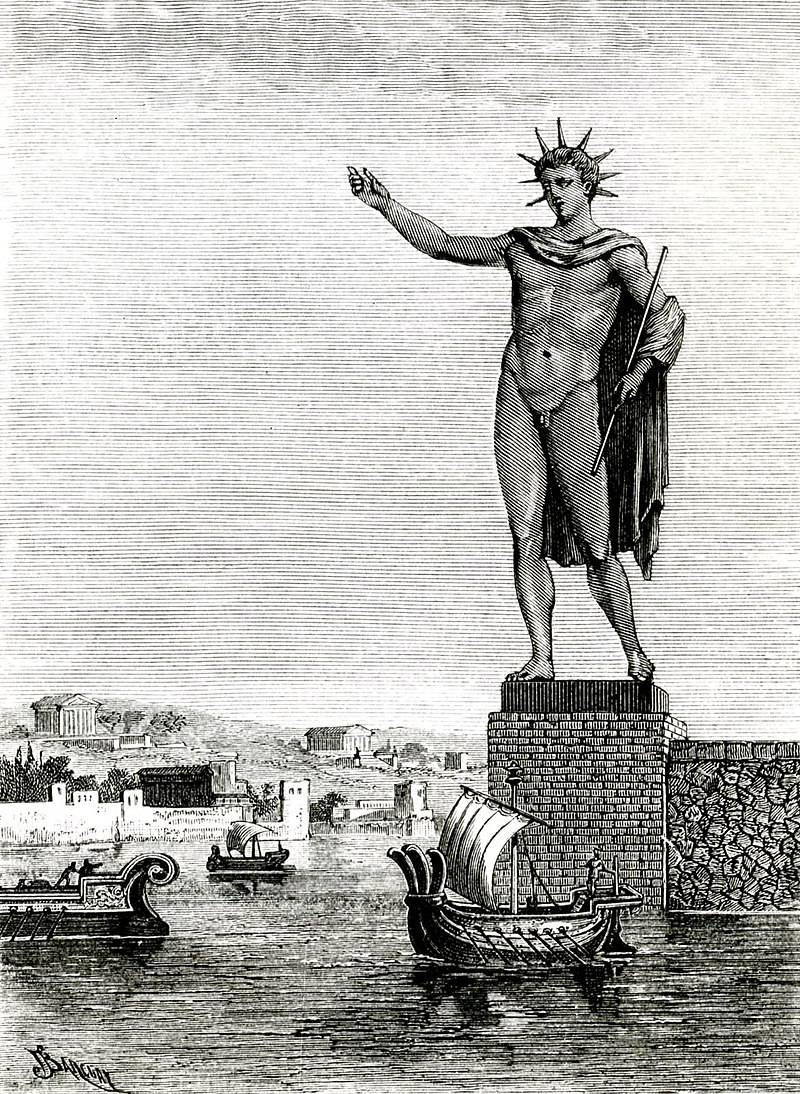
Colossus of Rhodes
statue of the Greek Titan Helios; one of the seven wonders of the ancient world

Helios
In ancient Greek religion and mythology, Helios (; ; Homeric Greek: ) is the god who personifies the Sun. His name is also Latinized as Helius, and he is often given the epithets Hyperion ("the one above") and Phaethon ("the shining"). Helios is often depicted in art with a radiant crown and driving a horse-drawn chariot through the sky. He was a guardian of oaths and also the god of sight. Though Helios was a relatively minor deity in Classical Greece, his worship grew more prominent in late antiquity thanks to his identification with several major solar divinities of the Roman period, partic

Medea
ancient Greek tragedy by Euripides

quadriga
thumb|upright=1.5|Quadriga on the Austrian Parliament Building, Vienna
Athena Parthenos
sculpture by Phidias

The North Wind and the Sun
Fable by Aesop
Sol
Roman god of the Sun

Augustaion
thumb|right|250px|Map of the administrative heart of Constantinople.
The Augustaion () or, in Latin, Augustaeum, was an important ceremonial square in ancient and medieval Constantinople (modern Istanbul, Turkey), roughly corresponding to the modern Aya Sofya Meydanı (Turkish, "Hagia Sophia Square"). Originating as a public market, in the 6th century it was transformed into a closed courtyard surrounded by porticoes, and provided the linking space between some of the most important edifices in the Byzantine capital. The square survived until the late Byzantine period, albeit in ruins, and trac
Thargelia
Thargelia () was one of the chief Athenian festivals in honour of the Delian Apollo and Artemis, held on their birthdays, the 6th and 7th of the month Thargelion (about May 24 and May 25).
radiant crown
radiate crown
Pyanopsia
Pyanopsia (Πυανόψια) or Pyanepsia (Πυανέψια) was an ancient Athenian festival held in honor of Apollo in Athens on the 7th day of the month Pyanepsion (October/November). Its name literally means "bean-stewing", in reference to one of the sacred offerings given during this time, and is taken from the Greek words πύανος - pyanos "bean" and ἕψειν - hepsein "to boil".
Skira
The Colossus of Rhodes
1954 painting by Salvador Dali

Andromède
thumb|Title page (1651, 2nd edition)
Har Senaim
mountain in Israel