Category
page 1Helios in mythology

Heracles

Odysseus
In Greek and Roman mythology, Odysseus (; , ), also known by the Latin variant Ulysses (, ; ), is a legendary Greek king of Ithaca and the hero of Homer's epic poem, the Odyssey. Odysseus also plays a key role in Homer's Iliad and other works in that same epic cycle.

Hephaestus
Hephaestus ( , ; eight spellings; ) is the Greek god of artisans, blacksmiths, carpenters, craftsmen, fire, metallurgy, metalworking, sculpture, and volcanoes. In Greek mythology, Hephaestus was the son of Hera, either on her own or by her husband Zeus. He was cast off Mount Olympus by his mother Hera because of his lameness, the result of a congenital impairment; or in another account, by Zeus for protecting Hera from his advances.

Icarus

Medea
In Greek mythology, Medea (; ; ) is the daughter of King Aeëtes of Colchis. Medea is known in most stories as a sorceress, an accomplished pharmakís, a worker in pharmakeía (medicinal magic), and is often depicted as a high priestess of the goddess Hecate. She is a mythical granddaughter of the sun god Helios and a niece of Circe, an enchantress goddess. Her mother may have been Idyia.

Orion
giant huntsman in Greek mythology
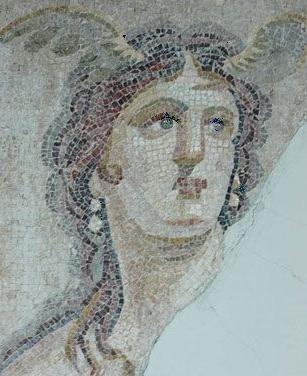
Tethys
ancient Greek mythological figure; mother of the river gods and the Oceanids

Theia
In Greek mythology, Theia (; ) also called Thea, Thia, Euryphaessa, Aethra or Basileia, was one of the Titans, the children of Uranus (Sky) and Gaia (Earth).

Hyperion
Titan in Greek mythology

Alkmene
In Greek mythology, Alcmene ( ; ) or Alcmena ( ; ; ; meaning "strong in wrath") was the wife of Amphitryon, by whom she bore two children, Iphicles and Laonome. She is best known as the mother of Heracles, whose father was the god Zeus. Alcmene was also referred to as Electryone (), a patronymic name as a daughter of Electryon.

Phaethon
Phaethon (; , ), also spelled Phaëthon, is the son of the Oceanid Clymene and the sun god Helios in Greek mythology.

Atreus
thumb|The Farnese Atreus (1574 engraving by Antonio Lafreri and [[Cornelis Cort) depicts Atreus and one of the sons of Thyestes, whom Atreus is about to kill]]

Giants
Giants from Greek myth

Boreas
Boreas (, , ; ; also ) is the Greek god of the cold north wind, storms, and winter. Although he was normally taken as the north wind, the Roman writers Aulus Gellius and Pliny the Elder both took Boreas as a northeast wind, equivalent to the Roman god Aquilo or Septentrio. Boreas is depicted as being very strong, with a violent temper to match. He was frequently shown as a winged old man or sometimes as a young man with shaggy hair and beard, holding a conch shell and wearing a billowing cloak. Boreas's most known myth is his abduction of the Athenian princess Oreithyia.
.jpg)
Geryon
thumb|upright|A statuette of Geryon at the [[Museum of Fine Arts of Lyon]]
In Greek mythology, Geryon (; , genitive ), also Geryone (, or ), son of Chrysaor and Callirrhoe, the grandson of Medusa and the nephew of Pegasus, was a fearsome giant who dwelt on the island Erytheia of the mythic Hesperides in the far west of the Mediterranean. A more literal-minded later generation of Greeks associated the region with Tartessos in southern Iberia. Geryon was often described as a monster with either three bodies and three heads, or three heads and one body, or three bodies and one head. He is common

Memnon
thumb|Attic neck-amphora featuring [[Heracles and Memnon (detail), BC]]
thumb|Eos retrieving the body of her son Memnon from the battlefield (detail); Etruscan bronze mirror, BC

Thyestes
thumb|Thyestes and Aerope, painting by Nosadella

Anemoi
thumb|Wind rose of ancient Greece, created by the scholar [[Adamantios Korais around 1796]]
Clytie
Oceanid of Greek mythology

Phineus
thumb|250px|Phineus with the Boreads.

Alcyoneus
thumb|right|Alcyoneus (?), Athena, Gaia, and Nike, detail of the Gigantomachy frieze, [[Pergamon Altar, Pergamon museum, Berlin.]]

Myrrha
thumb|Marcantonio Franceschini - The Birth of Adonis, 1690
Alectryon
Greek mythical character
Nerites
Greek deity
Moly
herb in Homeric poetry
Leucothoë
daughter of Orchamus in Greek mythology
Merops
set of mythological Greek characters
Erytheia
Erytheia () ("the red one"), also latinized as Erythia, part of Greek mythology, is one of the three Hesperides. The name was applied to the island close to the coast of southern Hispania, that was the site of the original Punic colony of Gadeira. Pliny's Natural History (4.36) records of the island of Gades: "On the side which looks towards Spain, at about 100 paces distance, is another long island, three miles wide, on which the original city of Gades stood. By Ephorus and Philistides it is called Erythia, by Timæus and Silenus Aphrodisias, and by the natives the Isle of Juno." The island wa
Helike
group of Greek mythical characters
Rape of Persephone
myth in Greek mythology
Cattle of Helios
group of animals in Greek mythology