Category
page 1Hiking

walking
thumb|Women walking in Hyderabad
Walking (also known as ambulation) is one of the main gaits of terrestrial locomotion among legged animals. Walking is typically slower than running and other gaits. Walking is defined as an "inverted pendulum" gait in which the body vaults over the stiff limb or limbs with each step. This applies regardless of the usable number of limbs—even arthropods, with six, eight, or more limbs, walk. In humans, walking has health benefits including improved mental health and reduced risk of cardiovascular disease and death.

hiking
alt=|thumb|upright=1.36|Hiking in the San Juan Mountains, Colorado, United States
thumb|upright=1.36|A hiker in the Alps
.jpg)
trail
thumb|alt=Photograph of a country track or fieldway |A country track, or fieldway, in [[Slovenia]]
thumb|alt=Photograph of a mountain bike trail |Mountain bike trail in the Forest of Dean, England
thumb|upright|alt=Photograph of a dirt trail through a forest |Trail in the Kruununpuisto Nature Park in Imatra, [[Finland]]

cairn
thumb|upright=1.2|A cairn a mile east of Nine Standards Rigg in the Yorkshire Dales.
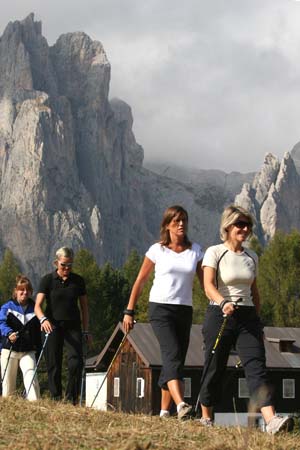
Nordic walking
physical activity or sport involving cross-country walking with specially designed walking poles similar to ski poles
.jpg)
alley
thumb|Alley in Sanaa, Yemen
An alley or alleyway is a narrow lane, path, or passageway, often reserved for pedestrians, which usually runs between, behind, or within buildings in towns and cities. It is also a rear access or service road (back lane), or a path, walk, or avenue (French allée) in a park or garden.
%2C_the_ancient_capital_of_Kangleipak_%E2%80%94_Early_modern_era_street_lamps_%E2%80%94_Old_Footpath.jpg)
footpath
thumb|Footpath inside the Kangla Fort, [[Imphal]]
thumb|upright|Footpath through the forest in Brastad, Sweden
wilderness backpacking
outdoor recreation of carrying gear on one's back, while hiking for more than a day. It is often but not always an extended journey, and may or may not involve camping outdoors
trail blazing
markings that indicate the route of a footpath
educational trail
groomed hiking or trail, provides visitors with knowledge
Normal route
Most often used route to climb a mountain
nude recreation
kind of recreation

boardwalk
thumb|Atlantic City, New Jersey boardwalk, as seen from [[Caesars Atlantic City, opened in 1870, as the first U.S. boardwalk. At long, it is also one of the world's longest, busiest, and oldest boardwalks. New Jersey is home to the world's highest concentration of boardwalks.|alt=Many people walking on a boardwalk at the beach in Atlantic City, New Jersey]]
mudflat hiking
type of walking recreation

Leave No Trace
set of outdoor ethics promoting responsible outdoor practices and minimizing impact on the environment
long-distance trail
long itinerary used for outdoors activities
summit cross
cross on the summit of a mountain or near the summit
scrambling
thumb|right|upright|Scrambling Mount Galwey in Waterton Park, [[Alberta, Canada]]
Thru-hiking
thumb|250px|A hiker who has completed the Appalachian Trail
portable water purification system
self-contained, easily transported units used to purify water from untreated sources
walking tour
tour of a historical or cultural site undertaken on foot, frequently in an urban setting
right-of-way
right to make a "way" (as in a type of easement) over a piece of land
Naismith's rule
Rule of thumb for hiking time
volksmarching
Volksmarching (from German "", ''people's march'') is a form of non-competitive fitness walking that developed in Europe in the mid-late 1960s. By 1968, the International Federation of Popular Sports (better known as the "IVV") was formed by Germany, Austria, Liechtenstein and Switzerland. The national emblems of these four countries were placed in a wreath to form the symbol IVV. The IVV Headquarters is located in Altötting, Germany (Bavaria) and the official languages of the IVV are English and German, though French is also used unofficially.