Category
page 1History of Tats
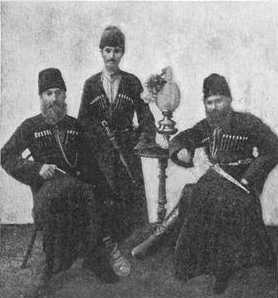
Mountain Jews
Jewish group of Khazaria and the Caucus

Shirvan
thumb|250px|Safavid conquest of Shirvan|The battle between the young Safavid ruler, [[Ismail I, and Farrukh Yasar, last independent ruler of Shirvan. Unknown artist (1541), Persian miniature currently preserved in the British Library, London.]]
thumb|250px|Location of Shirvan from a geographic map of the Caucasus by German cartographer Johann Christoph Matthias Reinecke (1804), [[Bibliothèque nationale de France, Paris.]]
Baku Khanate
Muslim khanate, mostly under Iranian suzerainty (A.D. 1747–1806)
Judeo-Tat
Judeo-Tat or Juhuri (, , ) is a Judeo-Persian dialect and the traditional language spoken by the Mountain Jews in the eastern Caucasus Mountains, especially Azerbaijan, parts of Russia and today in Israel. It belongs to the southwestern group of the Iranian division of the Indo-European languages, albeit with heavy influence from Hebrew. The words Juhuri and Juhuro translate as "Jewish" and "Jews".
Quba Khanate
independent principality from 1747–1806, part of modern-day Azerbaijan
Derbent Khanate
historical Azerbaijani khanate
Shirvan Khanate
khanate that existed in what is now Azerbaijan
history of Baku
history of the capital city of Azerbaijan
Safavid Shirvan
Armeno-Tats
Armeno-Tats ( – hay-tater; ) are a distinct group of Christian Tat-speaking Armenians that historically populated eastern parts of the South Caucasus, in what constitutes the modern-day Republic of Azerbaijan. Most scholars researching the Tat language, such as Boris Miller, agree that Armeno-Tats are ethnic Armenians who underwent a language shift and adopted Tat as their first language. This is explained on one hand by the self-identification of Armeno-Tats who stated during Miller's research that they consider themselves Armenian as well as by some linguistic features of their dialect. The
timeline of Baku