Category
page 1Holocaust terminology
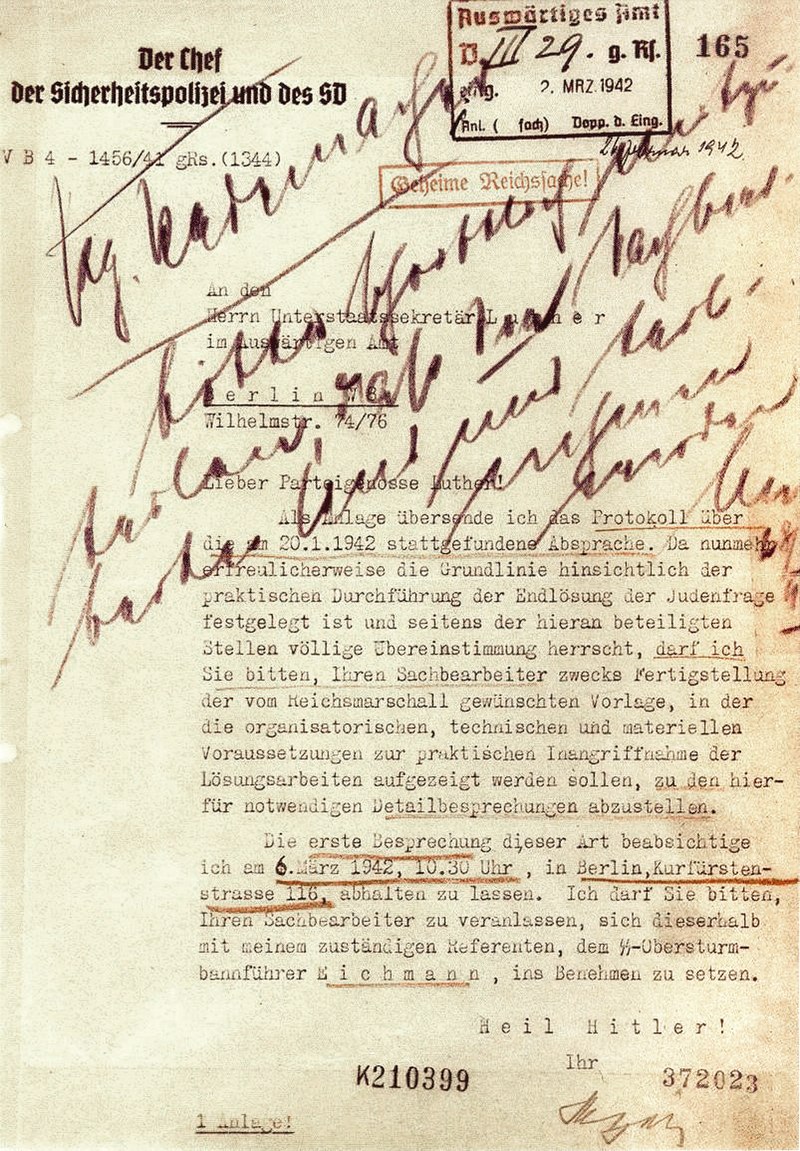
Final Solution
Nazi plan for the genocide or extermination of the Jews, resulted in the genocide known as 'Holocaust' or 'Shoah'

Einsatzgruppen
'''''' (, ; also 'task forces') were (SS) paramilitary death squads of Nazi Germany that were responsible for mass murder, primarily by shooting, during World War II (1939–1945) in German-occupied Europe. The had an integral role in the implementation of the so-called "Final Solution to the Jewish question" () in territories conquered by Nazi Germany, and were involved in the murder of much of the intelligentsia and cultural elite of Poland, including members of the Catholic priesthood. Almost all of the people they murdered were civilians, beginning with the intelligentsia and swiftly progres
Arbeit macht frei
slogan (“Work sets you free”) on the entrance of Auschwitz and other Nazi concentration camps
Generalplan Ost
Nazi racial plan of enslavement and genocide of peoples of Central and Eastern Europe, mainly Jews, Slavs & Roma

Untermensch
thumb|upright=0.95|Cover of the Nazi propaganda brochure "Der Untermensch" ("The Subhuman"), 1942. The SS booklet depicted the natives of Eastern Europe as "subhumans".
Untermensch (; plural: Untermenschen) is a German language word literally meaning 'underman', 'sub-man', or 'subhuman', which was extensively used by Germany's Nazi Party to refer to their opponents and non-Aryan people they deemed as inferior. It was mainly used against "the masses from the East", that is Jews, Roma, and Slavs (mainly ethnic Poles, Belarusians, Ukrainians, Russians and Serbs).
.jpg)
Ordnungspolizei
The Ordnungspolizei (Orpo, , meaning 'Order Police') were the uniformed police force in Nazi Germany from 1936 to 1945. The Orpo was absorbed into the Nazi monopoly of power after regional police jurisdiction was removed in favour of the central Nazi government ("Reich-ification", Verreichlichung, of the police). In 1936, Heinrich Himmler, the commander (Reichsführer-SS) of the Schutzstaffel (SS), was appointed Chief of the German Police in the Interior Ministry. The top and upper leadership positions of the Orpo were filled by police officers who belonged to or had joined the SS. Owing to the

Kapo
A kapo was a type of prisoner functionary () at Nazi concentration and extermination camps. They were, whether voluntary or coerced, collaborators who worked under the Schutzstaffel (SS) to carry out administrative tasks or supervise the forced labour of inmates. Given authority over their fellow prisoners, they would often enjoy comparatively better conditions at the camps, such as increased food rations and less physical brutality from SS guards. Due to their privileged status and actions, kapos were highly resented and were frequently lynched by other prisoners when the camps were liberated

Judenrat
thumb|Judenrat in the town of Szydłowiec in [[occupied Poland, where the Jewish population was in the majority before the Holocaust]]
Night and Fog Decree
directive by Adolf Hitler on 7 December 1941

Judenfrei
thumb|"Whoever wears this sign is an enemy of our people" – Parole der Woche, 1 July 1942 showing a [[yellow badge used by the Nazis to identify Jews]]
thumb|Synagogue in Occupation of Poland (1939–1945)|German-occupied [[Bydgoszcz, Poland, September 1939. The inscription in German reads: "This city is free of Jews!"]]
thumb|German map showing the number of Jewish executions carried out by Einsatzgruppe A in: [[Estonia (declared judenfrei), Latvia, Lithuania, Belarus, and Russia]]
thumb|Advertisement for a café in Tübingen, describing itself as judenfrei
Judenfrei (, "free of Jews") and
Life unworthy of life
Eugenic concept for the murder of humans declared "unworthy"
.jpg)
Schutzmannschaft
The Schutzmannschaft, or Auxiliary Police ( "protection team"; plural: Schutzmannschaften, abbreviated as Schuma) was the collaborationist auxiliary police of native policemen serving in those areas of the Soviet Union and the Baltic states occupied by Nazi Germany during World War II. Heinrich Himmler, head of the Schutzstaffel (SS), established the Schutzmannschaft on 25 July 1941, and subordinated it to the Order Police (Ordnungspolizei; Orpo). By the end of 1941, some 45,000 men served in Schutzmannschaft units, about half of them in the battalions. During 1942, Schutzmannschaften expanded
SS Race and Settlement Main Office
organization in Nazi Germany
Sonderaktion 1005
destruction of evidence of mass murder at Operation Reinhardt killing centres
SS Main Economic and Administrative Office
Nazi organization responsible for managing the finances, supply systems and business projects for the Allgemeine-SS

Umschlagplatz in Warsaw ghetto
Umschlagplatz () was the term used during The Holocaust to denote the holding areas adjacent to railway stations in occupied Poland where Jews from ghettos were assembled for deportation to Nazi death camps. The largest collection point was in Warsaw next to the Warsaw Ghetto. In 1942 between 254,000 – 265,000 Jews passed through the Warsaw Umschlagplatz on their way to the Treblinka extermination camp during Operation Reinhard, the deadliest phase of the Holocaust in Poland. Often those awaiting the arrival of Holocaust trains, were held at the Umschlagplatz overnight. Other examples of Umsch
Jedem das Seine
idiomatic German expression for several centuries, cynically phrase used by the Nazis displayed over the entrance of Buchenwald concentration camp
Concentration Camps Inspectorate
The central SS administrative and managerial authority for the concentration camps of the Third Reich

Hilfspolizei
thumb|Members of Schutzpolizei (Nazi Germany)|Schutzpolizei (left) and Hilfspolizei (right) patrol Berlin on 5 March 1933, the day of the Reichstag election
Action 14f13
campaign of the Third Reich to murder Nazi concentration camp prisoners
Never again
expression regarding the Holocaust

Szmalcownik
thumb|200px|Polish underground Biuletyn Informacyjny (Information Bulletin), 2 September 1943, announcing death sentences carried out on collaborators, including a szmalcownik named Jan Grabiec
thumb|Announcement by the governor of the Warsaw District, [[Ludwig Fischer, of 13 May 1943, encouraging the inhabitants of Warsaw to hand over communist agents and Jews to the German authorities]]
thumb|200px|Directorate of Underground Resistance poster, September 1943, announcing death sentences carried out on collaborators, including Bogusław Jan Pilnik, sentenced for 'blackmailing, and delivering to

Bandenbekämpfung
thumb|250px|Heinrich Himmler's report Number 51 from 1 October 1942 to 1 December 1942 detailing the murder of "bandits" and Jews in [[Southern Russia, Ukraine, and the Bialystok District]]
In German military history, ' (), also referred to as Nazi security warfare' during World War II, refers to the concept and military doctrine of countering resistance or insurrection in the rear area during wartime with extreme brutality. The doctrine provided a rationale for disregarding the established laws of war and for targeting any number of groups, from armed guerrillas to civilians, as "bandits" or
glossary of Nazi Germany
Wikimedia glossary list article
Lagerordnung
Geltungsjude
Geltungsjude was the term for people who were considered Jews by the first supplementary decree to the Nuremberg Laws from 14 November 1935. The term was not used officially, but was coined because the persons were deemed (gelten in German) Jews rather than exactly belonging to any of the categories of the previous Nuremberg Laws. There were three categories of Geltungsjuden: 1. offspring of an intermarriage who belonged to the Jewish community after 1935; 2. offspring of an intermarriage who was married to a Jew after 1935; 3. illegitimate child of a Geltungsjude, born after 1935.
Selection (Holocaust)
sorting for enslavement or extermination
Genickschussanlage
thumb|upright 1.2| (taken 28 July 1941 in Berdychiv (Berditschew)
thumb|upright 1.2|Einsatzgruppen murder Jews in Ivanhorod, Ukraine, 1942
Like sheep to the slaughter
a proverb regarding the jewish holocaust
Arbeitslager
right|thumb|200px|Arbeitsbuch Für Ausländer (Workbook for Foreigners) identity document issued to a Polish Forced Labourer in 1942 by the Germans, together with a letter "P" patch that Poles were required to wear to identify them to the German population.
Arbeitslager () is a German language word which means labor camp. Under Nazism, the German government (and its private-sector, Axis, and collaborator partners) used forced labor extensively, starting in the 1930s but most especially during World War II. Another term was Zwangsarbeitslager ("forced labor camp").
Gemeinnützige Krankentransport GmbH
organization for transport of sick and disabled people to the Nazi killing centers
Perpetrators, victims, and bystanders
Aspect of Genocide studies