Category
page 1Horizontal coordinate system

horizon
thumb|right|300px|True, visible, and astronomical horizons. Not shown: refracted horizon.
Most commonly, the horizon is the border between the surface of a celestial body and its sky when viewed from the perspective of an observer on or above the surface of the celestial body. This concept is further refined as -
thumb|right|The curvature of the horizon as observed from a Space Shuttle at an altitude of .
The true or geometric horizon, which an observer would see if there was no alteration from refraction or from obstruction by intervening objects. The geometric horizon assumes a spherical ea

zenith
thumb|upright=1.25|right|Diagram showing the relationship between the zenith, the nadir, and different types of [[horizon]]
The zenith (, ) is the imaginary point on the celestial sphere directly "above" a particular location. "Above" means in the vertical direction (plumb line) opposite to the gravity direction at that location (nadir). The zenith is the "highest" point on the celestial sphere. The direction opposite of the zenith is the nadir.

azimuth
right|thumb|The azimuth is the angle formed between a reference direction (in this example north) and a sightline|line from the observer to a point of interest projected on the same plane as the reference direction orthogonal to the [[zenith.]]
nadir
thumb|300px|right|Diagram showing the relationship between the zenith, the nadir, and different types of [[horizon. Note that the zenith is opposite the nadir.]]
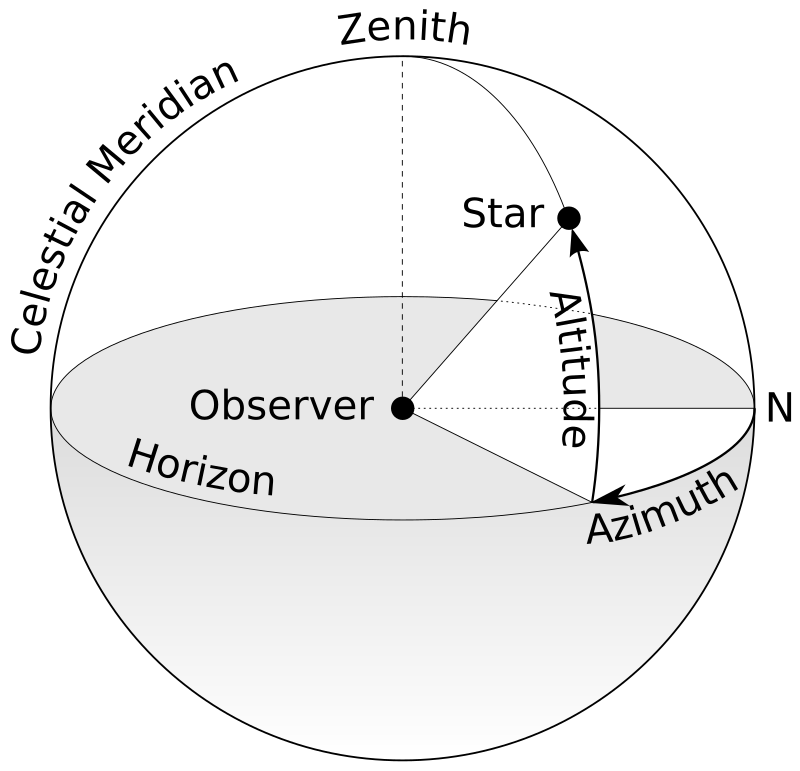
horizontal coordinate system
type of celestial coordinate system that uses the observer's local horizon as the fundamental plane
solar elevation angle
angle between the zenith and the centre of the Sun's disc
Solar azimuth angle
Azimuth angle of the Sun's position