Category
page 1Human mouth anatomy

tongue
The tongue is a muscular organ in the mouth of a typical tetrapod. It manipulates food for chewing and swallowing as part of the digestive process, and is the primary organ of taste. The tongue's upper surface (dorsum) is covered by taste buds housed in numerous lingual papillae. It is sensitive and kept moist by saliva and is richly supplied with nerves and blood vessels. The tongue also serves as a natural means of cleaning the teeth. A major function of the tongue is to enable speech in humans and vocalization in other animals.

lip
The lips are a horizontal pair of soft appendages attached to the jaws and are the most visible part of the mouth of many animals, including humans. Mammal lips are soft, movable and serve to facilitate the ingestion of food (e.g. suckling and gulping) and the articulation of sound and speech. Human lips are also a somatosensory organ, and can be an erogenous zone when used in kissing and other acts of intimacy.

gums
The gums or gingiva (: gingivae) consist of the mucosal tissue that lies over the mandible and maxilla inside the mouth. Gum health and disease can have an effect on general health.

maxilla
In vertebrates, the maxilla (: maxillae ) is the upper fixed (not fixed in Neopterygii) bone of the jaw formed from the fusion of two maxillary bones. In humans, the upper jaw includes the hard palate in the front of the mouth. The two maxillary bones are fused at the intermaxillary suture, forming the anterior nasal spine. This is similar to the mandible (lower jaw), which is also a fusion of two mandibular bones at the mandibular symphysis. The mandible is the movable part of the jaw.
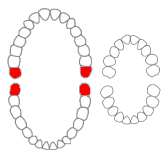
wisdom tooth
rearmost teeth of the mouth that erupt during adulthood
facial nerve
seventh cranial nerve

human mouth
part of human anatomy
soft palate
tissue constituting the back of the roof of the mouth
root canal
hollow part of the root of a tooth containing the nerve and blood vessels

cementum
Cementum is a specialized calcified substance covering the root of a tooth. The cementum is the part of the periodontium that attaches the teeth to the alveolar bone by anchoring the periodontal ligament.
tooth supporting structure
The periodontium () is the specialized tissues that both surround and support the teeth, maintaining them in the maxillary and mandibular bones. Periodontics is the dental specialty that relates specifically to the care and maintenance of these tissues. It provides the support necessary to maintain teeth in function. It consists of four principal components, namely:
Gingiva (the gums)
Periodontal ligament (PDL)
Cementum
Alveolar bone proper
crown
area of teeth covered by enamel
hard palate
thin horizontal bony plate made up of two bones, located in the roof of the mouth
maxillary central incisor
the first upper tooth from the dental midline on both sides of the mouth
maxillary first molar
upper teeth at the back of the mouth
dental notation
notational system in dentistry for associating information with a specific tooth
mandibular central incisor
the first lower tooth from the dental midline on both sides of the mouth
maxillary first premolar
upper teeth on the sides of the mouth

maxillary canine
third upper tooth from the dental midline
musculus uvulae
Human muscle
maxillary second molar
upper teeth at the back of the mouth
mandibular first premolar
lower teeth on the sides of the mouth
mandibular second premolar
lower teeth on the sides of the mouth
maxillary lateral incisor
the second upper tooth from the dental midline on both sides of the mouth
maxillary second premolar
upper teeth on the sides of the mouth
mandibular first molar
lower teeth at the back of the mouth
neck of tooth
anatomical area between the crown and root of teeth

mandibular second molar
lower teeth at the back of the mouth
mandibular lateral incisor
the second lower tooth from the dental midline on both sides of the mouth
mandibular canine
the third lower tooth from the dental midline
Bonwill Triangle
anatomical region in the face
neonatal teeth
medical condition; teeth that emerge through the gingiva during the first month of life (the neonatal period)
FDI World Dental Federation notation
world's most commonly used dental notation
sinodonty and sundadonty
descriptions of two alleged types of human dentiture, sometimes used in racialist/racist theories
Palmer notation
tooth detection system used by dentists to associate information to a specific tooth