Category
page 1Hydrophiloidea
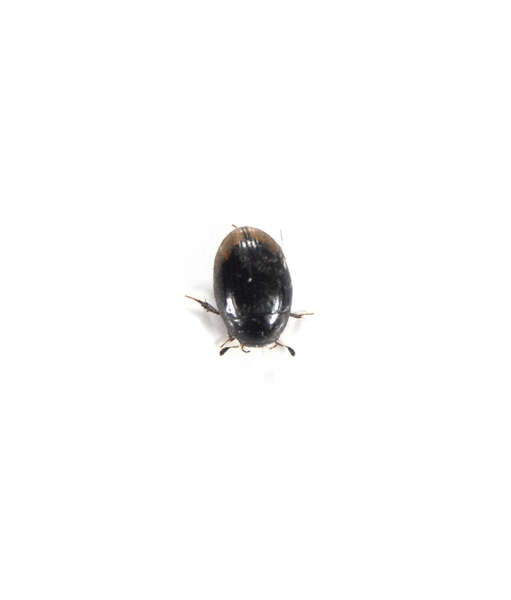
Hydrophiloidea
Hydrophiloidea, known as water scavenger beetles, is a superfamily of beetles. Until recently it included only a single family, the Hydrophilidae (water scavenger beetles), but several of the subfamilies have been removed and raised to family rank. Hydrophiliidae remains by far the largest member of the group, with nearly 3,000 described species. The other families have no more than 400 species. The Histeroidea are closely related and sometimes considered part of a sensu lato Hydrophiloidea. The majority of the clade is aquatic, which is thought to be the ancestral ecology of the group, with s

Georissus
Georissus, also called minute mud-loving beetles, is the only genus in the beetle family Georissidae (or Georyssidae). They are tiny insects living in wet soil, often near water. They are found on every continent except Antarctica.

Helophorus
thumb|Helophorus grandis
Helophorus is the only genus in the beetle family Helophoridae (traditionally included within Hydrophilidae as the subfamily Helophorinae) within the Hydrophiloidea. They are small insects, found mainly in the Holarctic region (150 occur in Palearctic and 41 species in North America), but two or three species also live in the Afrotropical region, Central America and one in the Indomalayan region (northern India).
Hydrochus
Hydrochus is the only living genus of beetle in the family Hydrochidae, which belongs to the superfamily Hydrophiloidea, and was formerly treated as a subfamily of Hydrophilidae. Hydrochus includes about 180 species, which are found worldwide. The name "Hydrochus" has also been used for a fly genus in the family Dolichopodidae, but this is a junior subjective synonym of the genus Rhaphium.
Epimetopidae
Epimetopidae is a family of semi-aquatic beetles belonging to the Hydrophiloidea. They are found in sand and gravel at the edges of streams, rivers and shallow freshwater ponds. These beetles are shorter than half a centimeter long and have a pronotum with a central projection forming a shelf above the head. On the underside of the abdomen only four sternites are visible. There are approximately 72 described species in three genera, Epimetopus which is restricted to the New World, mostly Neotropical, Eupotemus with two Afrotropical species and Eumetopus with some Oriental species. Females carr
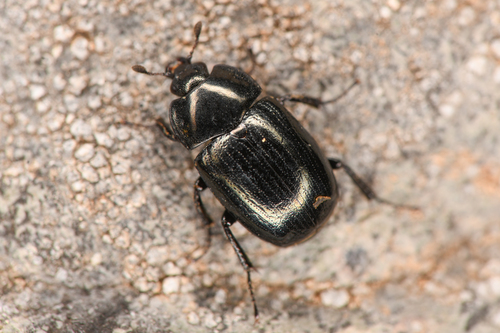
Sphaerites politus
species of insect