Category
page 1Hyperbolic geometry
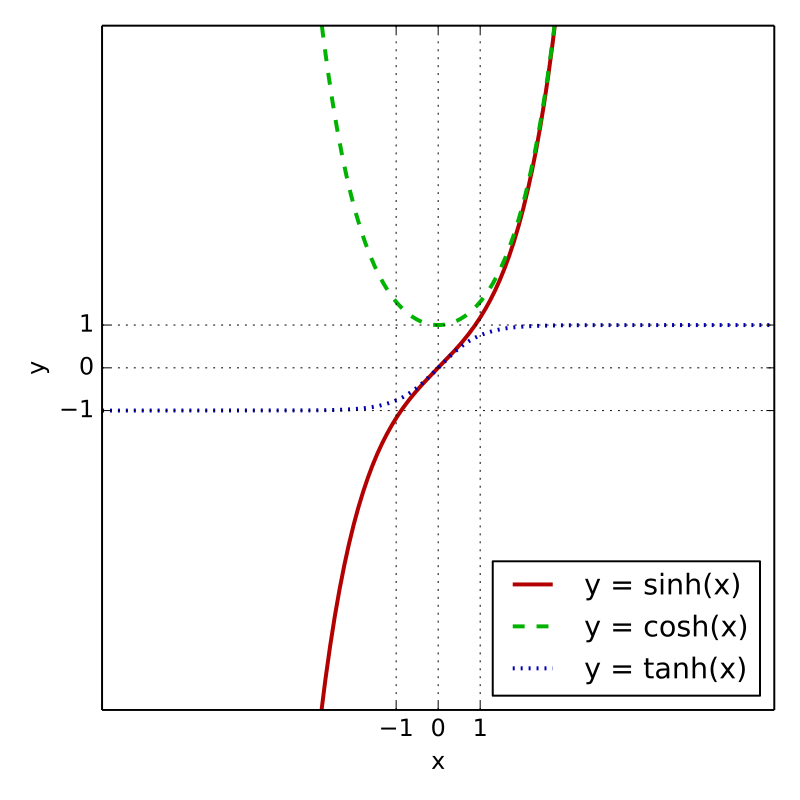
hyperbolic function
mathematical function related with trigonometric functions

hyperbolic geometry
type of non-Euclidean geometry

pseudosphere
In geometry, a pseudosphere is a surface in \mathbb{R}^3. It is the most famous example of a pseudospherical surface. A pseudospherical surface is a surface piecewise smoothly immersed in \mathbb{R}^3 with constant negative Gaussian curvature. A "pseudospherical surface of radius " is a surface in \mathbb{R}^3 having curvature −1/R2 at each point. Its name comes from the analogy with the sphere of radius , which is a surface of curvature 1/R2. Examples include the tractroid, Dini's surfaces, breather surfaces, and the Kuen surface.
point at infinity
limiting point in some geometric spaces
hyperbolic triangle
triangle in the hyperbolic plane, possibly having ideal vertices
anti-de Sitter space
maximally symmetric Lorentzian manifold with negative cosmological constant, which appears in the AdS/CFT correspondence
Poincaré disk model
model of hyperbolic geometry
Apollonian gasket
fractal generated from three mutually tangent circles by repeatedly placing a tangent circle into the gap between three circles
hyperbolic space
homogeneous space that has a constant negative curvature (not any hyperbolic manifold)
Saccheri quadrilateral
quadrilateral with two equal sides perpendicular to the base
defect
failure of some angles to add up to the expected amount of 360° or 180°, when such angles in the plane would
upper half-plane
complex numbers with positive imaginary part

Poincaré half-plane model
upper-half plane model of hyperbolic non-Euclidean geometry
Fuchsian group
discrete subgroup of the real projective special linear group of dimension 2
Beltrami–Klein model
model of hyperbolic geometry
hypercycle
curve in hyperbolic plane whose points have the same orthogonal distance from a given straight line

SL2(R)
In mathematics, the special linear group SL(2, R) or SL2(R) is the group of 2 × 2 real matrices with determinant one:
\mbox{SL}(2,\mathbf{R}) = \left\{ \begin{pmatrix}
a & b \\
c & d
\end{pmatrix} \colon a,b,c,d \in \mathbf{R}\mbox{ and }ad-bc=1\right\}.
Lambert quadrilateral
quadrilateral with three right angles
hyperbolic group
Mathematical concept
horocycle
220px|right|thumb|
A blue horocycle in the Poincaré disk model and some red normals. The normals converge asymptotically to the upper central [[ideal point.]]
angle of parallelism
in hyperbolic geometry, the angle at one vertex of a right hyperbolic triangle that has two hyperparallel sides
hyperboloid model
model of n-dimensional hyperbolic geometry
triangle group
Group realized geometrically by reflections across the sides of a triangle
hyperbolic coordinates
coordinate system
ideal triangle
hyperbolic triangle such that all three of its vertices are ideal points
ideal point
point at infinity in hyperbolic geometry
Split-quaternion
{|class="wikitable" align="right" style="text-align:center"
|+Split-quaternion multiplication
|-
!width=15| ×
!width=15| 1
!width=15| i
!width=15| j
!width=15| k
|-
! 1
| 1
| i
| j
| k
|-
!i
|i
|−1
|k
|−j
|-
!j
|j
|−k
|1
|−i
|-
!k
|k
|j
|i
|1
|}
Poincaré metric
metric tensor describing constant negative (hyperbolic) curvature
hyperbolic tree
mathematical tree in the hyperbolic plane
Horosphere
220px|right|thumb|A horosphere within the Poincaré disk model tangent to the edges of a [[hexagonal tiling cell of a hexagonal tiling honeycomb]]
thumb|Apollonian sphere packing can be seen as showing horospheres that are tangent to an outer sphere of a [[Poincaré disk model]]
In hyperbolic geometry, a horosphere (or parasphere) is a specific hypersurface in hyperbolic n-space. It is the boundary of a horoball, the limit of a sequence of increasing balls sharing (on one side) a tangent hyperplane and its point of tangency. For n = 2 a horosphere is called a horocycle.
Δ-hyperbolic space
Concept in mathematics