Category
page 1Iconography

Andromeda
Ethiopian princess in Greek mythology
%20(cropped).jpg)
personification
thumb|upright=1.35|Set of porcelain figures of personifications of the [[four continents, Germany, , from left: Asia, Europe, Africa, and America. Of these, Africa has retained her classical attributes. Formerly James Hazen Hyde collection.]]
Personification is the representation of any thing, being, or abstraction as a person or with person-like qualities. In the arts and as a literary device, personification is common for: places, especially cities, countries, and continents; elements of the natural world, such as trees, the seasons, the traditional "four elements", the four cardinal winds,

Bathsheba
Bathsheba (; , ) was an Israelite queen consort. According to the Hebrew Bible, she was the wife of Uriah the Hittite and later of David, with whom she had all of her five children. Her status as the mother of Solomon, who succeeded David as monarch, made her the Gebirah () of the Kingdom of Israel.

triskelion
thumb|Neolithic triple-spiral symbol

iconography
thumb|Hans Holbein the Younger|Holbein's The Ambassadors (1533) is a complex work whose iconography remains the subject of debate.
.jpg)
triptych
thumb|330px|Triptych of the The Elevation of the Cross (Rubens)|Raising of the Cross, Rubens, 1610–11, Antwerp Cathedral
A triptych ( ) is a work of art (usually a panel painting) that is divided into three sections, or three carved panels that are hinged together and can be folded shut or displayed open. It is therefore a type of polyptych, the term for all multi-panel works. The middle panel is typically the largest and flanked by two smaller related works, although there are triptychs of equal-sized panels. The form can also be used for pendant jewelry.

memento mori
artistic or symbolic reminder of the inevitability of death

cornucopia
thumb|upright|Cornucopia of a Roman statue of Livia as [[Fortuna, 42-52 AD, marble, Altes Museum, Berlin ]]
thumb|Cornucopia, part of a Roman statue, Archaeological Museum A. Salinas, Palermo, Sicily, Italy
In classical antiquity, the cornucopia (; ), also called the horn of plenty, is a symbol of abundance and nourishment, commonly a large horn-shaped container overflowing with produce, flowers, or nuts. In Greek, it was called the horn of Amalthea (), after Amalthea, a nurse of Zeus, who is often part of stories of the horn's origin.

danse macabre
artistic motif on the universality of death

Fountain of Youth
mythological theme in art and literature, a spring that supposedly restores the youth of anyone who drinks or bathes in its waters
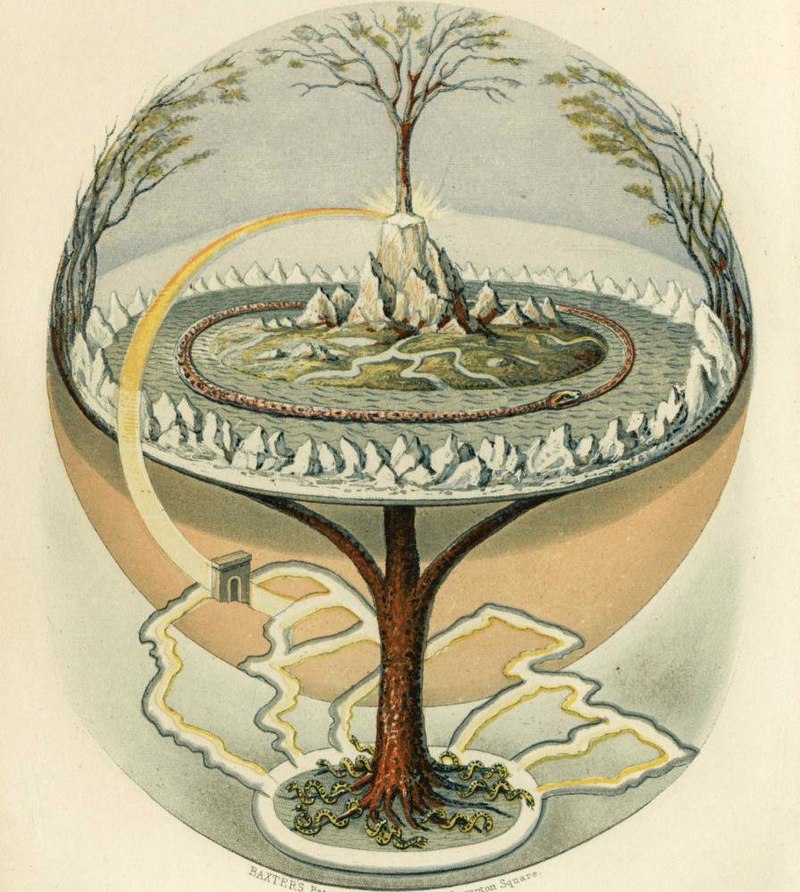
tree of life
motif in art and culture

initial
thumb|A historiated initial (the letter O) from an illuminated manuscript|alt=A large letter O in a frame. At the centre of the letter, there is an illustration of Moses receiving the Ten Commandments on tablets of stone.

vanitas
thumb|333px|Vanitas by Antonio de Pereda
star and crescent
symbol
halo
religious symbol representing a ring of light
rape of the Sabine women
episode in the history of Rome

hexagram
[[File:Regular_hexagon_as_intersection_of_two_triangles.png|thumb|A regular hexagram, [[List_of_regular_polytopes_and_compounds#Two_dimensional_compounds|{6}[2{3}]{6}]], can be seen as a compound composed of an upwards (blue here) and downwards (pink) facing equilateral triangle, with their intersection as a regular hexagon (in green).]]
mural crown
heraldic crown resembling a wall
iconology
Iconology is a method of interpretation in cultural history and the history of the visual arts used by Aby Warburg, Erwin Panofsky and their followers that uncovers the cultural, social, and historical background of themes and subjects in the visual arts. Though Panofsky differentiated between iconology and iconography, the distinction is not very widely followed, "and they have never been given definitions accepted by all iconographers and iconologists". Few 21st-century authors continue to use the term "iconology" consistently, and instead use iconography to cover both areas of scholarship.
Green Man
sculpture or other representation of a face surrounded by or made from leaves
aquila
Roman military standard
Roman Charity
legendary story about a woman Pero who secretly breastfeeds her father Cimon
motif
in the visual arts, individual design element, alone or combined to produce a pattern
sheela na gig
sculpture motif
wild man
mythical figure common in western European legend

triquetra
right|thumb|Interlaced triquetra which is a trefoil knot
The triquetra ( ; from the Latin adjective triquetrus "three-cornered") is a triangular figure composed of three interlaced arcs, or (equivalently) three overlapping vesicae piscis lens shapes. It is used as an ornamental design in architecture, and in medieval manuscript illumination (particularly in the Insular tradition). Its depiction as interlaced is common in Insular ornaments from about the 7th century. In this interpretation, the triquetra represents the topologically simplest possible knot.
thumb|Comparison of associated Reuleau

tronie
thumb|The Smoker, Joos van Craesbeeck

Amazonomachy
thumb|4th century AD Amazonomachy mosaic from Daphne, a suburb of Antioch on the Orontes (modern [[Antakya, Turkey); Louvre, Denon Wing]]
thumb|Relief now in Vienna
archaic smile
motif in archaic Greek art
.svg)
yin-yang
In Chinese philosophy, a taijitu () is a symbol or diagram () representing taiji () in both its monist (wuji) and its dualist (yin and yang) forms. A taijitu in application provides a deductive and inductive theoretical model. Such a diagram was first introduced by Neo-Confucian philosopher Zhou Dunyi of the Song Dynasty in his Taijitu shuo ().
gorgoneion
REDIRECT Gorgons
.jpg)
Anasyrma
thumb|Copy of a Hellenistic period|Hellenistic [[Aphrodite Kallipygos at The Hermitage in St. Petersburg]]
Anasyrma (, composed of and ; plural anasyrmata ), also called anasyrmos (), is the gesture of lifting the skirt or kilt. It is used in connection with certain religious rituals, eroticism, and lewd jokes (see, for example, Baubo). The term is used in describing corresponding works of art.
Promptuarium Iconum Insigniorum
1553 book published in Lyon, France - written by Guillaume Rouillé
Potnia Theron
female divinitiy associated with animals
Leda and the Swan
artistic theme from Greek mythology
interlace
decorative element of bands or portions of other motifs looped, braided, and knotted in complex geometric patterns
vesica piscis
shape that is the intersection of two circles with the same radius
fig leaf
leaf of the fig tree, traditionally used in art to obscure nudity
Venus Anadyomene
one of the iconic representations of Aphrodite
heroic nudity
concept in classical scholarship to describe the use of nudity in classical sculpture to indicate that a sculpture's apparently mortal human subject is in fact a hero or semi-divine being
depictions of Muhammad
Muhammad depicted in culture
Aristotle and Phyllis
medieval tale of a woman making a fool of an aged philosopher

Salabhanjika
thumb| Salabhanjika, Hoysala era sculpture, Belur, Karnataka, India
A salabhanjika or shalabhanjika is a term found in Indian art and literature with a variety of meanings. In Buddhist art, it means an image of a woman or yakshi next to, often holding, a tree, or a reference to Maya under the sala tree giving birth to Siddhartha (Buddha). In Hindu and Jain art, the meaning is less specific, and it is any statue or statuette, usually female, that breaks the monotony of a plain wall or space and thus enlivens it.
Thracian horseman
Ancient Thracian divinity
Liberty
personifications of the concept of Liberty
palm branch
symbol of victory, triumph, peace and eternal life
Apollo and Daphne
story from ancient Greek mythology
speech scroll
illustrative device denoting speech in art, used in pre-Columbian Mesoamerica and Medieval Europe

Timoclea
thumb|right|1659 painting by Elisabetta Sirani (adapting Merian's engraving); Timoclea pushing the Thracian captain who raped her into a well.
Father Time
personification of time passing
emblem book
book collecting emblems (allegorical illustrations) with accompanying explanatory text
conversation piece
painting genre
circle of stars
heraldic symbol
radiant crown
radiate crown
Master of Animals
motif in ancient art showing a human between and grasping two confronted animals
Power of Women
Medieval artistic and literary topos

Iconclass
thumb|The Threatened Swan, c. 1650, [[Jan Asselijn, Rijksmuseum, Amsterdam, Classed as:
45A10 = 'symbols, allegories of war; 'Guerra' (Ripa)'
25F36(SWAN) = 'water-birds'
34B11 = 'dog'
41C642 = 'eggs, egg-dishes']]
Iconclass is a specialized library classification designed for classifying the subjects and content of images in art (their iconography). It was originally conceived by the Dutch art historian Henri van de Waal in the 1970s, and was further developed by a group of scholars after his death.
Imago clipeata
Art term
pleurant
thumb|upright=1.2|Pleurants of Margaret of Bourbon (1438–1483) in the [[Royal Monastery of Brou, in Bourg-en-Bresse, France, by Conrad Meit]]
Pleurants or weepers (the English meaning of pleurants) are anonymous sculpted figures representing mourners, used to decorate elaborate tomb monuments, mostly in the late Middle Ages in Western Europe. Typically they are relatively small, and a group were placed around the sides of a raised tomb monument, perhaps interspersed with armorial decoration, or carrying shields with this. They may be in relief or free-standing. In English usage the term "weepe
puer mingens
artistic motif of a urinating boy