Category
page 1Igneous petrology

magma
thumb|350x350px|Magma can be found in the mantle or the crust.
Magma () is the molten or semi-molten natural material from which all igneous rocks are formed. Magma (sometimes colloquially but incorrectly referred to as lava) is found beneath the surface of the Earth, and evidence of magmatism has also been discovered on other terrestrial planets and some natural satellites. Besides molten rock, magma may also contain suspended crystals and gas bubbles.
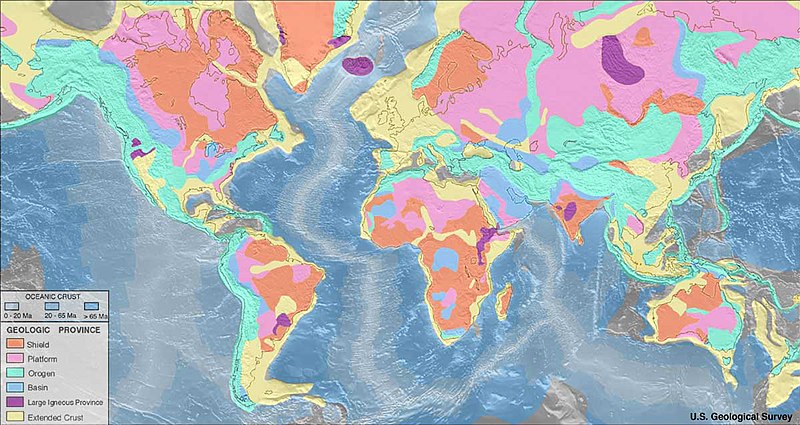
igneous rock
one of the three main rock types; formed through the cooling and solidification of magma or lava

pumice
thumb|Kutkhiny Baty, a pumice rock formation outcrop located 4 km from the source of the Ozyornaya (Sea of Okhotsk)|Ozyornaya River (Lake Kurile), near the southern tip of the [[Kamchatka Peninsula, Russia]]

tephra
thumb|Volcanic tephra at Brown Bluff, Antarctica (2016)
volcanic rock
rock formed from lava erupted from a volcano
%206%20(48555518367).jpg)
xenolith
thumb|Gabbroic xenolith in andesite, Tertiary of Wyoming, United States
thumb|Olivine [[weathering to iddingsite within a mantle xenolith]]

komatiite
thumb|Komatiite lava at the type locality in the Komati Valley, Barberton Mountainland, South Africa, showing the distinctive "spinifex texture" formed by dendritic plates of olivine (scale shown by a hammer on the right edge of photo)

maficity
thumbnail|Basalt
Mafic is a term used in geology to describe silicate minerals, magmas, and igneous rocks that are rich in magnesium and iron, while being relatively low in silica content. Most mafic minerals are dark in color, and common rock-forming mafic minerals include olivine, pyroxene, amphibole, and biotite. Common mafic rocks include basalt, diabase and gabbro. Mafic rocks often also contain calcium-rich varieties of plagioclase feldspar. Mafic materials can also be described as ferromagnesian.

scoria
Scoria or cinder (plural: scoriae) is a pyroclastic, highly vesicular, dark-colored volcanic rock formed by ejection from a volcano as a molten blob and cooled in the air to form discrete grains called clasts. It is typically dark in color (brown, black or purplish-red), and basaltic or andesitic in composition. Scoria has relatively low density, as it is riddled with macroscopic ellipsoidal vesicles (gas bubbles), but in contrast to pumice, most scoria usually has a specific gravity greater than or at 1 and sinks or remains in place in water rather than float at the surface. However, some sco
phonolite
thumb|Demonstration of sound produced when phonolite is struck, Cerro de la Campana (Hermosillo, Sonora, Mexico)
thumb|Lithophone made of Phonolite in Schellerhau botanic garden (Germany)
subvolcanic rock
medium-grained intrusive rock
Bowen's reaction series
Order of crystallization of minerals in magma
QAPF diagram
classification system for igneous rocks

agglomerate
thumb|300px|right|Mesozoic agglomerate of the Seymour Canal Formation in [[Alaska, United States]]
Agglomerate (from the Latin agglomerare meaning "to form into a ball") is a coarse accumulation of large blocks of volcanic material that contains at least 75% bombs. Volcanic bombs differ from volcanic blocks in that their shape records fluidal surfaces: they may, for example, have ropy, cauliform, scoriaceous, folded, spindle, spatter, ribbon, ragged, or amoeboid shapes. Globular masses of lava may have been shot from the crater at a time when partly molten lava was exposed, and was frequently

felsicity
In geology, felsic is a modifier describing igneous rocks that are relatively rich in elements that form feldspar and quartz. It is contrasted with mafic rocks, which are richer in magnesium and iron. Felsic refers to silicate minerals, magma, and rocks which are enriched in the lighter elements such as silicon, oxygen, aluminium, sodium, and potassium. Molten felsic magma and lava is more viscous than molten mafic magma and lava. Felsic magmas and lavas have lower temperatures of melting and solidification than mafic magmas and lavas.

lamprophyre
thumb|Minette (a type of lamprophyre), from Jáchymov in the Czech Republic
trap
formation of dark-colored, fine-grained, non-granitic intrusive or extrusive igneous rock

norite
thumb|right|Sample of norite
thumb|right|Shocked norite found in the Taurus-Littrow valley on the moon during the [[Apollo 17 mission (sample 78236).]]
Norite is a mafic intrusive igneous rock composed largely of the calcium-rich plagioclase labradorite, orthopyroxene, and olivine. The name norite is derived from Norway, by its Norwegian name Norge.
TAS classification
system to assign names to many common types of volcanic rocks based upon the relationships between the combined alkali content and the silica content

felsite
thumb|Felsite covered with Dendrite (crystal)|dendritic [[pyrolusite]]
thumb|Dike (geology)|Dike of felsite on [[Islay in Scotland]]
Felsite is a very fine-grained volcanic rock that may or may not contain larger crystals. Felsite is a field term for a light-colored rock that typically requires petrographic examination or chemical analysis for more precise definition. Color is generally white through light gray, or red to tan and may include any color except dark gray, green or black (the colors of trap rock). The mass of the rock consists of a fine-grained matrix of felsic materials, particul
nepheline syenite
holocrystalline plutonic rock

lamproite
thumb|right|Sample of lamproite
Lamproite is an ultrapotassic mantle-derived volcanic or subvolcanic rock. It has low CaO, Al2O3, Na2O, high K2O/Al2O3, a relatively high MgO content and extreme enrichment in incompatible elements.
igneous intrusion
body of intrusive igneous rock that forms by crystallization of magma slowly cooling below the surface of the Earth

phenocryst
thumb|right|300px|Granites often have large feldspathic phenocrysts. This granite, from the Swiss side of the [[Mont Blanc massif, has large white phenocrysts of plagioclase (that have trapezoid shapes when cut through). 1 euro coin (diameter 2.3 cm) for scale.]]
anatexis
Anatexis (via Latin from Greek roots meaning 'to melt down') is the partial melting of rocks. Traditionally, anatexis is used specifically to discuss the partial melting of crustal rocks, while the generic term "partial melting" refers to the partial melting of all rocks, in both the crust and mantle.
igneous differentiation
processes by which magmas undergo bulk chemical change during the partial melting process, cooling, emplacement, or eruption
partial melting
process in which only a portion of a solid is melted

aphanite
thumb|The smooth texture of this basaltic [[volcanic bomb is aphanitic.]]
thumb|upright=1.3|IUGS classification of aphanitic extrusive [[igneous rocks according to their relative alkali (Na2O + K2O) and silica (SiO2) weight contents. Blue area is roughly where alkaline rocks plot; yellow area where subalkaline rocks plot.]]
thumb|An aphanitic volcanic sand grain, with fine-grained matrix (geology)|groundmass, as seen through a [[petrographic microscope]]
fractional crystallization
geochemical process in which magma evolves in composition because different minerals crystallize and drop away from the melt at different temperatures
trondhjemite
Trondhjemites are leucotonalites, a variety of leucocratic tonalite in which the modal mineralogy mostly consists of plagioclase in the form of albite to andesine, >20% quartz, and <10% alkali feldspar. Trondhjemites that occur in the oceanic crust or in ophiolites are usually called plagiogranites.

hornblendite
thumb|300px|Hornblendite from Poland
boninite
Boninite is an extrusive rock high in both magnesium and silica, thought to be usually formed in fore-arc environments, typically during the early stages of subduction. The rock is named for its occurrence in the Izu-Bonin arc south of Japan. It is characterized by extreme depletion in incompatible trace elements that are not fluid mobile (e.g., the heavy rare-earth elements plus Nb, Ta, Hf) but variable enrichment in the fluid mobile elements (e.g., Rb, Ba, K). They are found almost exclusively in the fore-arc of primitive island arcs (that is, closer to the ocean trench) and in ophiolite com
extrusive rock
igneous rock formed when magma emerges above the Earth's surface before cooling
quartz monzonite
type of igneous rock

phacolith
thumb|right|Cross-sectional diagram of phacoliths (red) in older folded rocks
A phacolith is a pluton of igneous rock parallel to the bedding plane or foliation of folded country rock. More specifically, it is a typically lens-shaped pluton that occupies either the crest of an anticline or the trough of a syncline. In rare cases the body may extend as a sill from the crest of an anticline through the trough of an adjacent syncline, such that in cross section it has an S shape. In intensely folded terrain the hinge of folds would be areas of reduced pressure and thus potential sites for magma m
pneumatolysis
Pneumatolysis is an obsolete geologic term for magma emitting gasses that alter surrounding rock or crystallize minerals. Pneumatolysis is now considered a type of hydrothermal interaction.
incompatible element
one that is unsuitable in size and/or charge to the cation sites of the minerals of which it is included, and is defined by the partition coefficient between rock-forming minerals and melt being much smaller than 1

granophyric granite
thumb|upright=1.3|Cross-polarized light microscope image of an intergrowth of quartz and alkali feldspar in a granophyre (Muskox intrusion), as seen in [[thin section (Long dimension is 1.5 mm)]]
Granophyre ( ; from granite and porphyry) is a subvolcanic rock that contains quartz and alkali feldspar in characteristic angular intergrowths such as those in the accompanying image.

Magmatic water
juvenile water
alkaline rock
series of alkaline magmas produced by igneous differentiation
layered intrusion
large sill-like body of igneous rock

peperino
thumb|240px|An ashlar block of peperino dating from Roman times
thumb|240px|The Porta Pretoria in Albano Laziale, [[Italy. A clear example of the durability and grey surface of peperino.]]
thumb|240px|A fountain Stone sculpture|sculpted from peperino, in Marino, Italy
Peperino is an Italian word describing a brown or grey volcanic tuff, containing fragments of basalt and limestone, with disseminated crystals of augite, mica, magnetite, leucite, and other similar minerals. The name originally referred to the dark-colored inclusions, suggestive of peppercorns.

nephelinite
thumb|Nephelinite lava (grey) containing a xenolith of [[peridotite (yellow), Kaiserstuhl, Germany.]]
Nephelinite is a fine-grained or aphanitic igneous rock made up almost entirely of nepheline and clinopyroxene (variety augite). If olivine is present, the rock may be classified as an olivine nephelinite. Nephelinite is dark in color and may resemble basalt in hand specimen. However, basalt consists mostly of clinopyroxene (augite) and calcic plagioclase.
calc-alkaline magma series
subdivision of the subalkaline magma series
geothermobarometry
Geothermobarometry is the methodology for estimating the pressure and temperature history of rocks (metamorphic, igneous, or sedimentary). Geothermobarometry is a combination of geobarometry, where the pressure attained (and retained) by a mineral assemblage is estimated, and geothermometry where the temperature attained (and retained) by a mineral assemblage is estimated.
thumb|upright=1.35|An illustration of geothermobarometry. A line of temperature equilibrium (orange) and a line of pressure equilibrium (blue) of selected mineral assemblages found in the specimen are plotted on the P-T diag
poikilitic texture
feature of some igneous rocks
leucitite
Leucitite or leucite rock is an igneous rock containing leucite. It is scarce, many countries such as England being entirely without them. However, they are of wide distribution, occurring in every quarter of the globe. Taken collectively, they exhibit a considerable variety of types and are of great interest petrographically. For the presence of this mineral it is necessary that the silica percentage of the rock should be low, since leucite is incompatible with free quartz and reacts with it to form potassium feldspar. Because it weathers rapidly, leucite is most common in lavas of recent and
essexite
thumb|upright=1.2|Craigleith, an island in Scotland, composed of essexite
normative mineralogy
an estimate of the mineralogy of the rock
shonkinite
Shonkinite is an intrusive igneous rock found in few places in the world. It is unique in having low silica, feldspathoid minerals, and large blocky crystals of black augite. It makes up much of the hard dark grey rock comprising certain mountains and buttes in Montana that are remnants of laccoliths and stocks, such as the Highwood mountains.
amygdule
thumb|right|Amygdules in lava from Kaiserstuhl (Baden-Württemberg)|Kaiserstuhl in Germany
andesite line
geologic distinction in the Pacific Ocean
Central Atlantic magmatic province
Largest continental igneous province on Earth
Sanukitoid
thumb|Sanukite is a black hard rock produced in Mt. Nijo on the boundary of Osaka and Nara prefectures
peralkaline rock
igneous rocks which have a deficiency of aluminium
tholeiitic magma series
series of sub-alkaline magmas
igneous petrology
study of igneous rocks
Lithophysa
thumb|A lithophysa from France
thumb|A collection of lithophysae "thundereggs"
A lithophysa (plural lithophysae, from Greek lithos "stone" + phusa "bubble") is a felsic volcanic rock with a spherulitic structure and interior cavity with concentric chambers. Its outer shape is spherical or lenticular. They vary in size from very small up to twelve feet in diameter depending on the age of the magma chamber. These rocks are usually found within obsidian or rhyolite lava flows. Lavas low in feldspar minerals may produce a version known as snowflake obsidian.
ring dike
circular igneous intrusion
Igneous textures
property of igneous rocks