Category
page 1Igneous rocks

lava
thumb|upright=1.5|Fresh lava from Fagradalsfjall volcano eruption in Iceland, 2023
Lava is molten or partially molten rock (magma) that has been expelled from the interior of a terrestrial planet (such as Earth) or a moon onto its surface. Lava may be erupted at a volcano or through a fracture in the crust, on land or underwater, usually at temperatures from . Lava may be erupted directly onto the land surface or onto the sea floor or it may be ejected into the atmosphere before falling back down. The solid volcanic rock resulting from subsequent cooling of the molten material is often also ca

magma
thumb|350x350px|Magma can be found in the mantle or the crust.
Magma () is the molten or semi-molten natural material from which all igneous rocks are formed. Magma (sometimes colloquially but incorrectly referred to as lava) is found beneath the surface of the Earth, and evidence of magmatism has also been discovered on other terrestrial planets and some natural satellites. Besides molten rock, magma may also contain suspended crystals and gas bubbles.
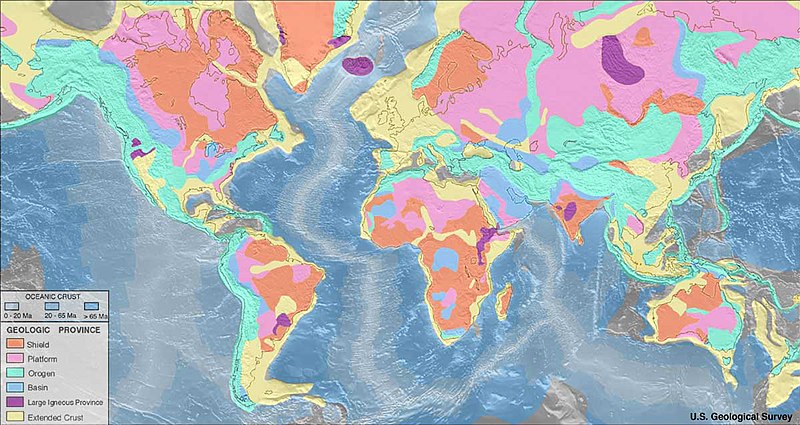
igneous rock
one of the three main rock types; formed through the cooling and solidification of magma or lava

caldera
thumb|right|Mount Mazama's eruption timeline, an example of caldera formation

pumice
thumb|Kutkhiny Baty, a pumice rock formation outcrop located 4 km from the source of the Ozyornaya (Sea of Okhotsk)|Ozyornaya River (Lake Kurile), near the southern tip of the [[Kamchatka Peninsula, Russia]]
porphyry
variety of igneous rock

ophiolite
thumb|Ordovician ophiolite in Gros Morne National Park, Newfoundland
thumb|Chromitic serpentinite, Bay of Islands Ophiolite, Lewis Hills, Newfoundland
thumb|Chromitite ore with chromite (black) & talc and/or antigorite (whitish). Shetland Ophiolite Complex, ~425-500 Ma. [[Shetland Islands, North Sea, UK]]

laccolith
thumb|upright=1.3|Cross section (geometry)|Cross section of a laccolith intruding into and deforming strata

carbonatite
thumb|Carbonatite lava at Ol Doinyo Lengai volcano, [[Tanzania]]
moon rock
piece or sample of soil from the Moon
clastic rock
type of sedimentary rock
list of rock types
Wikimedia list article
.jpg)
greisen
thumb|upright=1.35|Granite (light) with sheeted veins of greisen (dark) at Cligga Head, Cornwall
Greisen is a highly altered granitic rock or pegmatite, usually composed predominantly of quartz and micas (mostly muscovite). Greisen is formed by self-generated alteration of a granite and is a class of moderate- to high-temperature magmatic-hydrothermal alteration related to the late-stage release of volatiles dissolved in a magma during the solidification of that magma.
QAPF diagram
classification system for igneous rocks
large igneous province
massive volcanic formation resulting from flood basalt eruptions
.JPG)
palagonite
right|thumb|250px|Palagonite layers at Moya Beach, Mayotte.
Palagonite is an alteration product from the interaction of water with volcanic glass of chemical composition similar to basalt. Palagonite can also result from the interaction between water and basalt melt. The water flashes to steam on contact with the hot lava and the small fragments of lava react with the steam to form the light-colored palagonite tuff cones common in areas of basaltic eruptions in contact with water. An example is found in the pyroclastic cones of the Galapagos Islands. Charles Darwin recognized the origin of the
Genesis Rock
rock retrieved from the Moon in 1971

lopolith
thumb| Basic types of intrusions:
1. Laccolith
2. Small dike
3. [[Batholith
4. Dike
5. Sill
6. Volcanic neck, pipe
7. Lopolith
As a general rule, in contrast to the smoldering volcanic vent in the figure, these names refer to the fully cooled and usually millions-of-years-old rock formations, which are the result of the underground magmatic activity shown.]]
A lopolith is a large igneous intrusion which is lenticular in shape with a depressed central region. Lopoliths are generally concordant with the intruded strata with dike or funnel-shaped feeder bodies below the body. The term was first d
TAS classification
system to assign names to many common types of volcanic rocks based upon the relationships between the combined alkali content and the silica content

magmatism
thumb|300px|Geological map showing the [[Gangdese batholith, which is a product of magmatic activity about 100 million years ago.]]
Magmatism is the emplacement of magma within and at the surface of the outer layers of a terrestrial planet, which solidifies as igneous rocks. It does so through magmatic activity or igneous activity, the production, intrusion and extrusion of magma or lava. Volcanism is the surface expression of magmatism.
igneous differentiation
processes by which magmas undergo bulk chemical change during the partial melting process, cooling, emplacement, or eruption

charnockite
thumb|300px|right| Late-stage charnockite dike (geology)|dykes cutting [[anorthosite, Rogaland, Norway]]
thumb|Job Charnock's Mausoleum at St John's Church compound, [[Kolkata]]
fractional crystallization
geochemical process in which magma evolves in composition because different minerals crystallize and drop away from the melt at different temperatures
troctolite
Troctolite (from Greek τρώκτης 'trout' and λίθος 'stone') is a mafic intrusive rock type. It consists essentially of major but variable amounts of olivine and calcic plagioclase along with minor pyroxene. It is an olivine-rich anorthosite, or a pyroxene-depleted relative of gabbro. However, unlike gabbro, no troctolite corresponds in composition to a partial melt of peridotite. Thus, troctolite is necessarily a cumulate of crystals that have fractionated from melt.

spherulite
thumb|Spherulites in volcanic ash|rhyolitic ash, Hailstone Trail, Echo Canyon, [[Chiricahua Mountains, Arizona]]
thumb|Spherulite markings on snowflake obsidian
thumb|thin section|Photomicrograph of [[rhyolite, showing spherulitic texture (brown, between grey to white crystals)]]
trondhjemite
Trondhjemites are leucotonalites, a variety of leucocratic tonalite in which the modal mineralogy mostly consists of plagioclase in the form of albite to andesine, >20% quartz, and <10% alkali feldspar. Trondhjemites that occur in the oceanic crust or in ophiolites are usually called plagiogranites.
extrusive rock
igneous rock formed when magma emerges above the Earth's surface before cooling

phacolith
thumb|right|Cross-sectional diagram of phacoliths (red) in older folded rocks
A phacolith is a pluton of igneous rock parallel to the bedding plane or foliation of folded country rock. More specifically, it is a typically lens-shaped pluton that occupies either the crest of an anticline or the trough of a syncline. In rare cases the body may extend as a sill from the crest of an anticline through the trough of an adjacent syncline, such that in cross section it has an S shape. In intensely folded terrain the hinge of folds would be areas of reduced pressure and thus potential sites for magma m
columnar jointing
geological structure where sets of intersecting closely spaced fractures, referred to as joints, result in the formation of a regular array of polygonal prisms, or columns
cumulate rock
igneous rocks formed by the accumulation of crystals from a magma either by settling or floating.
intermediate rock
type of igneous rock

peperite
thumb|Peperite at Puy de Crouel in Auvergne, France
thumb|Peperite from Cumbria, England. This example was formed during the [[Ordovician Period and it is of andesitic composition.]]
A peperite is a type of volcaniclastic rock consisting of sedimentary rock that contains fragments of younger igneous material and is formed when magma comes into contact with wet sediments. The term was originally used to describe rocks from the Limagne region of France, from the similarity in appearance of the granules of dark basalt in the light-coloured limestone to black pepper. Typically the igneous fragment

peperino
thumb|240px|An ashlar block of peperino dating from Roman times
thumb|240px|The Porta Pretoria in Albano Laziale, [[Italy. A clear example of the durability and grey surface of peperino.]]
thumb|240px|A fountain Stone sculpture|sculpted from peperino, in Marino, Italy
Peperino is an Italian word describing a brown or grey volcanic tuff, containing fragments of basalt and limestone, with disseminated crystals of augite, mica, magnetite, leucite, and other similar minerals. The name originally referred to the dark-colored inclusions, suggestive of peppercorns.
layered intrusion
large sill-like body of igneous rock
tezontle
thumb|One of the Houses of the Mayorazgo de Guerrero showing tezontle walls with cantera accents.
Tezontle () is a porous, highly oxidized, volcanic rock used extensively in construction in Mexico. It is usually reddish in color due to iron oxide.
Tezontle is a well-cemented, agglomeritic and scoriaceous rock.
teschenite
alt=Image of a small, non-uniform and jagged white rock with black stripes of mineral running across the surface (an image of teschenite)|thumb|Sample of teschenite from Poland
Teschenite is a type of coarse or medium grained igneous rock, akin to gabbro or dolerite, that contains essential analcime. Its name is derived from the region of Teschen, where it was discovered. The term crinanite has previously been used as a synonym for teschenite (particularly for deposits with increased analcime content), but there have been attempts to standardise terminology by stopping its use. Rocks related t
quartz porphyry
thumb|Quartz porphyry from the island of Alnön|Alnö, Sweden. [[Phenocrysts of clear glassy rounded quartz and white orthoclase feldspar are set in a fine-grained matrix. Sample is just over 10 cm long]]
Quartz-porphyry, in layman's terms, is a type of volcanic (igneous) rock containing large porphyritic crystals of quartz. These rocks are classified as hemi-crystalline acid rocks.
amygdule
thumb|right|Amygdules in lava from Kaiserstuhl (Baden-Württemberg)|Kaiserstuhl in Germany
søvite
Sovite (or sövite) is the coarse-grained variety (or facies) of carbonatite, an intrusive, igneous rock. The fine-grained variety of carbonatite is known as alvikite. The two varieties are distinguished by minor and trace element compositions. Sovite is often a medium-to-coarse-grained calcite rock with variable accessory amphibole, biotite, pyrite, pyrochlore and fluorite.
nakhlite
thumb|150px|Nakhla meteorite's two halves, showing its inner surfaces after being broken in 1998
Nakhlites are a group of Martian meteorites, named after the first one, Nakhla meteorite.
variolite
thumb|Beach pebble of variolitic pillow lava (varolite) from the Olympic Peninsula, Washington state
thumb|right|Variolite pebble, Maguelone, Hérault, France.
Variolites are mafic, igneous, and typically volcanic rocks, e.g. tholeiite, basalt or komatiite, that contain centimeter-scale spherical or globular structures, called varioles, in a fine-grained matrix. These structures are lighter colored than the host rock and typically range in diameter from 0.05mm to over 5 cm. In 1648, Aldrovandi created the term variolite for aphanitic or fine-grained igneous rocks containing varioles. The w
pyrolite
Pyrolite is a term used to characterize a model composition of the Earth's mantle. This model is based on that a pyrolite source can produce mid-ocean ridge basalts (MORB) by partial melting. It was first proposed by Ted Ringwood (1962) as being 1 part basalt and 4 parts harzburgite, but later was revised to being 1 part tholeiitic basalt and 3 parts dunite. The term is derived from the mineral names pyroxene and olivine. However, whether pyrolite is entirely representative of the Earth's mantle remains debated.
Tonalite-Trondhjemite-Granodiorite
thumb|344x344px|Archean TTG rock outcrop in Kongling Complex, South China Craton. The white TTG rock body is intruded by dark mafic dikes, as well as light color felsic dikes. The mafic minerals in the TTG rock body, possibly biotite, were weathered, which introduced a brownish coating on the TTG rock surface.
Tonalite–trondhjemite–granodiorite (TTG) rocks are intrusive rocks with typical granitic composition (quartz and feldspar) but containing only a small portion of potassium feldspar. Tonalite, trondhjemite, and granodiorite often occur together in geological records, indicating similar pe
foidolite
thumb|Foidolite (Sodalite|sodalitolite variety) from Namibia
thumb|Thin section of foidolite under polarizing microscope. In the foreground there is a large yellow sodium pyroxene grain surrounded by fine grains.
Apache tears
Popular term for pebbles of obsidian
peralkaline rock
igneous rocks which have a deficiency of aluminium
igneous petrology
study of igneous rocks
Ōya Stone
geologic formation in Japan
flow banding
bands or layers that can sometimes be seen in rock that formed from magma