Category
page 1Incendiary weapons

hand grenade
thumb|upright=1.35|Replica WW2 hand grenades on display
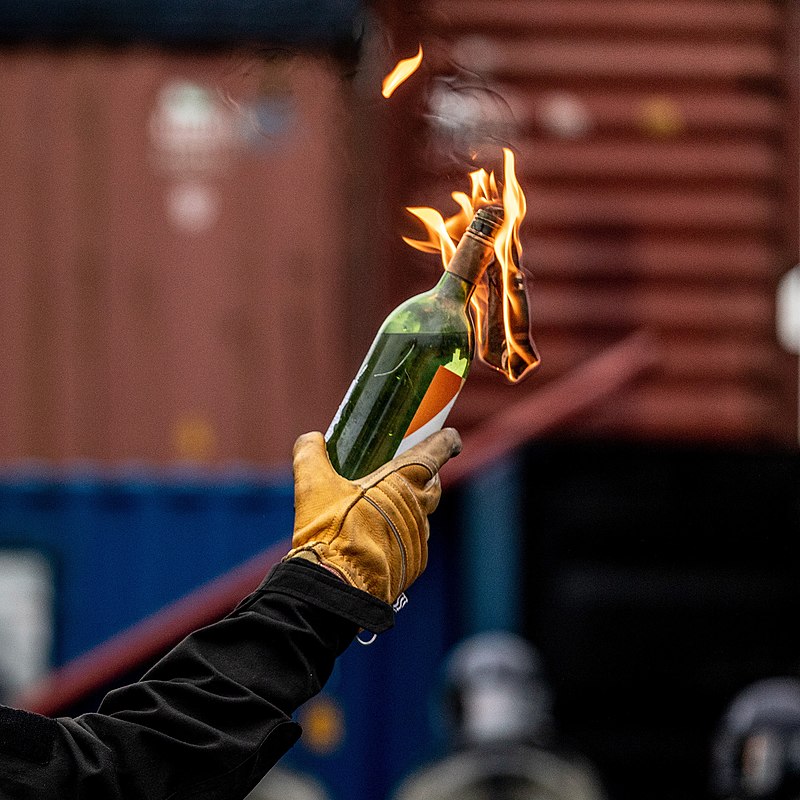
Molotov cocktail
incendiary weapon using flammable liquid in a bottle

napalm
thumb|upright=1.35|North American F-100 Super Sabre dropping napalm in a training exercise

Greek fire
incendiary weapon used by the Eastern Roman (Byzantine) Empire developed c. 672

flamethrower
thumb|A Type 93/Type 100 flamethrower|Type 93 flamethrower used by the [[Imperial Japanese Army, drawing made for the US Military Intelligence Service]]
thumb| A U.S. Soldier firing a flamethrower during the Vietnam War
thumbnail|United States Soldiers demonstrating flamethrower usage (2012)

thermite
thumb|A thermite mixture using iron(III) oxide
fire ship
ship filled with combustibles, deliberately set on fire, and then steered or allowed to drift into an enemy fleet

flare
thumb|upright=1.35|Illumination flares being used during military training exercises
thumb|upright=1.35|Flares being fired from a ship during a fleet review
chlorine trifluoride
chemical compound
incendiary device
bomb designed to start fires
white phosphorus munition
incendiary munition based on white phosphorus
Fu-Go balloon bomb
Japanese World War II fire balloon weapon
triethylaluminum
Triethylaluminium is one of the simplest examples of an organoaluminium compound. Despite its name, the compound has the formula Al2(C2H5)6 (abbreviated as Al2Et6 or TEA). This colorless liquid is pyrophoric. It is an industrially important compound, closely related to trimethylaluminium.
fougasse
weapon
bat bomb
experimental World War II weapon in which bats carried incendiary devices
Molotov bread basket
Soviet incendiary cluster bomb used during the Winter War
incendiary ammunition
ammunition that causes fire upon hitting a target
balm of Gilead
historical perfume used medicinally, of herbal origin
war pig
pigs used in warfare

Astragalus sarcocolla
species of plant
falarica
Falarica, also phalarica, was an ancient Iberian ranged polearm that was sometimes used as an incendiary weapon.
high explosive incendiary
type of ammunition
Mark 77 bomb
American air-dropped incendiary bomb
Le Prieur rocket
French WWI air-to-air rocket
early thermal weapons
category of historical weapons using heat or burning to attack enemy personnel, fortifications or territories
Incendiary kite
improvised weapon
Operation Outward
WWII British balloon attack on Germany
incendiary balloon
weaponized balloon carrying an incendiary device as payload
Thermate
Thermate is a variation of thermite and is an incendiary pyrotechnic composition that can generate short bursts of very high temperatures focused on a small area for a short period of time. It is used primarily in incendiary grenades.
firebombing
thumb|An American aircraft drops napalm on [[Viet Cong positions in 1965.]]
thumb|right|A Nazi Germany|German [[World War II incendiary bomb remnant]]
Nano-thermite
Nano-thermite or super-thermite is a metastable intermolecular composite (MIC) characterized by a particle size of its main constituents, a metal fuel and oxidizer, under 100 nanometers. This allows for high and customizable reaction rates. Nano-thermites contain an oxidizer and a reducing agent, which are intimately mixed on the nanometer scale. MICs, including nano-thermitic materials, are a type of reactive materials investigated for military use, as well as for general applications involving propellants, explosives, and pyrotechnics.
Flame fougasse
type of anti-personnel and anti-tank mine
heated shot
heated projectile fired from a cannon
fire pot
container for carrying fire, usually earthenware
carcass
early form of incendiary bomb or shell, intended to set targets on fire
M-69 Incendiary cluster bomb
US Army Air Forces WWII incendiary bomblet
Sanshiki
Japanese anti-aircraft shell
Dragon's breath
incendiary-effect round for shotgun