Category
page 1Indian religions

Buddhism
thumb|The Kamakura Daibutsu, a 13th-century bronze statue of the Buddha [[Amitābha in Kanagawa Prefecture, Japan]]

Hinduism
Hinduism () is an umbrella term for a range of Indian religious and spiritual traditions (sampradayas) that are unified by adherence to the concept of dharma, a cosmic order maintained by its followers through rituals and righteous living, as expounded in the Vedas. The word Hindu is an exonym, and while Hinduism has been called the oldest surviving religion in the world, it is also described by the 19th century term Sanātana Dharma (). Vaidika Dharma () and Arya Dharma are historical endonyms for Hinduism.

Sikhism
Sikhism, also known as Sikhi, is an Indian religion and philosophy that originated in the Punjab region of the Indian subcontinent around the end of the 15th century CE. It is one of the most recently founded major religions and is followed by 25–30million adherents, known as Sikhs.

Zoroastrianism
Zoroastrianism, also called Mazdayasna and Behdin, is an Iranian religion centred on the Avesta and the teachings of Zarathushtra Spitama, who is more commonly referred to by the Greek translation, Zoroaster (). Among the world's oldest organized faiths, its adherents exalt an uncreated, benevolent, and all-wise deity known as Ahura Mazda (), who is hailed as the supreme being of the universe. Opposed to Ahura Mazda is Angra Mainyu (), who is personified as a destructive spirit and the adversary of all things that are good. As such, the Zoroastrian religion combines a dualistic cosmology of go

Jainism
Jainism ( ), also known as Jain Dharma, is an Indian religion which teaches a path toward spiritual purity and enlightenment through disciplined non-violence (') to all living creatures. The tradition is spiritually guided by twenty-four ' (ford-makers), supreme teachers who have conquered the cycle of rebirth and attained omniscience ('). The core of Jain philosophy is established on three ethical pillars: ' (nonviolence), ' (non-absolutism or many-sided reality), and ' (non-possession). While its ultimate spiritual goal is ' (liberation from '), these ethical principles have historically fos
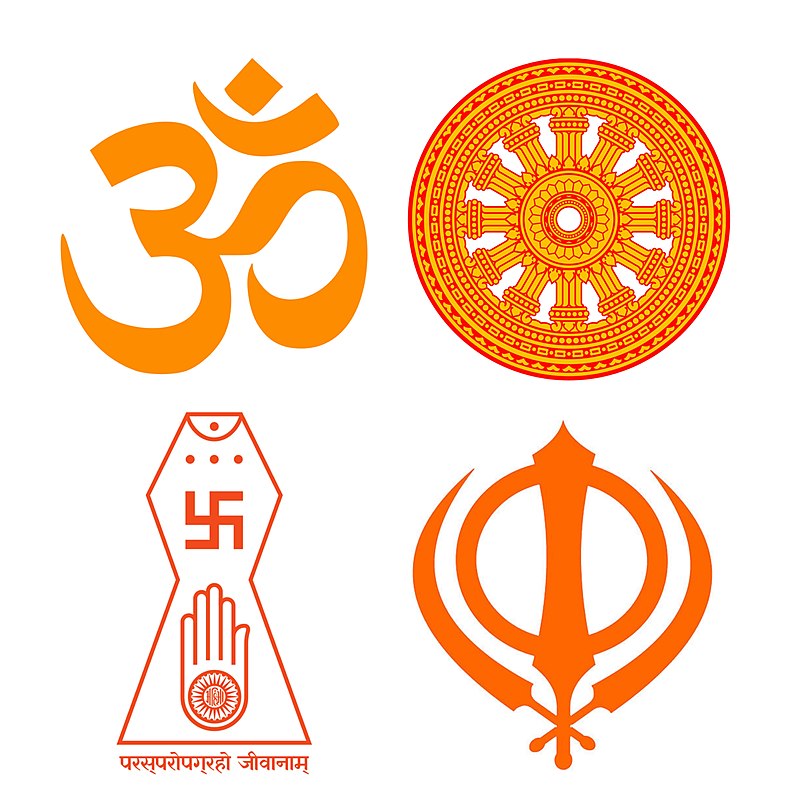
Indian religions
religions that originated in the Indian subcontinent
.png)
Lingayatism

Sarnaism
Sarnaism is a religious faith of the Indian subcontinent, predominantly followed by indigenous communities of the Chota Nagpur Plateau region across states such as Jharkhand, Odisha, West Bengal, Bihar, and Chhattisgarh.
Mazdaism
Mazdaism (Armenian: Մազդէականութիւն; Persian: آیین مزدایی) It is a pre-Zoroastrian Iranian religion, believed to be the ancestor of Zoroastrianism, from which later religions would derive, unlike Zoroastrianism, Ahura Mazda is one of the gods in Mazdaism, considered to be equal to Mithra.

Sanamahism
Sanamahism , also known as Meiteism , or Lainingthouism is an ethnic religion of the Meitei people of Manipur, in Northeast India. It is a polytheistic religion and is named after Lainingthou Sanamahi, one of the most important deities of the Meitei faith. Sanamahi is the eldest son of the supreme god Sidaba Mapu and the supreme goddess Leimarel Sidabi. Traditionally every Meitei household, irrespective of the religion, worships Sanamahi and Leimarel Sidabi. Sanamahism does not have a religious head but has a body, the Maru Loishang, that oversees the main religious activities and governs all
Ajñana
Ajñāna (, (Vedic) IPA: /ɐd͡ʑ.ɲɑː.nɐ/; (Classical) IPA: /ɐd͡ʑˈɲɑː.n̪ɐ/) is an ancient nāstika, or 'heterodox,' Indian school of agnosticism that embraces radical skepticism. It emerged as a Śramaṇa movement and was a major rival of early Buddhism, Jainism and the Ājīvika school. They have been recorded in Buddhist and Jain texts. They held that it was impossible to obtain knowledge of metaphysical nature or ascertain the truth value of philosophical propositions; and even if knowledge was possible, it was useless and disadvantageous for final salvation. They specialized in refutation without pr
Ravidassia
Ravidassia or the Ravidas Panth is a religion based on the teachings of Guru Ravidas. It was considered a sect within Sikhism until 2009. The new religion was officially announced on 29 January 2010 by the Dera Sachkhand Ballan. Its scripture is the Amritbani Satguru Ravidas Maharaj Ji. However, some Ravidassias continue to maintain mainstream Sikh religious practices, including the reverence of the Guru Granth Sahib as their focal religious text, wearing Sikh articles of faith (5Ks), and appending Singh or Kaur to their names.
Donyi-Polo
Donyi Polo is the designation given to the indigenous religion, of animistic and shamanic type, of the Tani and other Tibeto-Burman ethnic groups of Arunachal Pradesh and Assam in Northeast India. The name "Donyi-Polo" means "Sun-Moon", and was chosen for the religion in the process of its revitalisation and institutionalisation started in the 1970s in response to inroads made by Christianity and the possibility of absorption into Hinduism.
Haidakhan Babaji
teacher in northern India
Kirat Mundhum
traditional folk religion of the Kirati people
Meitei mythology
mythology of the Meitei people which is sometimes intertwined with historical facts

Dravidian folk religion
form of Hinduism
Dinkoism
Dinkoism (), the Dinkoist religion, or Dinkamatham is a parody religion and social movement that emerged and evolved on social networks organized by independent welfare groups in the Indian state of Kerala. Adherents describe Dinkoism as a genuine religion.
sant
saint-like exemplar and teacher of truth and virtue in Indian religions
Bathouism
Bathouism (also, Bathou) is the folk religion of the Boro people of Assam in Northeast India. The name (, five; , deep) in Boro means five principles. The five principles are: (air), (fire), (earth), (water) and (ether). The chief deity, called (: "the Elder")— omnipresent, omniscient and omnipotent— is said to have created the five principles. Though there are other minor gods and goddesses, Bathoubwrai is considered the Supreme God. Bathoubwrai is unseen. The second most important deity is , the daughter of Bathoubwrai, who is considered as the "protector of the rice fields".
Panthan
Panth (also panthan, meaning "path" in Sanskrit), also called the Sampradaya, is the term used for several religious traditions in India. A panth is founded by a guru or an acharya in guru-shishya parampara, and is often led by scholars or senior practitioners of the tradition.