Category
page 1Industrial history
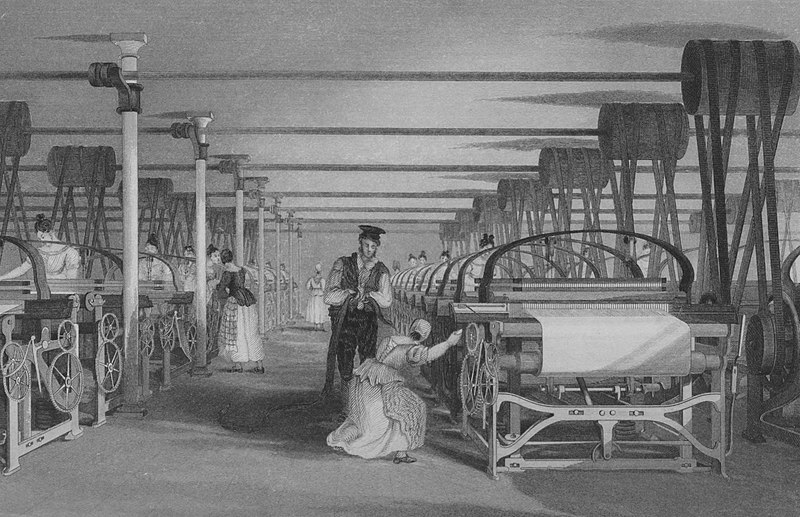
Industrial Revolution
transition to new manufacturing processes in Europe and the United States, in the 18th-19th centuries

industrialisation
thumb|The effect of industrialisation shown by rising income levels in the 19th century, including gross national product at [[purchasing power parity per capita between 1750 and 1900 in 1990 U.S. dollars for the First World, including Western Europe, United States, Canada and Japan, and Third World nations of Europe, Southern Asia, Africa, and Latin America]]
thumb|The effect of industrialisation is also shown by rising levels of CO2 emissions.
thumb|Industrialisation also means the mechanisation of traditionally manual economic sectors such as agriculture.
thumb|Factories, refineries, mines,

division of labour
separation of tasks in any system (particularly the society) so that participants may specialize

Second Industrial Revolution
phase of rapid industrialization in the final third of the 19th century and the beginning of the 20th
Newly Industrialized Country
developing country with high economic growth and recent industrialization and urbanization

mechanization
thumb|right|A water-powered Hoist (device)#Mine hoists|mine hoist used for raising ore. This woodblock is from [[De re metallica by George Bauer (pen name Georgius Agricola, ca. 1555) an early mining textbook that contains numerous drawings and descriptions of mining equipment.]]

deindustrialization
thumb|Bethlehem Steel in Bethlehem, [[Pennsylvania, one of the world's leading steel manufacturers for most of the 20th century, discontinued most of its operations in 1982, filed for bankruptcy in 2001, and was dissolved in 2003.]]
Deindustrialization is a process of social and economic change caused by the removal or reduction of industrial capacity or activity in a country or region, especially of heavy industry or manufacturing industry.
Venetian Arsenal
complex of former shipyards and armories in Venice, Italy
history of paper
aspect of history

ironmongery
thumb|An ironmonger's shop in Pickering, North Yorkshire
thumb|Inside a typical ironmonger's in Soignies (Belgium)
thumb|An ironmonger's shop in France, with iron goods and other consumer goods
Ironmongery originally referred, first, to the manufacture of iron goods and, second, to the place of sale of such items for domestic rather than industrial use. In both contexts, the term has expanded to include items made of steel, aluminium, brass, or other metals, as well as plastics.

sexual division of labour
delegation of different tasks between males and females

history of candle making
aspect of history
history of Tejo Power Station
history of Tejo Power Station in Lisboa
turret lathe
type of metal-working lathe

Soda oppositifolia
species of plant
history of the Panama Canal
aspect of history
Forsby-Köping limestone cableway
material ropeway in Sweden
Efficiency movement
movement intended to eliminate "waste" in all areas of life
Soda inermis
species of plant