Category
page 1Islamic mythology

Japheth
Japheth ( Yép̄eṯ, in pausa Yā́p̄eṯ; '; ; ') was one of the three sons of Noah in the Book of Genesis. In the biblical narrative he plays a role in the story of Noah's drunkenness and the curse of Ham, and subsequently in the Table of Nations, he is named as the ancestor of the peoples of the Aegean Sea, Anatolia, Caucasus, Greece, and elsewhere in Eurasia.
.jpg)
Nimrod
thumb|267px|Nimrod by David Scott (painter)|David Scott, 1832
Nimrod is a biblical figure mentioned in the Book of Genesis and the Books of Chronicles. The son of Cush and thus the great-grandson of Noah, Nimrod was described as a king in the land of Shinar (Lower Mesopotamia). The Bible states that he was "a mighty hunter before the Lᴏʀᴅ [and] ... began to be mighty in the earth". Nimrod became a symbol of defiance against God.

Al-Jinn
Al-Jinn (, "The Jinn") is the 72nd chapter (sūrah) of the Quran with 28 verses (āyāt). The name as well as the topic of this chapter is jinn. In the Quran, it is stated in that humans are created from the earth and jinn from smokeless fire.

Az-Zumar
thumb|Some famous verses of Az-Zumar seen in the tilings of Imam Ali Shrine|Imam Ali Mosque in [[Najaf, Iraq, 1994.]]
Az-Zumar (, ; "The Troops, The Throngs") is the 39th chapter (surah) of the Qur'an, the central religious text of Islam. It contains 75 verses (ayat). This surah derives its name from the Arabic word zumar (troops) that occurs in verses 71 and 73. Regarding the timing and contextual background of the believed revelation (asbāb al-nuzūl), it is believed to have been revealed in the mid-Meccan period when persecutions of the Muslim believers by the polytheists had escalated.

Ibrahim
forefather of the Abrahamic religions from the Islamic perspective

Isra and Mi'raj
night journey undertaken by Muhammad in Jerusalem
Luqman
Luqman (; also known as Luqman al-Hakim, meaning Luqman the Wise) was a legendary sage and hero in pre-Islamic Arab tradition. The 31st surah (chapter) of the Qur'an, Luqman, is named after him and depicts him as a monotheist and a father giving pious advice to his son. Subsequently, a large number of proverbs were attributed to Luqman, and at some point in the medieval era he was identified as a writer of fables. Many fables and biographical details which in Europe were connected with Aesop were transferred to Luqman. There are many stories about Luqman in Persian, Arabic and Turkish literatu

fall of man
in Christianity, the transition of the first man and woman from a state of innocent obedience to God to a state of guilty disobedience

Zulfiqar
Zulfiqar or Zulfaqar (, ), also spelled Zu al-Faqar, Zulfakar, Dhu al-Faqar, or Dhulfaqar) is the sword of Ali ibn Abi Talib that was distinguished by having a double blade.
Gog and Magog
pair of individuals, peoples, or lands in the Bible and the Qur'an

Dhu'l-Qarnayn
figure in the Quran

Khidr
Khidr () is a quranic figure of Islam. He is described in Surah al-Kahf as a righteous servant of God possessing great wisdom or mystic knowledge. In various Islamic and non-Islamic traditions, Khidr is described as an angel, prophet, or wali (saint), who guards the sea, teaches secret knowledge and aids those in distress. He prominently figures as patron of the Islamic saint Ibn Arabi. The figure of al-Khidr has been syncretized over time with various other figures including Dūraoša and Sorūsh in Iran, Sargis the General and Saint George in Asia Minor and the Levant, Elijah and Samael (the di
Yusuf and Zulaikha
romantic story

parī
A parī or peri is a supernatural entity originating from Persian tales and distributed into wider Asian folklore. The parīs are often described as winged creatures of immense beauty who are structured in societies similar to that of humans. Unlike jinn, the parīs usually feature in tales involving supernatural elements.
Islamic mythology
body of myths associated with Islam
religion in pre-Islamic Arabia
religions practiced by Arabs before Islam
Qisas Al-Anbiya
Genre of Islamic literature, describing the history and stories of the prophets in Islam
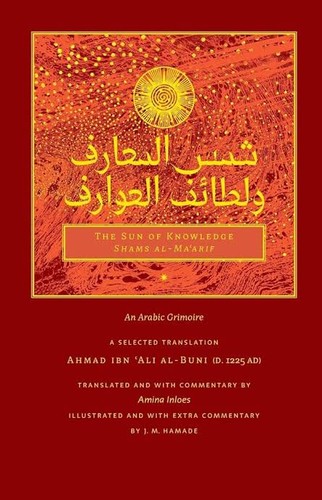
Shams al-Ma'arif
13th-century book by houari smail
'Amr ibn Luhayy
Pre-islamic tribal chief
Well of Souls
Cave in the Dome of the Rock, Jerusalem, underneath the Foundation stone

Asfi bin Barkhiya
figure in Islamic tradition who brought Queen of Sheba's throne to Solomon

Japhetic people
thumb|230px|right|This T and O map, from the first printed version of Isidore's [[Etymologiae (Augsburg 1472), identifies the three known continents (Asia, Europe, and Africa) as respectively populated by descendants of Sem (Shem), Iafeth (Japheth), and Cham (Ham).]]
Barṣīṣā
Barsisa, ("the man of priestly regalia", from Aramaic bar, "son", and ṣīṣa, "gold plate", referring specifically to the high priest's breastplate) in Islamic theology, was an ascetic who succumbed to the Devil's temptations and denied God.

Rawzat as-Safa
History of the origins of Islam, early Islamic civilisation, and Persian history by Mirkhvand
Yakub
noted black scientist within the beliefs of the Nation of Islam