Category
page 1Jewish life cycle

kippah
thumb|300px|Crocheted kippot for sale in Jerusalem
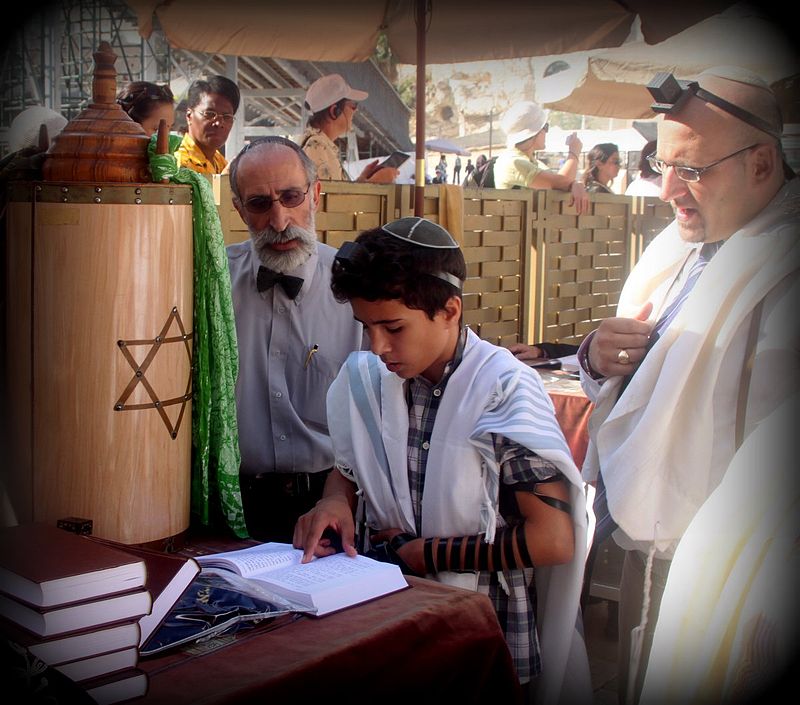
bar and bat mitzvah
Jewish coming-of-age rituals

tefillin
Tefillin ( or ; ), or phylacteries, are sets of small black leather boxes with leather straps containing scrolls of parchment inscribed with verses from the Torah. Tefillin are traditionally worn by male adult Jews during Shacharit on weekdays.

tallit
alt=A close-up photograph of a framed, long rectangular silver lace neckband for a prayer shawl, featuring intricate symmetrical patterns of interlaced metallic threads on a dark background.|thumb
brit milah
Jewish religious male circumcision ceremony performed by a mohel on the eighth day of a male infant's life
Kaddish
The Kaddish (, 'holy' or 'sanctification'), also transliterated as Qaddish, is a hymn praising God that is recited during Jewish prayer services. The central theme of the Kaddish is the magnification and sanctification of God's name. In the liturgy, different versions of the Kaddish are functionally chanted or sung to separate the sections of the service.

minyan
In Judaism, a minyan ( minyān , lit. (noun) count, number; pl. minyānīm ) is the quorum of ten Jewish adults required for certain religious obligations. In all traditional orthodox practising Jewish religious movements, only men aged 13 years and older may constitute a minyan. The minimum of 10 Jews needed for a minyan has its origin (in part) in Abraham's prayer to God in Genesis 18:32. The minyan has additional roots in the judicial structure of ancient Israel as Moses first established it in Exodus 18:25 (i.e., the "rule of the 10s"). Cyrus Adler's and Lewis Naphtali Dembitz's entry for "Mi
%20box%2C%20Charleston%2C%201820%2C%20silver%2C%20National%20Museum%20of%20American%20Jewish%20History.JPG)
Tzedakah
thumb|Tzedakah box (Pushke), Charleston, 1820, silver, [[National Museum of American Jewish History]]
Tzedakah ( ṣədāqā, ) is a Hebrew word meaning "righteousness", but commonly used to signify charity. This concept of "charity" differs from the modern Western understanding of "charity". The latter is typically understood as a spontaneous act of goodwill and a marker of generosity; tzedakah is an ethical obligation, and it is not properly "charity", like in Christendom, but a way to empower poor people to support themselves, helping them in developing their talents and skills. The Medieval Jew
Weekly Torah portion
section of the Torah used in Jewish liturgy during a single week
Pidyon haben
Jewish ceremony
Chevra kadisha
Jewish burial association

Niddah
A niddah (alternative forms: nidda, nida, or nidah; nidá), in traditional Judaism, is a woman who has experienced a uterine discharge of blood (most commonly during menstruation), or a woman who has menstruated and not yet completed the associated requirement of immersion in a mikveh (ritual bath).
Shiva
week-long mourning period in Judaism for first-degree relatives
Bereavement in Judaism
Jewish mourning practices
Minhag
A minhag (; ) is an accepted tradition or group of traditions in Judaism. A related concept, nusach (; ), refers to the traditional ordering and forms of Jewish prayer.

Tzniut
Tzniut ( , , ; "modesty" or "privacy"; ) describes the character trait of modesty and discretion, as well as a group of Jewish laws pertaining to conduct. The concept is most important within Orthodox Judaism.
get
Jewish divorce document
Zeved habat
Jewish naming ceremony for newborn girls
Shidduch
The Shidduch (, pl. shidduchim , Aramaic shidduchin) is a system of matchmaking in which Jewish singles are introduced to one another in Orthodox Jewish communities for the purpose of marriage.

Upsherin
thumb|Upsherin celebration by Rabbi Eliezer Shlomo Schick
thumb|alt=Upsherin, 1992|Upsherin, 1992
thumb|alt=Upsherin, 1992|Upsherin, 1992
Upsherin, Upsheren, Opsherin or Upsherinish (, ) is a first haircut ceremony observed by a wide cross-section of Jews and is particularly popular in Haredi Judaism. It is typically held when a boy turns three years old.
Hebrew name
name of Hebrew-language origin
Ana bekoach
Jewish prayer