Category
page 1Jewish ritual objects
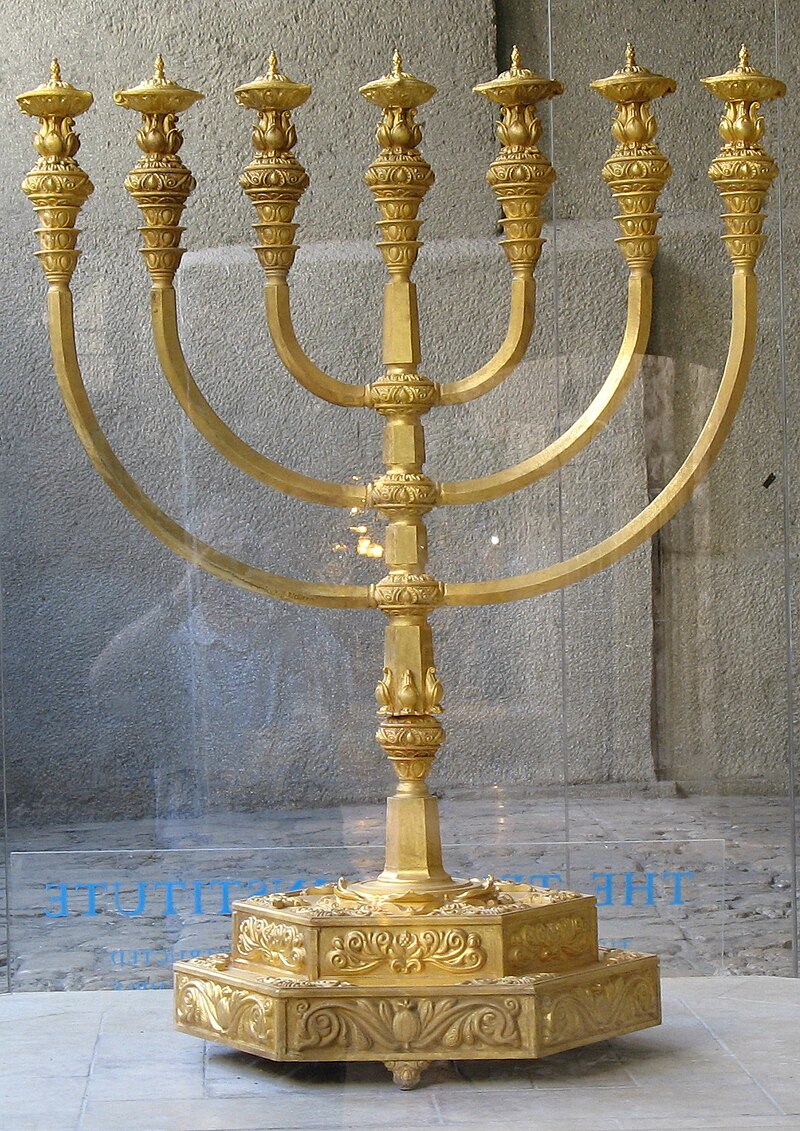
menorah
ancient Hebrew lampstand

kippah
thumb|300px|Crocheted kippot for sale in Jerusalem

Mezuzah
thumb|upright|Ashkenazi Jews|Ashkenazi mezuzah. The case is tilted and features the Hebrew letter (Shin).
thumb|upright|A Sephardi Jews|Sephardic mezuzah. The mezuzah case is vertical and features the Hebrew letter (Shin).

tefillin
Tefillin ( or ; ), or phylacteries, are sets of small black leather boxes with leather straps containing scrolls of parchment inscribed with verses from the Torah. Tefillin are traditionally worn by male adult Jews during Shacharit on weekdays.

tallit
alt=A close-up photograph of a framed, long rectangular silver lace neckband for a prayer shawl, featuring intricate symmetrical patterns of interlaced metallic threads on a dark background.|thumb

shofar
thumbnail|Shofar
thumbnail|Shofar
thumbnail|Blowing the shofar
A shofar ( ; from , ) is an ancient musical horn, typically a ram's horn, used for Jewish ritual purposes. Like the modern bugle, the shofar lacks pitch-altering devices, with all pitch control done by the player's varying their embouchure. The shofar is blown in synagogue services on Rosh Hashanah and at the end of Yom Kippur; it is also blown every weekday morning in the month of Elul running up to Rosh Hashanah. Shofars come in a variety of sizes and shapes, depending on the choice of animal and level of finish.
hanukkiah
nine-branched candelabrum lit during the eight-day holiday of Hanukkah

dreidel
thumb|upright=1.35|Dreidels for sale at Mahane Yehuda Market in [[Jerusalem, Israel, with Israel specific lettering on blue dreidels (נ ג ה פ) and diaspora lettering on orange dreidels (נ ג ה ש)]]
thumb|upright=1.35|A variety of dreidels

Tzitzit
Tzitzit ( ṣīṣīṯ, ; plural ṣīṣiyyōṯ, Ashkenazi: '; and Samaritan: ') are specially knotted ritual fringes, or tassels, worn in antiquity by Israelites and also modern observant Jews and Samaritans. are usually attached to the four corners of the tallit gadol (prayer shawl), usually referred to simply as a or ; and tallit katan (everyday undershirt). Through synecdoche, a may be referred to as .

shtreimel
thumb|upright=.9|Shtreimel on a mannequin
Sefer Torah
handwritten copy of the Torah

sukkah
250px|thumb|Canvas-sided sukkah on a roof, topped with palm branches and bamboo s'chach
250px|thumb|Sukkah with walls made of cardboard signs in Oakland, California

yad
thumb|upright=0.9|right|Pointing with a yad on an open Torah scroll
Shabbat candles
candles lit on Friday evening to usher in Shabbat

tekhelet
thumb|right|300px|Tzitzit produced from a blue dye derived from [[Hexaplex trunculus and tied according to the opinion of the Sefer ha-Chinuch, resting atop volumes of the Shulchan Aruch.]]
thumb|upright|The flag of Israel, which emulates the tekhelet color for the [[Star of David and the two tallit-like stripes.]]
thumb|upright|A contemporary tekhelet thread tied according to the method of the 18th-century rabbi Vilna Gaon.
thumb|A Jew wearing blue tzitzit, 15th-century

kittel
right|thumb|220px|A kittel
Four Species
a mitzvah held on the seven days of Sukkot
Molten Sea
large basin in the Temple in Jerusalem made by Solomon for ablution of the priests
Jewish ceremonial art
Array of objects used by Jews for ritual purposes
Afikoman
Afikoman or Afikomen (Mishnaic Hebrew: אֲפִיקִימוֹן ʾăpîqîmôn; Modern pronunciation: אֲפִיקוֹמָן ʾăpîqômān) based on Greek epikomon [ἐπὶ κῶμον] or epikomion [ἐπικώμιον], meaning "that which comes after" or "dessert"), a word originally having the connotation of "refreshments eaten after the meal", is now almost strictly associated with the half-piece of matzo which is broken in two during the early stages of the Passover Seder and set aside to be eaten as a dessert after the meal.
.jpg)
parochet
thumb|Parochet on a mobile ark at the Western Wall in Jerusalem
A parochet (; ), meaning "curtain" or "screen", is the curtain that covers the Torah ark (Aron Kodesh) containing the Torah scrolls in a synagogue.
Hadass
right|thumb|250px|Three hadass branches, seen here in front of the lulav (middle), and the [[aravah branches in the back]]
wimpel
thumb|center|600px|A modern Wimpel with the name obscured
Challah cover
special cloth used to cover the two braided loaves
hachnasat sefer torah
Jewish ceremony involving Torah scrolls
Shiviti
thumb|upright|Shiviti with Hebrew text in the form of a menorahA shiviti or shivisi () is a type of mystical meditation aid. It is crowned at the top by Psalm 16:8, including the sacred name of God in the center, followed by Psalm 67 set in the shape of the Temple lampstand. It is used in Kabbalah for contemplation of the Tetragrammaton. One type of shiviti is placed at the front of the synagogue, where it may also serve as a type of mizrah; another popular format, designed for personal use, fits inside a prayerbook.