Category
page 1Julius Caesar

Julius Caesar
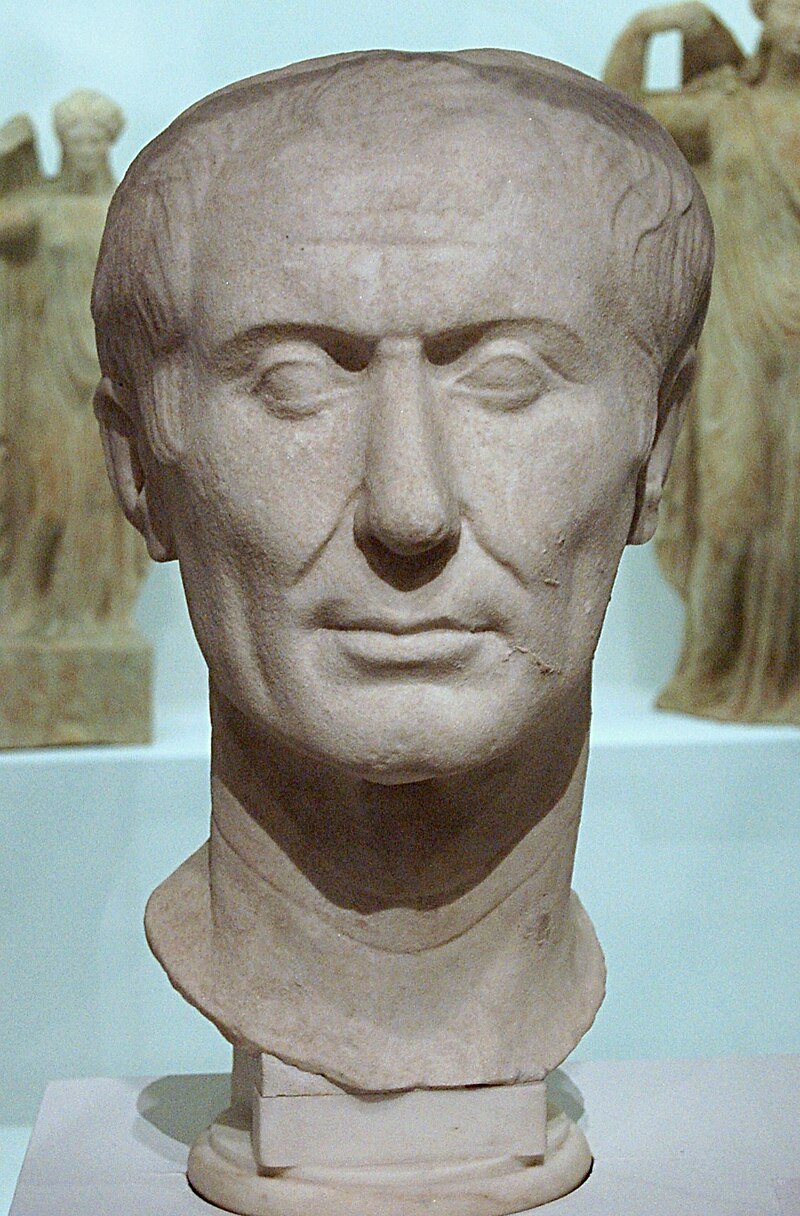
Gaius Julius Caesar was a Roman general, statesman, and author who was the dictator of the Roman Republic almost continuously from 49 BC until his assassination in 44 BC. A member of the First Triumvirate, he led the Roman armies through the Gallic Wars and defeated his political rival Pompey in Caesar's civil war. He consolidated power and proclaimed himself dictator for life in 44 BC, which contributed to the political conditions that led to the collapse of the Roman Republic and the emergence of the Roman Empire. For his role in these events, he is regarded as one of the most influential historical figures.

Pompey
Gnaeus Pompeius Magnus (; 29 September 106 BC – 28 September 48 BC), known in English as Pompey ( ) or Pompey the Great, was a Roman general and statesman who was prominent in the last decades of the Roman Republic. As a young man, he was a partisan and protégé of the dictator Sulla, after whose death he achieved much military and political success himself.

Rubicon
The Rubicon (; ; ) is a shallow river in northeastern Italy, just south of Cesena and north of Rimini. It was known as Fiumicino until 1933, when it was identified with the ancient river Rubicon, crossed by Julius Caesar in 49 BC.
The river flows for around from the Apennine Mountains to the Adriatic Sea through the south of the Emilia-Romagna region, between the towns of Rimini and Cesena.

Caesar cipher
simple and widely known encryption technique

Gallic War
war (58–50 BCE) between the Roman Republic and Gaul
First Triumvirate
alliance between Roman politicians Caesar, Pompey and Crassus
assassination of Julius Caesar
stabbing attack that caused the death of Julius Caesar (44 BCE)
Basilica Julia
building in Roman Forum, Italy
Legio V Alaudae
Roman legion
Legio III Gallica
Roman legion
Legio XII Fulminata
Roman legion
crossing the Rubicon
historical event and idiom
Caesar's Comet
non-periodic comet
Saepta Julia
archaeological site in Rome

Caesarism
thumb|right|220px|A statue of Julius Caesar, in the city of Rimini, Italy
Siege of Alexandria
48-47 BC battle of the Alexandrian War, Caesar vs Ptolemy XIII

Avaricum
Avaricum was an oppidum in ancient Gaul, near what is now the city of Bourges. Avaricum, situated in the lands of the Bituriges Cubi, was the largest and best-fortified town within their territory, situated on very fertile lands. The terrain favored the oppidum, as it was flanked by a river and marshland, with only a single, narrow entrance.
By the time of the Roman conquest in 52 BC, the city, according to Julius Caesar, had a population of 40,000 people who were then almost all killed.
Legio X Equestris
Roman legion
Siege of Massilia
49 BCE military blockade and naval battle, part of Caesar's civil war against Pompey
Alexandrian War
Caesar's intervention in Egypt during his civil war
Ludi Romani
Ancient Roman religious festival

Caesar's Rhine bridges
construction and location
Gate of Athena Archegetis
dictator perpetuo
office held by Julius Caesar
Temple of Hercules Gaditanus
Roman temple in Cádiz
Siege of the Atuatuci
56 BCE siege

Lex Julia de repetundis
law against extortion brought by Julius Caesar in 59 BC
Lex Trebonia
Roman law from 55 BC
Florentia
Roman city
Lucca Conference
56 BC conference between members of the First Triumvirate
Maria Wyke
British academic and scholar of Latin
military campaigns of Julius Caesar
overview about the military campaigns of Julius Caesar
Portico of Pompey
a large quadriporticus located directly behind the scaenae frons of the Theatre of Pompey
Julius Caesar's planned invasion of the Parthian Empire
military campaign that Gaius Julius Caesar never executed