Category
page 1Jurassic England

Pliosaurus
Pliosaurus is the type genus (defining example) of the pliosaurs, one of the major group of the plesiosaurs, an extinct group of aquatic marine reptiles. It lived from the Upper Jurassic to the Lower Cretaceous in what is now Europe and South America. The first known fossil consists of a partial skeleton of an immature specimen collected by William Buckland in Market Rasen, England. Although initially mentioned in a 1824 paper by William Daniel Conybeare, it was not until 1841 that it was first formally described by Richard Owen as belonging to a new species of Plesiosaurus, before being given

Cryptoclidus
Cryptoclidus ( ) is a genus of plesiosaur reptile from the Middle Jurassic period of England, France, and Cuba.

Peloneustes
Peloneustes (meaning ) is a genus of pliosaurid plesiosaur from the Middle Jurassic of England. Its remains are known from the Peterborough Member of the Oxford Clay Formation, which is Callovian in age. It was originally described as a species of Plesiosaurus by palaeontologist Harry Govier Seeley in 1869, before being given its own genus by naturalist Richard Lydekker in 1889. While many species have been assigned to this genus, P. philarchus is currently the only one still considered valid, with the others moved to different genera, considered nomina dubia, or synonymised with P. philarchus

Stenopterygius
Stenopterygius is an extinct genus of thunnosaur ichthyosaur known from Europe (England, France, Germany, Luxembourg and Switzerland).

Leptolepis
Leptolepis (from , 'slight' and 'scale') is an extinct genus of stem-teleost fish that lived in what is now Europe (Germany, Luxembourg, France, England, Italy and maybe Greece) and North of Africa (Algeria, Tunisia and Morocco) during the Jurassic period (Pliensbachian–Callovian ages).

Microcleidus
Microcleidus is an extinct genus of sauropterygian reptile belonging to the Plesiosauroidea. The species has 40 neck vertebrae and a short tail of 28 vertebrae. Fossils of the genus have been found in France, the Posidonia Shale in Germany and Luxembourg, and the Alum Shale Formation of England.

Colymbosaurus
Colymbosaurus is a genus of cryptoclidid plesiosaur from the Middle-Late Jurassic (Callovian-Tithonian) of the UK and Svalbard, Norway. There are two currently recognized species, C. megadeirus and C. svalbardensis.
Amphilestes
Amphilestes is a genus of extinct eutriconodont mammal from the Middle Jurassic of the United Kingdom. It was one of the first Mesozoic mammals discovered and described.

Eretmosaurus
Eretmosaurus (meaning "oar lizard") is an extinct genus of plesiosaur from the Early and Middle Jurassic of England and Russia. Two species are known: E. rugosus and E. dubius.
Torvoneustes
Torvoneustes is an extinct genus of metriorhynchid thalattosuchian. It is known from skull and postcranial remains found in the Kimmeridge Clay Formation of Dorset and Wiltshire, England, the Virgula Marls of Switzerland and also from Oaxaca, Mexico
. The holotype skull of the type species was initially assigned to the species Metriorhynchus superciliosus. Postcranial remains were later discovered from the same quarry as the skull, and then these specimens were recognised as belonging to a new species of Dakosaurus, as D. carpenteri. The species was named to honour Simon Carpenter, an amateur
Amphitherium
Amphitherium is an extinct genus of stem cladotherian mammal that lived during the Middle Jurassic of England. It was one of the first Mesozoic mammals ever described. A recent phylogenetic study found it to be the sister taxon of Palaeoxonodon. It is found in the Forest Marble Formation and the Taynton Limestone Formation.
Tyrannoneustes
Tyrannoneustes is an extinct genus of geosaurine metriorhynchid crocodyliform from the Callovian stage Oxford Clay Formation of England and the Marnes de Dives of France. It contains a single species, Tyrannoneustes lythrodectikos, meaning "blood-biting tyrant swimmer".
Atychodracon
Atychodracon is an extinct genus of rhomaleosaurid plesiosaurian known from the Late Triassic - Early Jurassic boundary (probably early Hettangian stage) of England. It contains a single species, Atychodracon megacephalus, named in 1846 originally as a species of Plesiosaurus. The holotype of "P." megacephalus was destroyed during a World War II air raid in 1940 and was later replaced with a neotype. The species had a very unstable taxonomic history, being referred to four different genera by various authors until a new genus name was created for it in 2015. Apart from the destroyed holotype a
Kimmeridge Clay
geological formation in Great Britain
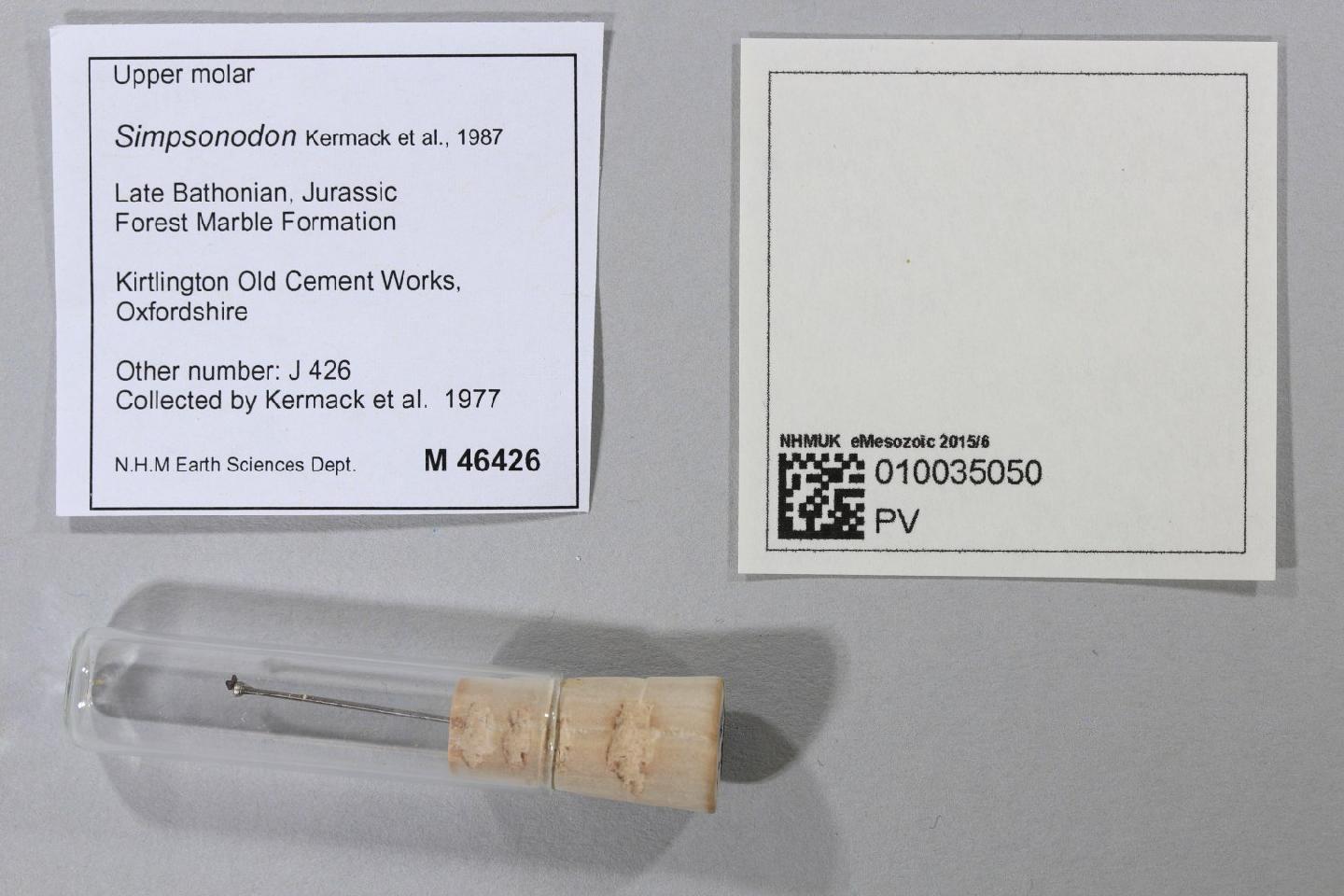
Simpsonodon
Simpsonodon is an extinct genus of docodontan mammaliaform known from the Middle Jurassic of England, Kyrgyzstan and Russia. The type species S. oxfordensis was described from the Kirtlington Mammal Bed and Watton Cliff in the Forest Marble Formation of England. It was named after George Gaylord Simpson, a pioneering mammalologist and contributor to the Modern Evolutionary Synthesis. A second species S. sibiricus is known from the Itat Formation of Russia, and indeterminate species of the genus are also known from the Balabansai Formation in Kyrgyzstan
Eardasaurus
Eardasaurus is a genus of thalassophonean pliosaurid from the middle Jurassic Oxford Clay Formation. The animal would have measured over long (the tail was not fully preserved) and possessed a high amount of teeth relative to other pliosaurs. Its teeth show distinct ridges formed by the tooth enamel, some of which are very pronounced and similar to carinae, giving the teeth a cutting edge.
Thomasia
genus of mammals (fossil)
Kuehneotherium
Kuehneotherium is an early mammaliaform genus, previously considered a holothere, that lived during the Late Triassic-Early Jurassic Epochs and is characterized by reversed-triangle pattern of molar cusps. Although many fossils have been found, the fossils are limited to teeth, dental fragments, and mandible fragments. The genus includes Kuehneotherium praecursoris and all related species. It was first named and described by Doris M. Kermack, K. A. Kermack, and Frances Mussett in November 1967. The family Kuehneotheriidae and the genus Kuehneotherium were created to house the single species Ku
Lias Group
sequence of rock strata found in a large area of western Europe
Cuspicephalus
Cuspicephalus is an extinct genus of monofenestratan pterosaur known from Dorset in England. Its fossil remains date back to the Late Jurassic period.

Strophodus
Strophodus is an extinct genus of durophagous hybodont known from the Triassic to Cretaceous. It was formerly confused with Asteracanthus.
Phascolotherium
Phascolotherium is a genus of extinct eutriconodont mammal from the Middle Jurassic of the United Kingdom. Found in the Stonesfield Slate, it was one of the first Mesozoic mammals ever found and described, although like the other mammal jaws found at the same time, it was mistakenly thought at first to be a marsupial.
Thalassemys
Thalassemys is a genus of extinct thalassochelydian turtle from the Late Jurassic of western and central Europe. While the genus was originally named by Rütimeyer in 1859 for a large carapace and other associated fragments from the late Kimmeridgian of the Reuchenette Formation of Switzerland, although the taxon was not validly named until 1873 when Rütimeyer designated the type species T. hugii. Rütimeyer also named T. gresslyi from the Reunchenette Formation in the same paper as T. hugii, but it cannot be differentiated from the type material of T. hugii and is therefore a junior synonym. A
Pleurosternon
Pleurosternon is an extinct genus of freshwater pleurosternid turtle from the latest Jurassic to earliest Cretaceous of Europe. Its type species, P. bullockii, was described by the paleontologist Richard Owen (noted for coining the word Dinosauria) in 1853. Since then, and throughout the late 19th century, many fossil turtles were incorrectly assigned to this genus, though only two are currently considered valid.
Neosteneosaurus
Neosteneosaurus is a genus of machimosaurid, known from the Middle Jurassic Oxford Clay of the UK, and Marnes de Dives, France.
Blapsium
Blapsium is an extinct genus of beetles from the Middle Jurassic of England. The only described species is B. egertoni, which was first described by John O. Westwood in 1854. The species is known from a single specimen found by the Earl of Enniskillen in the Stonesfield Slate, now known as part of the Taynton Limestone Formation, which Sir Philip Egerton then passed to Westwood for description. The specimen is deposited in the Natural History Museum, London. It is incompletely preserved, lacking a head, pronotum and legs. It has a broad, convex body. It has a very short metathorax, which sugge

Pachythrissops
Pachythrissops is an extinct genus of ray-finned fish. It contains two species, P. laevis from the Purbeckian of England and P. propterus from the Tithonian of Germany. A third species, P. vectensis, has been reassigned to the elopiform genus Arratiaelops. Pachythrissops is often regarded as one of the most primitive members of the order Ichthyodectiformes; however, a phylogenetic analysis by Cavin et al. (2013) placed it and the related genus Ascalabothrissops outside the group.