Category
page 1KGB

KGB
The Committee for State Security (, ), abbreviated as KGB (, ; ) was the main security agency of the Soviet Union from 1954 to 1991. It was the direct successor of preceding Soviet secret police agencies including the Cheka, OGPU, and NKVD. Attached to the Council of Ministers, it was the chief government agency of "union-republican jurisdiction", carrying out internal security, foreign intelligence, counter-intelligence and secret police functions. Similar agencies operated in each of the republics of the Soviet Union aside from the Russian SFSR, where the KGB was headquartered, with many ass
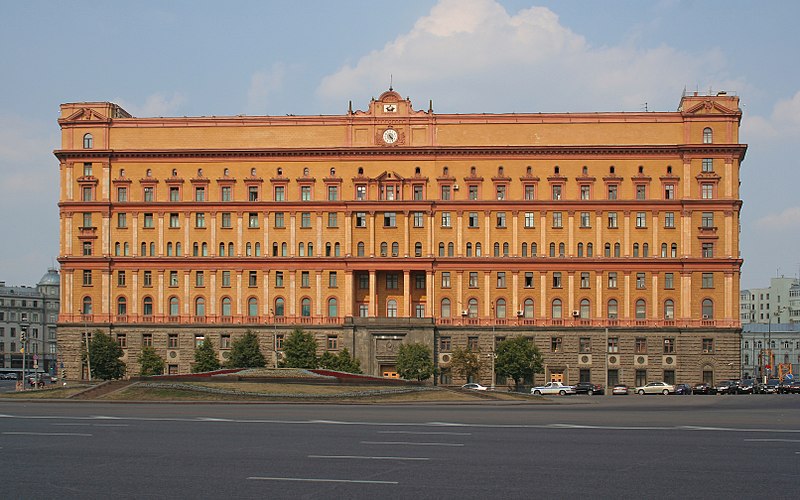
Lubyanka Building
popular name for the headquarters of the KGB and affiliated prison on Lubyanka Square in Moscow, Russia
Alpha Group
Russian spetsnaz unit under the command of the FSB
State Security Committee of the Republic of Belarus
National intelligence agency of Belarus
Lefortovo Prison
Prison in Moscow, Russia
Mitrokhin Archive
KGB leaked secret files given by Vasili Mitrokhin

Vympel
Directorate "V" of the FSB Special Purpose Center, often referred to as Spetsgruppa "V" Vympel (pennant in Russian, originated from German , and having the same meaning), but also known as KGB Directorate "V", Vega Group, is a stand-alone sub-unit of Russia's special forces within the Russian Special Purpose Center of the Federal Security Service (FSB).
active measures
term for the actions of political warfare conducted by the Soviet and Russian security services
The Thing
Audio bug formerly hidden in Moscow US embassy
Museum of Occupations and Freedom Fights
museum in Vilnius, Lithuania
Dynamo Sports Club
sports club founded in the Soviet Union
First Chief Directorate
foreign surveillance organisation of the Soviet Union, within the KGB
Bolshoy Dom
administrative building of the OGPU-NKVD-KGB-FSB in Saint Petersburg, Russia
FAPSI
FAPSI () or Federal Agency of Government Communications and Information (FAGCI) () was a Russian government agency, which was responsible for signal intelligence and security of governmental communications.
Academy of Foreign Intelligence
espionage academy in Russia
Operation Jungle
1945–1955 British Secret Intelligence Service program to infiltrate its agents into Poland and Baltic states
Military counterintelligence of the Soviet Army
Federal Tax Police Service of the Russian Federation
law enforcement agency
Corner House
former Latvian headquarters of the KGB
Poison laboratory of the Soviet secret services
secret research facility
Fialka
In cryptography, Fialka (M-125) is the name of a Cold War-era Soviet cipher machine. A rotor machine, the device uses 10 rotors, each with 30 contacts along with mechanical pins to control stepping. It also makes use of a punched card mechanism. Fialka means "violet" in Russian. Information regarding the machine was quite scarce until c. 2005 because the device had been kept secret.

Sobieskiego 100
residential building complex in Warsaw, Poland
SOUD
SOUD, standing for System of Joint Acquisition of Enemy Data was a computerized intelligence exchange system where information acquired by the intelligence and security agencies from participating Warsaw Pact countries was stored.
thumb|The application form for the SOUD system
The intelligence exchange organization was founded in 1977, and its initial goal was to safeguard the USSR from 'foreign threats' during the 1980 Olympics in Moscow.
Stasi engineers conceived the system using stolen Western technology, and it was operational in 1979. Its main computer was based in Moscow, the input lang
TKB-506
__NOTOC__
Committee for State Security of the Latvian Soviet Socialist Republic
Tuskulėnai Manor
building in Vilnius, Lithuania
First Department
Institute of Cryptography, Telecommunications and Computer Science
Russian college of FSB Academy
Russian Federation Security Guard Service Federal Academy
organization in Oryol, Russia