Category
page 1Labor history

division of labour
separation of tasks in any system (particularly the society) so that participants may specialize
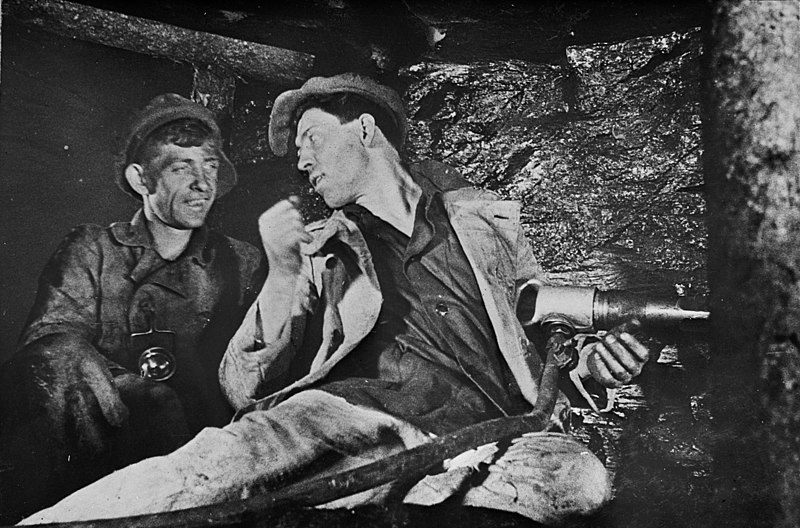
Stakhanovite movement
Soviet work ethos equating labor with heroism
.jpg)
coolie
250px|thumb|Indian labourers in British Trinidad and Tobago; around 1890s

corvée
thumb|14th-century serfs in England, working under the supervision of the lord's reeve at harvest time
slavery in ancient Greece
History of slavery in ancient Greece
overtime
Overtime is the amount of time someone works beyond normal working hours. The term is also used for the pay received for this time. Normal hours may be determined in several ways:
by custom (what is considered healthy or reasonable by society),
by practices of a given trade or profession,
by legislation,
by agreement between employers and workers or their representatives.
company town
place where practically all stores and housing are owned by the one company that is also the main employer
flextime
Flextime, also spelled flex-time or flexitime (BE), is a flexible hours schedule that allows workers to alter their workday and adjust their start and finish times. In contrast to traditional work arrangements that require employees to work a standard 9a.m. to 5p.m. day, Flextime typically involves a "core" period of the day during which employees are required to be at work (e.g., between 11a.m. and 3p.m.), and a "bandwidth" period within which all required hours must be worked (e.g., between 5:30 a.m. and 7:30 p.m.). The working day outside of the core period is "flexible time", in

udarnik
thumb|right|Agitprop poster by [[Vladimir Mayakovsky: "Hurry to join shock brigades!"
– Do you want it? Then join.
1. Want to defeat cold?
2. Want to defeat hunger?
3. Want to eat?
4. Want to drink?
Hurry, join the advanced exemplary labour group. ]]
In the terminology of the Soviet Union, the Eastern Bloc, and other communist countries, an udarnik (, plural udarniks or udarniki; ), also known in English as a shock worker or strike worker (collectively known as shock brigades or a shock labor team) is a high productivity worker. It derived from the expression "udarny trud" for "superproducti
socialist emulation
form of competition that was practiced in the Soviet Union

Mary Heaton Vorse
American journalist (1874–1966)

sexual division of labour
delegation of different tasks between males and females

repartimiento
The Repartimiento () (Spanish, "distribution, partition, or division") was a colonial labor system imposed upon the indigenous population of Spanish America and the Philippines. In concept, it was similar to other tribute-labor systems, such as the ''mit'a of the Inca Empire or the corvée of the Ancien Régime de France: Through the pueblos de indios, the Amerindians were drafted work for cycles of weeks, months, or years, on farms, in mines, in workshops (obrajes''), and public projects.
workweek and weekend
parts of the week devoted to labor and rest, respectively

In Dubious Battle
novel by John Steinbeck
history of Solidarity
aspect of history
Half-pay
Half-pay (h.p.) was a term used in the British Army and Royal Navy of the 18th, 19th and early 20th centuries to refer to the pay or allowance an officer received when in retirement or not in actual service.
Swedish General Strike of 1909
Swedish general strike
Social division of labor
Cincinnati Time Store
experimental store
labor history
study of labour relations and workers' social movements