Category
page 1Language articles without language codes
Basic English
English-based controlled language

Balhae
Balhae() or Parhae, also rendered as Bohai, was a multiethnic kingdom established in 698 by Dae Joyeong (대조영). It was called by Tang dynasty as the Kingdom of Jin (震, 진) until 713 when its name was officially declared as Parhae. At its greatest extent it corresponded to what is today Northeast China, the northern half of the Korean Peninsula and the southeastern Russian Far East.
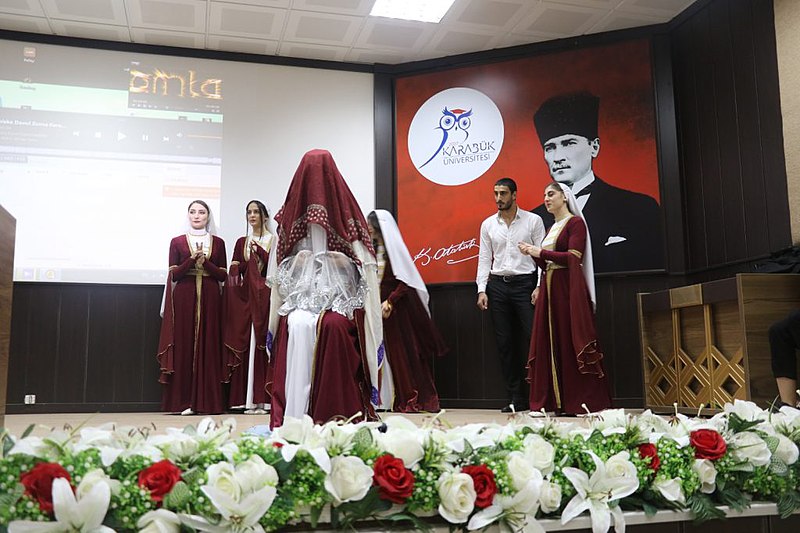
Meskhetian (Turks)
ethnic group

Spanglish
Spanglish (a blend of the words "Spanish" and "English") is any language variety (such as a contact dialect, hybrid language, pidgin, or creole language) that results from conversationally combining Spanish and English. The term is mostly used in the United States and in Puerto Rico. It refers to a blend of the words and grammar of Spanish and English. More narrowly, Spanglish can specifically mean a variety of Spanish with heavy use of English loanwords.
Apabhraṃśa
Apabhraṃśa (, , Prakrit: ) is a term used by vaiyākaraṇāḥ (native grammarians) since Patañjali to refer to languages spoken in Northern India before the rise of the modern languages. In Indology, it is used as an umbrella term for the dialects forming the transition between the late Middle and the early Modern Indo-Aryan languages, spanning the period between the 6th and 13th centuries CE. However, these dialects are conventionally included in the Middle Indo-Aryan period. wikt:अपभ्रंश#Sanskrit| in Sanskrit literally means "corrupt" or "non-grammatical language", that which deviates from the n
Tasmanian
extinct group of languages indigenous to the island of Tasmania, Australia

Tamna
Tamna () was a kingdom based on Jeju Island from ancient times until it was absorbed by the Korean Joseon dynasty in 1404, following a long period of being a tributary state or autonomous administrative region of various Korean kingdoms.
Pomeranian
language
Slavonic-Serbian
Slavonic-Serbian (славяносербскій, slavjanoserbskij), also known as Slavo-Serbian or Slaveno-Serbian (славено-сербскiй, slaveno-serbskij; , slavenosrpski), was a literary language used by the Serbs in the Habsburg Empire, mostly in what is now Vojvodina, from the mid-18th century to the first decades of the 19th century, falling into obscurity by the 1870s. It was a linguistic blend of Church Slavonic of the Russian recension, vernacular Serbian (Shtokavian dialect), and Church Slavonic of the Serbian recension, with varying sources and differing attempts at standardisation.
Globish (Nerrière)
subset of standard English grammar and a list of 1500 English words

Geordie
Geordie ( ) is a demonym and vernacular dialect characterising Newcastle upon Tyne and the wider Tyneside area of North East England.
George Psalmanazar
French writer (1679–1763)
Classical Japanese
literary form of the Japanese language, standard until WW2, based on Heian-period Early Middle Japanese with later influences
Czechoslovak
political sociolinguistic concept used in Czechoslovakia in 1920–1938 for the definition of the state language of the country
Malay trade and creole languages
languages descended from Low Malay
Old Norman
historical language spoken in northern France
Dryopes
Dryopes (; ) or Dryopians () were one of the aboriginal tribes of ancient Greece. According to Herodotus, their earliest abode is said to have been on Mount Oeta in Central Greece and its adjacent valleys, in the district called after them, Dryopis (Δρυοπίς). The Dorians settled in that part of their country which lay between Oeta and Mount Parnassus, and which was afterwards called Doris; but Dryopis originally extended as far north as the river Spercheios. The name of Dryopis was still applied to the latter district in the time of Strabo, who calls it a tetrapolis, like Doris.
Standard Algerian Berber
language

LoCos
LoCoS (short for Lovers Communication System) is a pictorial language developed by Yukio Ota of Japan in 1964. It was meant as communication for the deaf and mute as well as for the illiterate. It is a universal and simple language, and as Ota put it, "It should emphasize the importance of communication among all the people of all the countries of the world."

Pannonian Romance
an extinct Latin Language
West Saxon
dialect of Old English
English language in England
dialects of British English from England
cued speech
visual system of communication used with and among deaf or hard-of-hearing people, it adds information about the phonology of the words that is not visible on the lips
Hilalian dialects
Continuum of Arabic dialects native to the Maghreb
Olivença Portuguese
subdialect of Alentejan Portuguese
Sheng
English-influenced slang lect of Swahili
Kentish
southern dialect of Old English spoken in the Anglo-Saxon kingdom of Kent
Tihamiyya Arabic
variety of Arabic
Chinglish
Chinglish (also known as the Chinese English) is slang for spoken or written English language that is either influenced by a Chinese language, or is poorly translated. In Hong Kong, Macau, Guangdong and Guangxi, the term "Chinglish" refers mainly to Cantonese-influenced English. This term is commonly applied to ungrammatical or nonsensical English in Chinese contexts, and may have pejorative or deprecating connotations. Chinglish also has its cultural impact, as seen in movies, TV shows, daily life and so on. It is used intentionally as a form of self-expression or as slang among Chinese speak
Law French
archaic linguistic form used in English courts after 1066
Northumbrian
dialect of Old English
Mercian
dialect
Saharan Spanish
dialect of Spanish spoken in Western Sahara
Beary
Dravidian language spoken by the Beary
Acolapissa
The Acolapissa were a small tribe of Indigenous peoples of the Southeastern Woodlands of North America. They lived along the banks of the Pearl River, between present-day Louisiana and Mississippi. They are believed to have spoken a Muskogean language, closely related to the Choctaw and Chickasaw spoken by other Southeast tribes of the Muskogean family.
Kaaps
Kaaps (, meaning 'of the Cape'), also known as Afrikaaps, is a dialect of Afrikaans that evolved in the Western Cape province of South Africa. Since the early 2020s there has been a significant increase in the number of works of literature published in Kaaps. Most works in Kaaps come from authors located in the Cape Flats area of Cape Town, South Africa, where it is most commonly spoken. Although Kaaps is considered a growing phenomenon, it is more specifically a colloquial dialect of Afrikaans. All other distinct colloquial variations of Afrikaans, including Kaaps, are organically connected t
Trojan
language
Middle Bulgarian
standard language during the time of Second Bulgarian Empire
Lwów subdialect
non-standard dialect of the Polish language
Serbian Church Slavic language
extinct Serbian redaction of the Church Slavic literary language
Newfoundland Irish
variety of Irish once spoken in Newfoundland, Canada
Chaharmahali Turkic
chaharmahal Oghuz Turkic variety
Ladin Dolomitan
constructed written standard language of the Dolomite Ladins,
Pre-Hilalian Arabic dialects
continuumof dialects of Arabic from North Africa
Western Morocco Arabic
Arabic variety of western Morocco
Beurla Reagaird
Scottish Gaelic-based cant
Dhakaiya Urdu
dialect of Urdu language used in Bangladesh

Patagonian Afrikaans
Patagonian Afrikaans is a form of Afrikaans brought to Argentina by Boer immigrants after the Second Boer War (1899–1902)
Antarctic English
variety of the English language spoken in Antarctica and within the subantarctic islands
Gacería
Gacería, also known as briquería or briquero, is a linguistic variant whose core has its origins between the 12th and 13th centuries, it was especially rooted during the 19th and 20th centuries as cant and slang within the professional world of threshing and farming implement manufacturers, cattle dealers as well as other traditional commercial activities, although its use is not limited to work activity.
Chakobsa
a fictional language used by the Fremen people of the Dune universe
Iyaric
Iyaric, also called Dread Talk or Rasta Talk, is a form of language constructed by members of the Rastafari movement through alteration of vocabulary. When Africans were taken into captivity as a part of the slave trade, English was imposed as a colonial language. In defiance, the Rastafari movement created a modified English vocabulary and dialect, with the aim of liberating their language from its history as a tool of colonial oppression. Iyaric sometimes also plays a liturgical role among Rastas, in addition to Amharic and Ge'ez.
Siberian Finnish
form of Finnish spoken in Siberia
Modern Palestinian Judeo-Arabic
Variety of Arabic
Mackem
Mackem, Makem or '''Mak'em''' is a nickname for residents of and people from Sunderland, a city in North East England. It is also a name for the local dialect and accent (not to be confused with Geordie); and for a fan, of whatever origin, of Sunderland A.F.C. It has been used by some people from Sunderland to describe themselves since the 1980s, prior to which it was mainly used in Tyneside as a disparaging exonym. An alternative name for a Mackem (except in the sense of a football supporter) is a Wearsider.
kiezdeutsch
Kiezdeutsch () is a variety of German spoken primarily by youth in urban spaces in which a high percentage of the population is multilingual and has an immigration background. Since the 1990s, Kiezdeutsch has come into the public eye as a multiethnic language.
Adu
Loloish language of Yunnan, China
Malamuthan language
dravidian language of India
Sant Bhasha
language composed of vocabulary common to northern Indian languages, used in Sikh scripture
Cholanaikkan
Dravidian language of India