Category
page 1Lean manufacturing

kaizen
is a Japanese concept in business studies which asserts that significant positive results may be achieved due to the cumulative effect of many, often small (and even trivial) improvements to all aspects of a company's operations. Kaizen is put into action by continuously improving every facet of a company's production and requires the participation of all employees from the CEO to assembly line workers. Kaizen also applies to processes, such as purchasing and logistics, that cross organizational boundaries into the supply chain. Kaizen aims to eliminate waste and redundancies. Kaizen may also
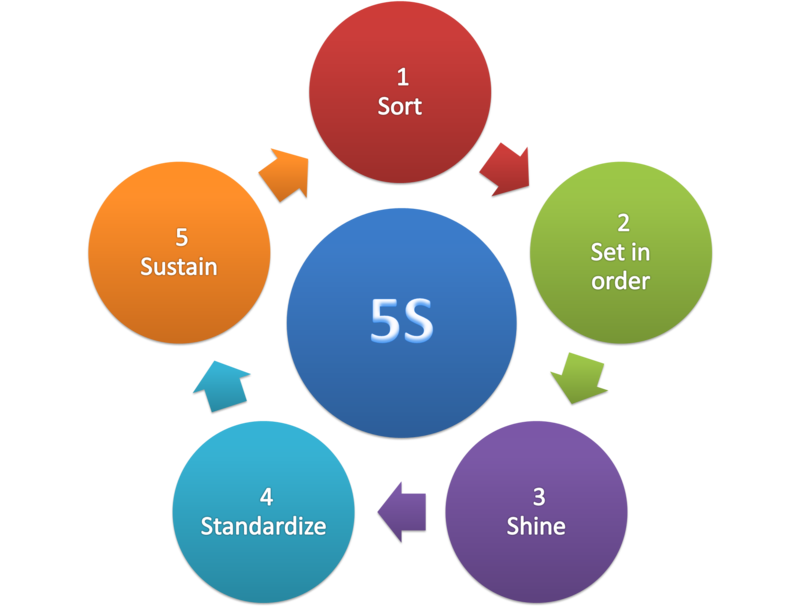
5S
workplace organisation method

lean manufacturing
lean methodology used to improve production time by reducing wastes

inventory
thumb|Electronics inventory
Inventory (British English) or stock (American English) is a quantity of the goods and materials that a business holds for the ultimate goal of resale, production or utilisation.

kanban
Kanban ( meaning signboard) is a scheduling system for lean manufacturing (also called just-in-time manufacturing, abbreviated JIT). Taiichi Ohno, an industrial engineer at Toyota, developed kanban to improve manufacturing efficiency. The system takes its name from the cards that track production within a factory. Kanban is also known as the Toyota nameplate system in the automotive industry.

poka-yoke
is any mechanism in a process that helps an equipment operator avoid mistakes and defects by preventing, correcting, or drawing attention to human errors as they occur. It is a Japanese term that means "mistake-proofing" or "error prevention", and is also sometimes referred to as a forcing function or a behavior-shaping constraint.
5 Whys
iterative interrogative technique
failure mode and effects analysis
systematic technique for identification of potential failure modes in a system and their causes and effects
Toyota Production System
integrated socio-technical system developed by Toyota
value-stream mapping
Lean Manufacturing Approach
single-minute exchange of die
lean production method for rapid and efficient changeover from making one product to the next product
overall equipment effectiveness
measure of how well a manufacturing operation is utilized compared to its full potential, during the periods when it is scheduled to run
andon
problem alert system in manufacturing
muda
type of waste (of time or resources) in lean manufacturing caused by work that does not create value from the customer's point of view
Lean Startup
Early business development tool
lead time
time between planning and starting something
continual improvement process
ongoing effort to improve products, services, or processes, by constantly evaluating and improving in the light of their efficiency, effectiveness and flexibility
autonomation
Autonomation describes a feature of machine design to effect the principle of used in the Toyota Production System (TPS) and lean manufacturing. It may be described as "intelligent automation" or "automation with a human touch". This type of automation implements some supervisory functions rather than production functions. At Toyota, this usually means that if an abnormal situation arises, the machine stops and the worker will stop the production line. It is a quality control process that applies the following four principles:Autonomation aims to:
inventory control
subconcept of Inventory
Lean software development
translation of lean manufacturing principles and practices to the software development domain

takt time
manufacturing term describing the required product assembly duration in order to match product demand
nemawashi
Nemawashi () is an informal Japanese business process of laying the foundation for some proposed change or project by talking to the people concerned and gathering support and feedback before a formal announcement. It is considered an important element in any major change in the Japanese business environment before any formal steps are taken. Successful nemawashi enables changes to be carried out with the consent of all sides, avoiding embarrassment.
The Toyota Way
set of managerial and production principles
timeboxing
In agile principles, timeboxing allocates a maximum unit of time to an activity, called a timebox, within which a planned activity takes place. It is used by agile principles-based project management approaches and for personal time management.
kanban board
board divided into steps in a process, used for coordinating work using the kanban project management methodology
lean construction
use of lean thinking in project-based construction processes
target costing
approach to determine a product's life-cycle cost
cellular manufacturing
flexible, scalable and mostly automated manufacturing process where a group of nearby machines complete different parts of the manufacturing process
Lean Six Sigma
methodology of systematically removing waste
muri
type of waste (of time or resources) where unreasonable expectations or overburdening of a system results in substandard work; avoidable by standardizing work
Genchi Genbutsu
business management / quality assurance strategy
lean government
initiative to increase government efficiency
CONWIP
Constant work in process or CONWIP are pull-oriented production control systems. Such systems can be classified as pull and push systems (Spearman et al. 1990). In a push system, the production order is scheduled, and the material is pushed into the production line. In a pull system, the start of each product assembly process is triggered by the completion of another at the end of production line. This pull-variant is known for its ease of implementation.
shadow board
tool board with drawings showing where tools should hang
Obeya
Obeya (from Japanese Ōbeya 大部屋 "large room") is a team spirit improvement tool at an administrative level, originating from a long history of learning & improving. It is considered a component of lean manufacturing. Obeya objectives are rapid decision-making, reduction in rework and reconsiderations, and reduction in unnecessary discussions. The Obeya Association enumerates 11 Obeya Principles that define Obeya and guide its improvement.
Just in sequence
inventory strategy
mura
type of waste (of time or resources) in lean manufacturing caused by unevenness or irregularities affecting manufacturing efficiency
production leveling
prerequisite to allow 'flow' in the factory