Category
page 1Lion gods

Heracles

Ra
Ra (; ; also transliterated , ; cuneiform: ri-a or ri-ia; Phoenician: 𐤓𐤏, romanized: rʿ) or Re () was the ancient Egyptian deity of the Sun. By the Fifth Dynasty, in the 25th and 24th centuries BC, Ra had become one of the most important gods in ancient Egyptian religion, identified primarily with the noon-day Sun. Ra ruled in all parts of the created world: the sky, the Earth, and the underworld. He was believed to have ruled as the first pharaoh of Ancient Egypt. He was the god of the Sun, order, kings and the sky.
.jpg)
Horus
Horus (), also known as Heru, Har, Her, or Hor () Ϩⲱⲣ (Coptic), in Ancient Egyptian, is one of the most significant ancient Egyptian deities who served many functions, most notably as the god of kingship, healing, protection, the sun, and the sky. He was worshipped from at least the late prehistoric Egypt until the Ptolemaic Kingdom and Roman Egypt. Different forms of Horus are recorded in history, and these are treated as distinct gods by Egyptologists. These various forms may be different manifestations of the same multi-layered deity in which certain attributes or syncretic relationships ar
.jpg)
Atum
Atum (, Egyptian: jtm(w) or tm(w), reconstructed ; Coptic Atoum), sometimes rendered as Atem, Temu, or Tem, is the primordial God in Egyptian mythology from whom all else arose. He created himself and is the father of Shu and Tefnut, the divine couple, who are the ancestors of the other Egyptian deities. Atum is also closely associated with the evening sun. As a primordial god and as the evening sun, Atum has chthonic and underworld connections. Atum was relevant to the ancient Egyptians throughout most of Egypt's history. He is believed to have been present in ideology as early as predynastic
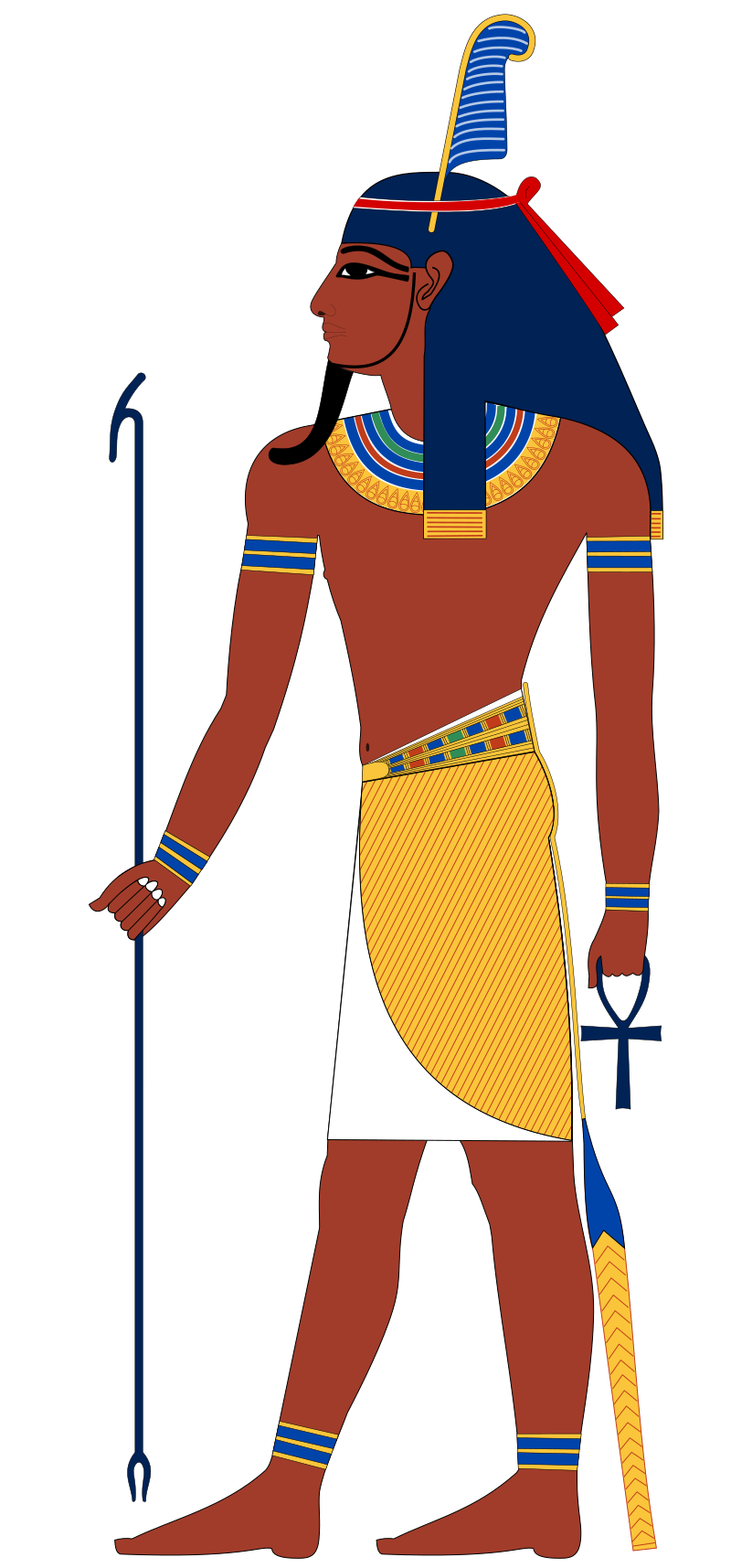
Shu
primordial Egyptian god, a personification of dry air, spouse and counterpart to goddess Tefnut

Typhon
thumb|right|280px|Zeus aiming his thunderbolt at a winged and snake-footed Typhon. Chalcidian black-figured [[hydria ( BC), Staatliche Antikensammlungen (Inv. 596).]]
Typhon (; , ), also known as Typhoeus (; ), Typhaon () or Typhos (), was a monstrous serpentine giant and one of the deadliest creatures in Greek mythology. According to Hesiod, Typhon was the son of Gaia and Tartarus. However, one source has Typhon as the son of Hera alone, while another makes Typhon the offspring of Cronus. Typhon and his mate Echidna were the progenitors of many famous monsters.

Hercules
Hercules (, ) is the Roman equivalent of the Greek divine hero Heracles, son of Jupiter and the mortal Alcmena. In classical mythology, Hercules is famous for his strength and for his numerous far-ranging adventures.

Phobos
personification of fear in Greek mythology
%2C%20Gupta%20period%2C%20mid-5th%20century%20AD.%20Boston%20Museum.jpg)
Narasimha
Narasimha (, , or , ), is a deity in Hinduism, revered as the fourth of the ten principal avatars (Dashavatara) of the god Vishnu. Depicted with a human torso and a lion's head and claws, Narasimha is venerated as a fierce protector who destroys evil and safeguards his devotees. He is most widely known for protecting his devotee Prahlada and for slaying the tyrannical demon king Hiranyakashipu.''''''

Nefertem
Nefertem (; possibly "beautiful one who closes" or "one who does not close"; also spelled Nefertum or Nefer-temu) was, in Egyptian mythology, originally a lotus flower at the creation of the world, who had arisen from the primal waters.
Nefertem represented both the first sunlight and the delightful smell of the Egyptian blue lotus flower, having arisen from the primal waters within an Egyptian blue water-lily, Nymphaea caerulea. Some of the titles of Nefertem were "He Who is Beautiful" and "Water-Lily of the Sun", and a version of the Book of the Dead says:

Aker
Egyptian deity of the eastern and western horizons and an earth and underworld god

Ninurta
Ninurta (: , possible meaning "Lord [of] Barley"), also known as Ninĝirsu (: , meaning "Lord [of] Girsu"), is an ancient Mesopotamian god associated with farming, healing, hunting, law, scribes, and war who was first worshipped in early Sumer. In the earliest records, he is a god of agriculture and healing, who cures humans of sicknesses and releases them from the power of demons. In later times, as Mesopotamia grew more militarized, he became a warrior deity, though he retained many of his earlier agricultural attributes. He was regarded as the son of the chief god Enlil and his main cult cen
Onuris
In Ancient Egyptian mythology, Onuris (also known as Onouris, Anhur, Anhuret, Han-Her, Inhert) was a god of war who was worshipped in the Egyptian area of Abydos, and particularly in Thinis. Myths told that he had brought his wife, Mehit, who was his female counterpart, from Nubia, and his name reflects this—it means '(one who) leads back the distant one'.

Maahes
Maahes (also spelled in Greek: Maches, Michos, Miysis, Mios, and Maeches) (Greek: Μαχές, Μιχός, Μίυσις, Μίος, or Μάιχες) was an ancient Egyptian lion-headed god of war, whose name means "he who is true beside her". He was seen as the son of the Creator god Ptah, as well as the feline goddess (Bast in Lower Egypt or Sekhmet in Upper Egypt) whose nature he shared. Maahes was a deity associated with war, protection, and weather, as well as that of knives, lotuses, and devouring captives. His cult was centred in Taremu and Per-Bast, the cult centres of Sekhmet and Bast respectively.

Zu
Anzû, also known as dZû and Imdugud (Sumerian: Determinative#Cuneiform|), is a demon in several Mesopotamian religions. He was conceived by the cosmic freshwater ocean Abzu and mother Earth Mami, or as son of Siris. In Babylonian myths Anzû was depicted as a massive bird - also as an eagle with lion head - who can breathe fire and water. This narrative seems to refer to much earlier Sumerian myths, in which he appears as a half-human storm bird who stole the tablet of destiny, challenging Enlil's power over his organisation of different gods that provided Mesopotamia with agriculture (cf. the

Ḫaldi
Ḫaldi (d,Ḫaldi, also known as Khaldi) was one of the three chief deities of Urartu (Urarat/Ararat Kingdom) along with Teisheba and Shivini. He was a warrior god to whom the kings of Urartu would pray for victories in battle. Ḫaldi was portrayed as a man with or without wings, standing on a lion.

Apedemak
Apedemak or Apademak (originally, due to the absence of the /p/ phoneme in Meroitic, it was probably pronounced 'abademak' (Father king, Aba meaning father and mak meaning king) ) was a major deity in the ancient Nubian and Kushite pantheon. Often depicted as a figure with a male human torso and a lion head, and at the temple of Naqa with a snakes body and a lion's head. Apedemak also appears as a three-headed leonine god with four arms., Apedemak was a war god worshiped by the Meroitic peoples inhabiting Kush. There are no counterparts of him in Ancient Egyptian religion, As a war god, Apedem
Aion
deity in Hellenistic mythology
Yaghuth
Yaghūth (Arabic "He Helps" يَغُوثَ) or Jageth, if translated to English, was a deity or idol referred to in the Quran (71:23). Jageth or Yaghuth was a righteous man who lived a few generations before Noah in Islam and after Adam. The Quran mentions him and 4 other idols who were righteous men but later worshipped by people who were deceived by Satan in Islam. They were possibly worshipped by Pre-Islamic Arabian tribes or in Mesopotamia and Turkey.
.jpg)
Dedun
Dedun (or Dedwen) was a Kushite or Nehasi (C-Group culture) god worshipped during ancient times in ancient Egypt and Sudan and attested as early as 2400 BC. There is much uncertainty about their original nature, especially since he was depicted as a lion, a role that usually was assigned to the son of another deity. Additionally, nothing is known of the earlier Kushite mythology from which the deity arose. The earliest known information in Egyptian writings about Dedun indicates that he already had become a god of incense by the time of the writings. Since at that historical point, incense was
Ash
ancient Egyptian god
%2C%20100-50%20BCE.%20Sandstone.%20National%20Museum%20of%20Scotland%2C%20Edinburgh%2C%20Scotland%2C%20UK.jpg)
Arensnuphis
Arensnuphis (in Egyptian: Iryhemesnefer, ỉrỉ-ḥms-nfr, "the good companion") is a deity from the Kingdom of Kush, first attested at Musawwarat el-Sufra in the 3rd century BC. His worship spread to the Egyptian-controlled portion of Kush in the Ptolemaic Period (305–30 BC). His mythological role is unknown; he was depicted as a lion and as a human with a crown of feathers and sometimes a spear.
thumb|left|Temple statue of god Arensnuphis, from Meroe, Nubia (modern-day Sudan), 100-50 BCE. National Museum of Scotland, Edinburgh
Arensnuphis was worshipped at Philae, where he was called the "compani

Śarabha
thumb|260x260px|Shiva as Sharabha subduing Narasimha, panel view from Munneswaram temple in [[Sri Lanka]]

Shezmu
Shezmu (alternatively Schesmu and Shesmu) is an ancient Egyptian deity with a contradictory character. He is an Underworld judge of the damned. He was worshiped from the early Old Kingdom period.

Yaldabaoth
thumb|A lion-faced, Snakes in mythology|serpentine [[deity found on a Gnostic gem in Bernard de Montfaucon's ''L'antiquité expliquée et représentée en figures'', a depiction of Yaldabaoth.]]
Tutu
Egyptian god protector of tombs and sleepers
Shara
Mesopotamian god from Umma
Kherty
Kherty is an ancient Egyptian deity. Despite being archaeologically attested since the early 2nd Dynasty, his original mythological role during this era is unclear. Kherty was an Egyptian god of the Duat. The earliest mythological descriptions of Kherty's role do not appear until the 6th Dynasty in the Pyramid Texts.
Heramba
Heramba (, ), also known as Heramba Ganapati (), is a five-headed iconographical form of the Hindu god Ganesha (Ganapati). This form is particularly popular in Nepal. This form is important in Tantric worship of Ganesha. He is one of the most popular of the thirty-two forms of Ganesha.
Vaikuntha Chaturmurti
Hindu god